Ministry of Oceans and Fisheries Announces Comprehensive Measures for 2020 High Water Temperature and Red Tide
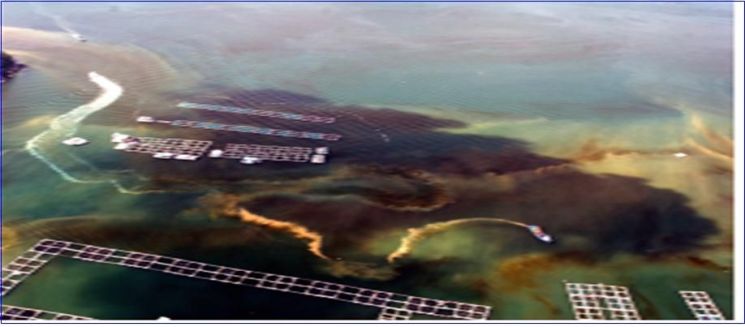
[Asia Economy Reporter Joo Sang-don] The government plans to establish real-time water temperature monitoring networks in the coastal waters of Chungnam and Jeonnam, areas frequently affected by high water temperatures, and to newly introduce a 24-hour real-time unmanned red tide monitoring system.
The Ministry of Oceans and Fisheries announced that it has prepared the "2020 Comprehensive Measures for High Water Temperature and Red Tide," which was finalized on the afternoon of the 3rd after the 107th National Policy Issue Inspection and Coordination Meeting chaired by Prime Minister Chung Sye-kyun.
According to domestic and international research institutions such as the Asia-Pacific Economic Cooperation (APEC) Climate Center and the National Institute of Fisheries Science, there will be no El Ni?o (sea surface warming) occurrence this summer, and due to the influence of a stronger than usual Kuroshio Current, coastal water temperatures in South Korea are expected to be 0.5 to 1°C higher than average. Accordingly, warnings for high water temperature and red tide are predicted to be issued somewhat earlier than last year, around mid to late July.
The Ministry of Oceans and Fisheries plans to prevent damage in advance by establishing a proactive response system. Before mid-July, when damage is concentrated, it will continuously provide aquaculture farms with price trends and supply-demand status of major aquaculture species to enable early shipment of cultured organisms. At the same time, it will promote the expansion of aquaculture product disaster insurance enrollment. Support will also be provided to equip on-site high water temperature and red tide response and control equipment in advance. This year, a total budget of 7.8 billion KRW, an increase of 1 billion KRW from the previous year, will be invested in the distribution and support of high water temperature and red tide response equipment.
Additionally, 15 new real-time water temperature monitoring stations will be established in the coastal waters of Chungnam and Jeonnam to observe water temperatures, and a 24-hour real-time unmanned red tide monitoring system will be newly introduced to enhance the effectiveness of regular red tide surveys and surveillance activities.
During periods when damage is concentrated, systematic responses will be carried out based on high water temperature and red tide crisis response guidelines according to the warning levels. Before the full onset of red tides, joint drills with related agencies and operation of joint red tide control fleets involving civilian, government, military, and police will be conducted to establish a comprehensive control system. When high water temperature and red tide occur, all available response equipment will be mobilized early to strongly control the situation, including the spreading of loess soil, to minimize damage.
Furthermore, to enable fishermen to proactively manage fishing grounds, the "Protect Your Own Fishing Ground Movement" will be actively implemented. From the high water temperature interest stage, joint on-site response teams from local governments and the National Institute of Fisheries Science will operate to provide close guidance on management practices such as activating response equipment, stopping feed supply, and encouraging shipment for each fishing ground.
In case of damage, dead fish will be promptly disposed of, and joint damage investigations will be conducted to quickly provide disaster insurance payments (for insured farms) and disaster relief funds (for uninsured farms). Additional measures such as extension of repayment deadlines and interest reductions for fishery management funds, as well as emergency management stabilization loans, will be implemented to stabilize the management of affected farms.
Um Ki-du, Director of Fisheries Policy at the Ministry of Oceans and Fisheries, said, "It is fundamentally difficult to prevent damage caused by natural disasters, but thorough situation management can prevent and minimize damage. We ask for active cooperation from the field to ensure the smooth implementation of these measures."
© The Asia Business Daily(www.asiae.co.kr). All rights reserved.
![User Who Sold Erroneously Deposited Bitcoins to Repay Debt and Fund Entertainment... What Did the Supreme Court Decide in 2021? [Legal Issue Check]](https://cwcontent.asiae.co.kr/asiaresize/183/2026020910431234020_1770601391.png)
















