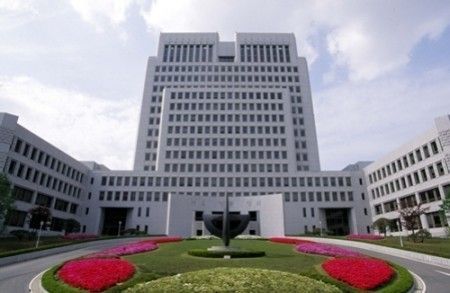
[Asia Economy Reporter Kim Hyung-min] The Supreme Court has ruled that a real estate seller who enters into a land sale contract with a buyer and receives the intermediate payment, but then sells the land to another person, is guilty of breach of trust.
The Supreme Court's First Division (Presiding Justice Kwon Soon-il) overturned the lower court's acquittal of Song Mo (84), who was charged with violation of the Act on the Aggravated Punishment of Specific Economic Crimes (breach of trust), and remanded the case to the Seoul High Court on the 3rd.
The court judged Song's breach of trust charge as guilty in accordance with the Supreme Court plenary session ruling issued in May 2018.
Previously, in May 2018, the Supreme Court plenary session upheld the precedent that punishes double real estate sales as breach of trust.
The court stated, "Even if Song provided a provisional registration to Company A, since he received the intermediate payment and part of the balance from Company A, he is in a fiduciary relationship to cooperate in preserving Company A's property," adding, "Song should be regarded as a 'person handling another's affairs' in relation to Company A."
In September 2015, Song entered into a contract to sell a 497㎡ piece of land located in Dongdaemun-gu, Seoul, to Company A for 5.2 billion KRW.
The condition was that Song would receive 1 billion KRW and transfer the land along with a mortgage debt of 4.2 billion KRW set on the land to Company A.
Song received a contract deposit of 400 million KRW from Company A and also provided a provisional registration for the claim to transfer ownership.
By providing provisional registration, the party can claim the main registration first, so even if they suffer from a double contract, they can reclaim ownership.
However, the sale transaction did not proceed smoothly. Company A, which succeeded the mortgage debt, failed to pay interest on the 4.2 billion KRW debt on time, and the land was auctioned off.
Eventually, Song sent a certified letter to Company A stating that he would hold them responsible for breach of contract, then entered into a land sale contract with another person and completed the ownership transfer registration. Company A filed a complaint against Song for breach of trust.
The first trial recognized Song's breach of trust and sentenced him to 1 year and 6 months in prison with a 3-year probation.
However, the second trial acquitted Song. The court held that for breach of trust to be established, there must be a situation where the seller and buyer can trust each other in the 'preservation of property' to ensure proper transfer of ownership.
But in this case, since provisional registration was made to preserve the property, the 'fiduciary relationship' between the seller and buyer was considered relatively less important, and the court ruled that the requirements for breach of trust were not met.
© The Asia Business Daily(www.asiae.co.kr). All rights reserved.
![User Who Sold Erroneously Deposited Bitcoins to Repay Debt and Fund Entertainment... What Did the Supreme Court Decide in 2021? [Legal Issue Check]](https://cwcontent.asiae.co.kr/asiaresize/183/2026020910431234020_1770601391.png)















