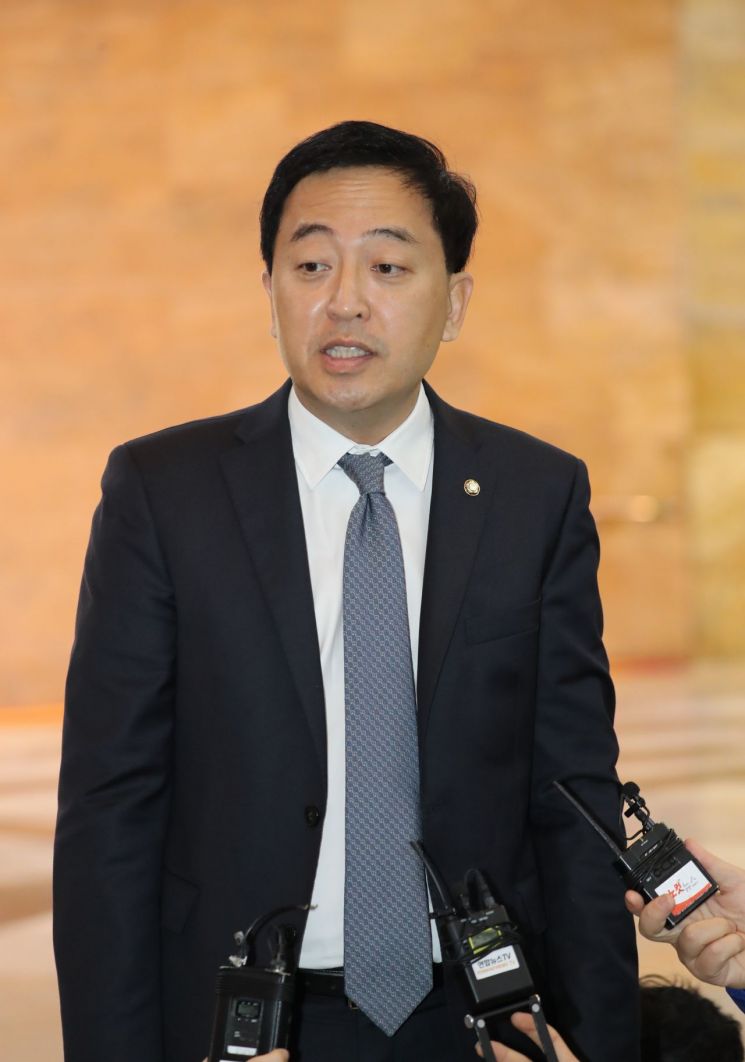
[Asia Economy Reporter Wondara] Concerns are rising that the 'free voting rights' guaranteed by the National Assembly Act in the 21st National Assembly may not be upheld as former Democratic Party lawmaker Geum Tae-seop, who opposed the vote on the High-ranking Public Officials Corruption Investigation Office Establishment Act (PCCIO Act), has been disciplined. Geum has filed for a retrial with the party's Ethics Tribunal, claiming that the disciplinary action against him is unconstitutional.
According to the Democratic Party on the 3rd, Geum filed a retrial request with the party's Ethics Tribunal. This was in response to the Ethics Tribunal's meeting on the 25th of last month, where it issued a 'warning' to Geum regarding a petition for expulsion submitted by some Democratic Party members.
In his retrial request, Geum criticized, "If there is a party regulation that sets disciplinary grounds for a lawmaker voting against the party line, it itself proclaims an undemocratic and unconstitutional party." He emphasized, "There has never been a case of disciplining a lawmaker for voting differently from the party line," and added, "As far as I know, the Central Party Ethics Tribunal has never disciplined lawmakers who did not participate in votes on party-line bills during the legislative process."
In a post on his Facebook the previous day, Geum also criticized the Democratic Party's 'gag order.' He said, "During the pre-election talent recruitment, reporters without exception asked the talents, 'What do you think about the Cho Kuk incident?'" He continued, "When the first few answers caused controversy, the party leadership provided the response that 'it is difficult because they have little political experience.' How can you present someone who cannot express their own opinion as a representative of the citizens?" He also criticized, "The party is showing a similar appearance to the prosecution."
Jo Eung-cheon, who opposed the PCCIO Act alongside Geum but voted in favor at the plenary session, appeared on CBS Radio the previous day and said, "I have never seen a lawmaker disciplined for making a conscientious judgment in the plenary session," adding, "There is a clause for free voting in the National Assembly Act. You just need to take political responsibility for your actions." He also added, "I think Geum has already taken responsibility by losing in the primary and being dropped from the candidacy."
In political circles, there is speculation that due to this unprecedented disciplinary decision, it will become difficult to see lawmakers like Geum, who do not hesitate to voice 'bitter truths,' in the 21st National Assembly. In the 20th National Assembly, lawmakers such as Geum, Park Yong-jin, and Kim Hae-young, a Supreme Council member, conveyed different voices within the party. However, except for Park, who gained attention for the 'Kindergarten 3 Laws,' all were either dropped from candidacy or lost the election. There are also criticisms that the Democratic Party's party regulations conflict with the National Assembly Act. Article 114 of the National Assembly Act states, "A member of the National Assembly shall not be bound by the will of the affiliated party and shall vote according to conscience as a representative of the people," while Article 14 of the Democratic Party's disciplinary regulations states that disciplinary action is taken against party members or officials who violate the party's platform or party line.
Meanwhile, regarding this controversy, Democratic Party leader Lee Hae-chan rebutted at a regular press briefing held at the National Assembly in the morning of the previous day, responding to the question, "Is there concern that minority opinions cannot be expressed despite holding 177 seats?" by saying, "Not at all." He said, "I have been running the party for nearly two years and have operated it democratically to some extent," adding, "A warning is the lowest level of disciplinary action in terms of content. If you do nothing when the forced party line is not followed, it would be meaningless."
© The Asia Business Daily(www.asiae.co.kr). All rights reserved.

















