6-Month Gap in Defense Cost-Sharing Agreement
Concerns Over Weakening ROK-US Alliance and Combined Defense Posture Due to Prolonged Forced Unpaid Leave
Ministry of National Defense to Proceed with Government Support Special Act as Is
Ministry of Foreign Affairs "Welcomes US Decision to Suspend Unpaid Leave for Korean Workers at USFK"
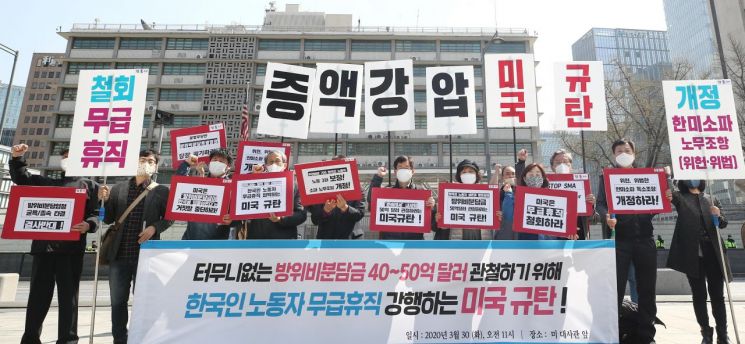
[Asia Economy reporters Yang Nak-gyu and Lim Cheol-young] The U.S. Department of Defense has agreed to pay the wages of Korean workers employed by the U.S. Forces Korea (USFK) who are currently on unpaid leave. This comes as South Korea has already enacted a special law to support those on unpaid leave, and it is interpreted as a result influenced by concerns within the U.S. that prolonged unpaid leave could weaken the ROK-U.S. alliance and combined defense posture.
On the 2nd (local time), the U.S. Department of Defense issued a statement announcing that under this agreement between South Korea and the U.S., the Korean government will bear $200 million (approximately 243.4 billion KRW) for 4,000 workers through the end of this year. This agreement allows USFK workers who went on unpaid leave by mid-month to return to work.
The U.S. Department of Defense stated, "This decision makes the burden of paying wages for Korean civilian employees of USFK more equitable," adding, "The U.S. can maintain the combined defense posture, which is the alliance's top priority." In response, a Ministry of Foreign Affairs official said on the 3rd, "We welcome the U.S. decision to halt unpaid leave for Korean workers of USFK," and added, "Both sides will strive to reach an agreement on defense cost-sharing negotiations as soon as possible."
USFK had placed some Korean workers on unpaid leave since April, citing the lack of a concluded ROK-U.S. defense cost-sharing agreement. Although the Korean government requested the U.S. side to prioritize wage payments regardless of the negotiation outcome, the U.S. side rejected Korea’s proposal to bear the wage costs, emphasizing the need for a "comprehensive agreement." In response, the National Assembly passed a special law at the end of April to provide livelihood support for those on unpaid leave, thereby addressing the urgent issue.
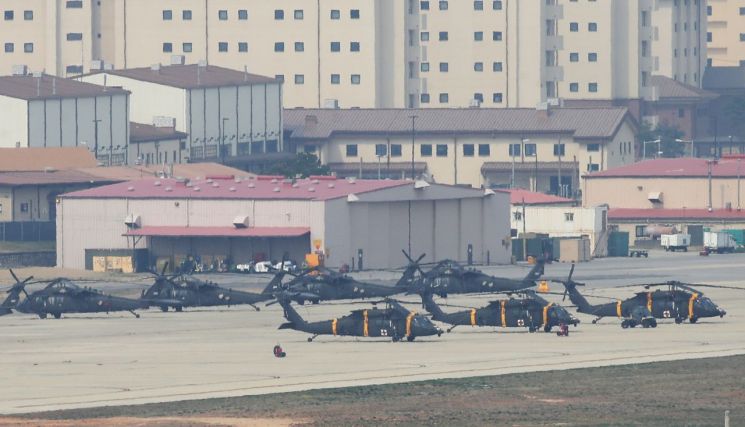
However, it appears that the U.S. side judged that if Korean employees are absent from this year’s ROK-U.S. combined exercises, the exercises themselves would be difficult to conduct. The combined exercises originally planned for early March were indefinitely postponed due to the COVID-19 pandemic, and the second half combined exercises are scheduled for August. Regarding the exercises, the U.S. insists that maintaining the "Fight tonight" readiness posture must be the top priority, while South Korea argues that the Future Combined Command’s FOC (Full Operational Capability) verification for wartime operational control transition should proceed as planned in the second half. Although there is conflict over these points, both sides agree that the combined exercises must proceed as scheduled. This means Korean workers must be reinstated.
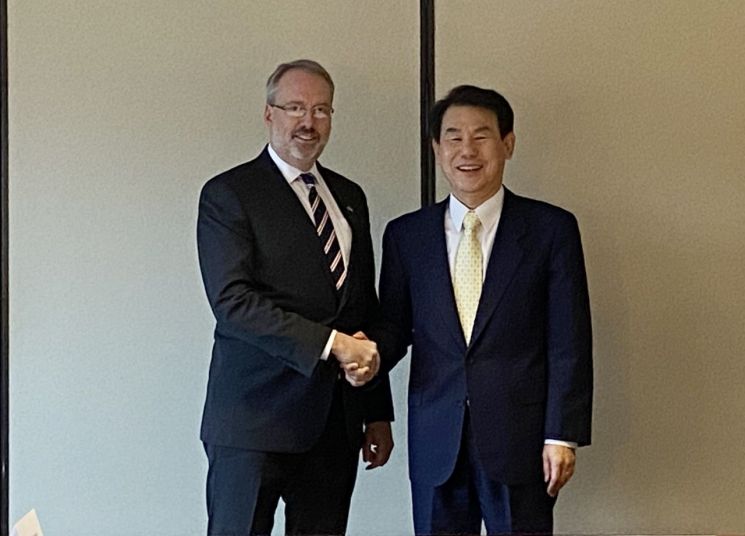
For this reason, the South Korean government has been steadily persuading the U.S. Defense Minister Jeong Kyeong-doo visited the U.S. in February and requested members of the U.S. Congress to consider concluding at least the wage payment part of the Special Measures Agreement (SMA) to prevent unpaid leave of Korean workers at USFK caused by delays in the defense cost-sharing agreement. He also made the same proposal during talks with U.S. Secretary of Defense Mark Esper. Minister Jeong’s suggestion of a phased negotiation approach was based on the judgment that the unpaid leave situation for Korean workers could affect military readiness.
The Ministry of National Defense maintains that even if it pays wages to Korean workers, the special law for government support will proceed as planned. The special law provides a legal basis for the Korean government to provide livelihood support payments if wages are not paid to Korean workers employed by USFK due to defense cost-sharing negotiations.
Meanwhile, the U.S. has proposed $1.3 billion (approximately 1.59 trillion KRW) as the defense cost-sharing amount for USFK. This is more than a 50% increase compared to the previous negotiation amount (1.0389 trillion KRW). The Korean side is reported to have proposed a 13% increase. A senior U.S. administration official reiterated on the 7th that "the $1.3 billion is the final offer."
© The Asia Business Daily(www.asiae.co.kr). All rights reserved.



















