[Asia Economy Reporter Buaeri] Shin Suhee (pseudonym), a Ministry of Justice official who frequently travels to the National Assembly, has found taxi usage much more convenient lately. Previously, when going on business trips, she had to call a taxi and pay individually with a business card, but now, by ordering a business taxi through the KakaoT application (app), the payment is completed automatically. Business taxis refer to taxi services used by organizations for purposes such as business trips and fieldwork. The Ministry of Justice recently formed a business partnership with KakaoT for this service.
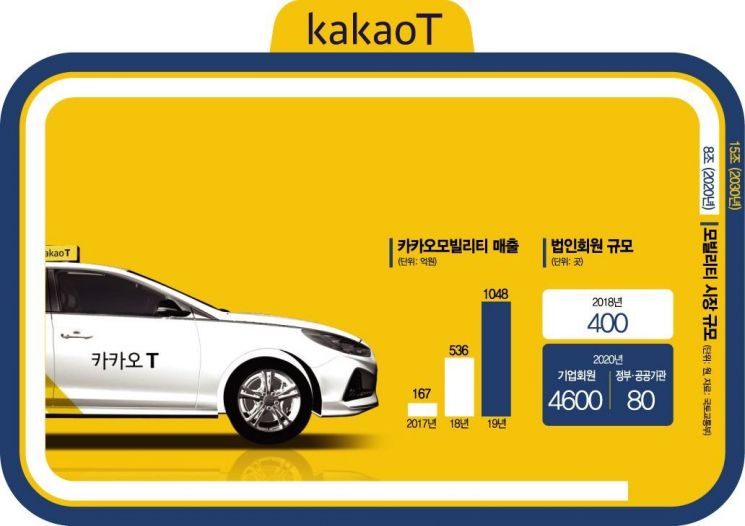
◆ Following the Ministry of Justice, the National Assembly also calls taxis via KakaoT~ = According to industry sources on the 3rd, Kakao Mobility is achieving results in the B2B (business-to-business) sector with government agencies. It is known that discussions are underway for National Assembly Budget Office officials to use KakaoT for business taxis, following the Ministry of Justice. According to Kakao Mobility, 'KakaoT for Business,' launched in 2018, has secured over 80 government and public institution members within two years. A Kakao Mobility representative stated, "Currently, various central government ministries, government-affiliated agencies, public offices, local governments, and public institutions are registered."
Government and corporate members subscribed to 'KakaoT for Business' can call taxis via the app, and taxi fares are automatically charged to pre-registered corporate cards. Kakao Mobility charges a commission of 1,000 KRW per business taxi use. Kakao Mobility explained, "Information such as taxi usage time, departure and arrival locations, and fares are automatically organized through the app and sent to the company, so the company does not need to handle related tasks separately," adding, "The commission corresponds to the cost of such services."
From Kakao Mobility's perspective, business taxis for public institutions represent a blue ocean. Public officials frequently travel due to the need for inter-departmental coordination, and most of their travel is by taxi. Partnering with large central ministries allows securing many customers. The Ministry of Justice has about 700 officials, and the National Assembly Budget Office has about 130 officials.
◆ From about 400 to over 4,600 corporate clients = Kakao Mobility is focusing on B2B strategies, including launching a corporate member-exclusive page called 'BizHome' (tentative name) within the KakaoT app this August. The strategy is to attract 'big clients' such as government agencies and corporate members to maximize revenue growth. Kakao Mobility has set an internal goal of acquiring 10,000 corporate members this year. The number of companies subscribed to 'KakaoT for Business' has increased elevenfold in two years. At the time of service launch in February 2018, there were 400 companies, but now there are over 4,600. Industries with frequent fieldwork such as distribution, consulting, and construction are the main customers. Thanks to this, Kakao Mobility's revenue nearly doubled from 53.6 billion KRW in 2018 to 104.8 billion KRW last year. A Kakao Mobility representative said, "The growth in B2B revenue is very significant," and added, "We will continue to increase the proportion of B2B revenue in the company's total revenue."
© The Asia Business Daily(www.asiae.co.kr). All rights reserved.

















