[Asia Economy Reporter Hwang Yoon-joo] Hanwha Total is wisely overcoming the COVID-19 situation by integrating digital transformation technologies into the regular maintenance of its petrochemical plant, which involves major equipment safety inspections and improvement work.
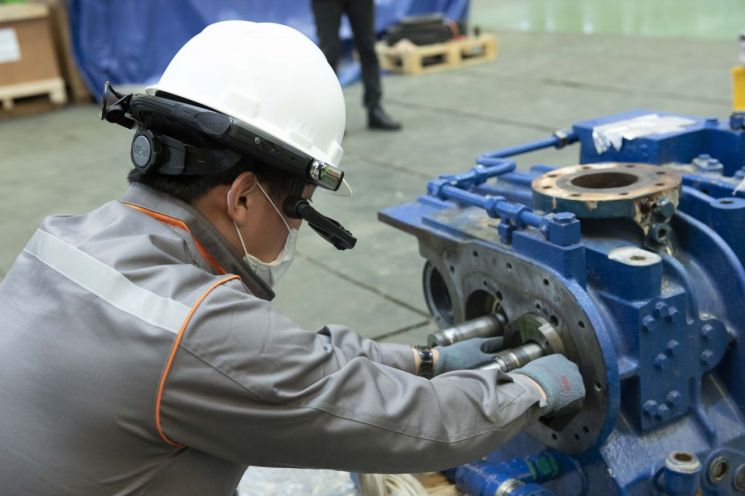
Hanwha Total announced on the 3rd that it has introduced a 'Smart Glass Remote Support System' utilizing wireless communication technology to expand non-face-to-face operations during the regular maintenance period at the Daesan plant.
Since May 7th until the end of June, Hanwha Total has been conducting regular maintenance work at the Aromatics 1 plant within the Daesan complex. Regular maintenance of petrochemical plants is a maintenance period conducted every 3 to 4 years, during which plant operations are halted to replace aging equipment and improve processes. This is a core task responsible for the future safety and productivity of the plant.
Hanwha Total, considering ways to provide technical support without the visit of overseas technical personnel, decided to promote real-time non-face-to-face meetings between the Daesan plant site and overseas technical personnel by introducing the Smart Glass Remote Support System.
Smart Glass is an Internet of Things (IoT) device that shares real-time video and audio with the other party through a camera lens and display attached to glasses. It allows continuous communication while moving around the site and has various functions such as file sharing, video and snapshot capturing, and chatting. It is raising satisfaction among not only Hanwha Total employees in Korea but also overseas technical personnel as a new alternative for on-site inspections in the COVID-19 era.
The background enabling Hanwha Total to use Smart Glass stably is its in-house P-LTE network (a private wireless communication network built for specific locations). In 2017, Hanwha Total became the first domestic petrochemical company to establish a wireless communication network within the complex that can process data in real time anywhere on the site.
Through this, they have prepared infrastructure that can utilize various industrial IoT devices such as wireless sensors and wireless devices that collect data even in hard-to-reach high places or in high-temperature and high-pressure environments.
In addition, Hanwha Total is attempting to integrate various IT technologies to expand the non-face-to-face work environment. Since the early stages of the COVID-19 outbreak, they have been conducting non-face-to-face video conferences based on in-house messengers instead of face-to-face meetings among employees. Non-face-to-face meetings have become routine, including meetings chaired by the CEO as well as meetings among staff.
Jo Yong-tae, head of Hanwha Total’s IT Strategy Team, said, "Since 2017, Hanwha Total has been promoting the construction of a smart plant by applying various digital transformation technologies within the petrochemical plant, and the recent COVID-19 situation has accelerated this process. Going forward, we plan to actively introduce 4th industrial revolution technologies such as AI, big data, and IoT to enhance not only the safety of petrochemical plants during regular maintenance but also the efficiency of daily work for employees."
© The Asia Business Daily(www.asiae.co.kr). All rights reserved.
![User Who Sold Erroneously Deposited Bitcoins to Repay Debt and Fund Entertainment... What Did the Supreme Court Decide in 2021? [Legal Issue Check]](https://cwcontent.asiae.co.kr/asiaresize/183/2026020910431234020_1770601391.png)















