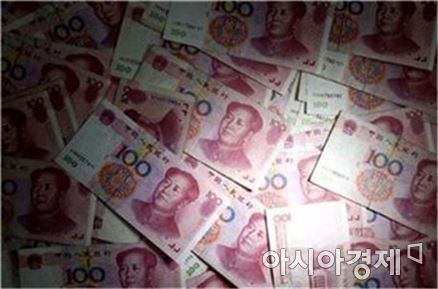
 Photo by Asia Economy DB
[Asia Economy Beijing=Special Correspondent Park Sun-mi] To minimize the economic shock caused by the COVID-19 pandemic this year, the Chinese government decided to mobilize a large-scale fund amounting to 1,000 trillion won, but it has encountered the unexpected challenge of 'rising financial risks.' While sufficient liquidity supply to the real economy requires the cooperation of the banking sector, the banking sector, which operates under a structure where the more the government injects money, the more it incurs losses, finds it difficult to keep pace.
Recently, global credit rating agency Moody's expressed concerns in its government policy evaluation report this year, stating, "The Chinese government's policies are entirely focused on economic recovery and employment market stabilization," and added, "Although the government still aims to reduce leverage, the expansionary infrastructure investments undertaken to recover the slowed economic growth rate may increase public sector debt. The banking sector's profitability may deteriorate, and asset quality may worsen."
Moody's explained, "Eased monetary policy accompanied by credit growth lowers the banking sector's net interest margin (NIM), thereby worsening bank profitability," and "While credit growth may delay the formation of non-performing loans (NPLs) among companies in the short term, in the long term, it results in higher leverage levels already at elevated levels, leading to deterioration in asset quality." Furthermore, it expressed concern that "Chinese banks, following government guidelines, are refraining from pressuring repayment of overdue loans from companies and individual customers affected by the COVID-19 pandemic, and face the challenge of increasing loans to small and medium-sized enterprises (SMEs) to 40% of total loans."
As the government is focusing on lowering interest rates to promote economic growth, the deterioration of bank profitability is already ongoing. Among China's four major banks, Industrial and Commercial Bank of China (ICBC) saw its NIM fall by 11 basis points to 2.04% at the end of the first quarter compared to a year earlier. Other major banks such as China Construction Bank (7bp), Agricultural Bank of China (3bp), and Bank of China (2bp) also experienced declines in NIM. Michael Chang, an analyst at Singapore's CGS-CIMB Securities, diagnosed, "The net interest margins of China's four major banks are expected to decline by 10 to 12 basis points in 2020," attributing this mainly to interest rate cuts.
The People's Bank of China (PBOC) is accelerating support for the banking sector, considering concerns over deteriorating profitability as banks face the challenge of lowering loan interest rates to expand SME lending. This is based on the judgment that even if the government takes measures to supply liquidity to the real economy, economic recovery will be difficult if banks respond passively to actual lending.
On the 1st, the PBOC announced the 'Strengthening Support Measures for SME Loans,' stating it will inject 400 billion yuan (approximately 68.7 trillion won) and use a new policy tool to purchase 40% of SME loans generated by qualified banks. The PBOC plans to apply this new policy tool to unsecured SME loans with a repayment maturity of at least six months, issued between March and December this year.
Banks must repay the funds borrowed from the PBOC after one year, but to ease the burden on banks, the repayment condition is set as interest-free principal repayment. Normally, banks had to pay about 2.5% annual interest when using the general PBOC re-lending program. The economic media Caixin explained, "This policy aims to induce the banking sector to utilize 1 trillion yuan of funds for SME loans amid the economic impact of COVID-19 on China."
© The Asia Business Daily(www.asiae.co.kr). All rights reserved.
















