
[Asia Economy Reporter Bu Aeri] Although the taxi industry raised claims that "Kakao is funneling calls to its affiliated taxis," the conflict seems to have been resolved as Kakao Mobility actively clarified the issue.
According to the related industry on the 2nd, the National Taxi Labor Union Federation sought legal advice to prepare a lawsuit alleging that Kakao Mobility violated the Fair Trade Act but recently concluded that it would be difficult. Previously, Lee Heonyeong, the Labor-Management Countermeasures Director of the National Taxi Labor Union Federation, stated, "We are seeking legal advice regarding the situation where Kakao unilaterally monopolizes a platform with a public good nature to increase profits, causing losses to other taxi drivers."
However, the National Taxi Labor Union Federation plans to continuously monitor the situation closely as complaints from drivers about "Kakao's call funneling" continue to be raised on the ground.
The National Taxi Labor Union Federation and the National Taxi Transportation Business Association Federation previously raised issues about Kakao Mobility's call discrimination. Lee Yangdeok, Executive Director of the National Taxi Transportation Business Association Federation, said, "There are 10 taxis at Gangnam Station, but when a customer calls a taxi using the KakaoT application (app), the call does not go to the taxis there, and instead, KakaoT Blue taxis located farther away receive the calls." KakaoT Blue is a taxi brand operated by Kakao. According to the taxi industry's claims, when a taxi is called via the KakaoT app, Kakao prioritizes calls to its affiliated service, KakaoT Blue. Currently, about 250,000 taxis operate nationwide, and KakaoT Blue, the affiliated taxi service, accounts for approximately 5,200 vehicles.
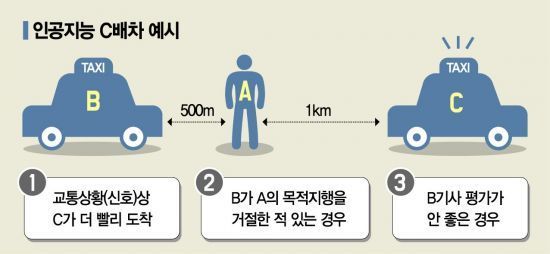
In response to the taxi industry's concerns, Kakao Mobility actively provided explanations. According to Kakao Mobility, KakaoT calls are automatically assigned not simply based on distance but considering estimated arrival time, driver ratings, acceptance rates, and traffic conditions. For example, if passenger A makes a call and taxi B is within 500 meters while taxi C is 1 km away, taxi B is not automatically assigned. If taxi B has previously rejected the destination entered by passenger A or has a poor driver rating, it may not be assigned. Also, considering traffic conditions, even if taxi B is closer, if taxi C can reach passenger A faster by making a U-turn, taxi C may be assigned. A Kakao Mobility official emphasized, "Since it is an AI-based dispatch system, artificial call assignment is impossible."
© The Asia Business Daily(www.asiae.co.kr). All rights reserved.
![User Who Sold Erroneously Deposited Bitcoins to Repay Debt and Fund Entertainment... What Did the Supreme Court Decide in 2021? [Legal Issue Check]](https://cwcontent.asiae.co.kr/asiaresize/183/2026020910431234020_1770601391.png)

















