4th Week of Government Emergency Disaster Relief Fund Applications... Perceived Economic Index Rises Compared to Previous Month
Some Small Business Owners Complain, "No Customers, How Can Emergency Disaster Relief Fund Be Effective?"
Experts Say, "Government Should Analyze Areas Where Relief Fund Is Ineffective and Prepare Measures"
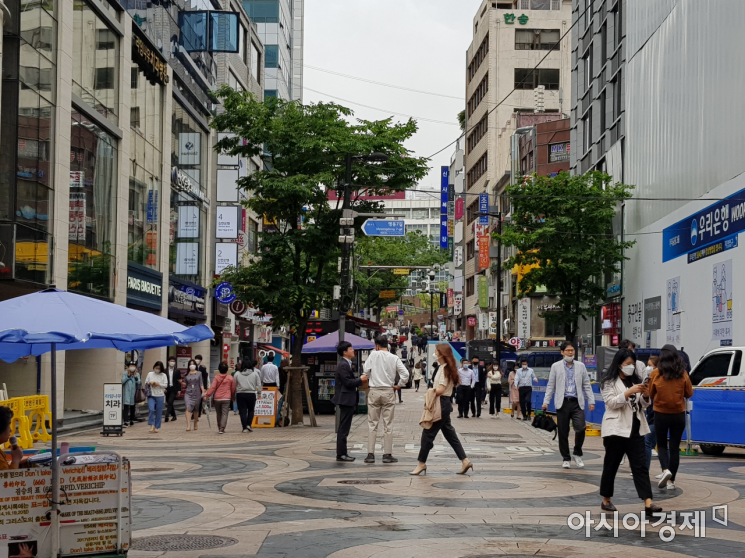 On the afternoon of the 2nd, Myeongdong Street in Jung-gu, Seoul. Citizens who came out to the street during lunchtime are walking / Photo by Kay Kim katekim221@asiae.co.kr
[Asia Economy Reporter Kim Ga-yeon] "People only go to places where they can use the disaster relief funds; they don’t come this far."
The application for emergency disaster relief funds to overcome the COVID-19 crisis has entered its fourth week. As the use of disaster relief funds has become more active, the local economy is showing signs of vitality, but some small business owners are still complaining about economic damage.
On the afternoon of the 2nd, self-employed individuals met in the Myeongdong area of Seoul all agreed that they have not seen significant effects even after the disaster relief funds were distributed.
A man in his 60s, Mr. A, who runs a shoe retail store in the Hoehyeon Underground Shopping Center, said, "I hear other areas are seeing good effects, but Myeongdong is not one of them," and complained, "Even if we put up signs saying 'Disaster relief funds accepted,' there isn’t a single customer."
Mr. A said, "Sales have dropped by 80% due to the spread of COVID-19. The losses are indescribably large. (To prevent the spread of COVID-19) the exit connecting to the bank is blocked, so people don’t come here," adding, "Look at the other stores here. They’ve all closed the places where they employ people. I’m alone, so I just keep the door open."
Mr. B, the owner of a clothing retail store in the Myeongdong underground shopping mall, also said, "The neighborhood seems to be somewhat lively, but Myeongdong, due to its regional characteristics, doesn’t seem to be seeing much effect."
He added, "Because of the regional characteristics, there used to be a lot of foreign tourists. But if you look now, there isn’t a single person," and lamented, "The floating population has definitely decreased, so even with the disaster relief funds, the economic impact is inevitably large."
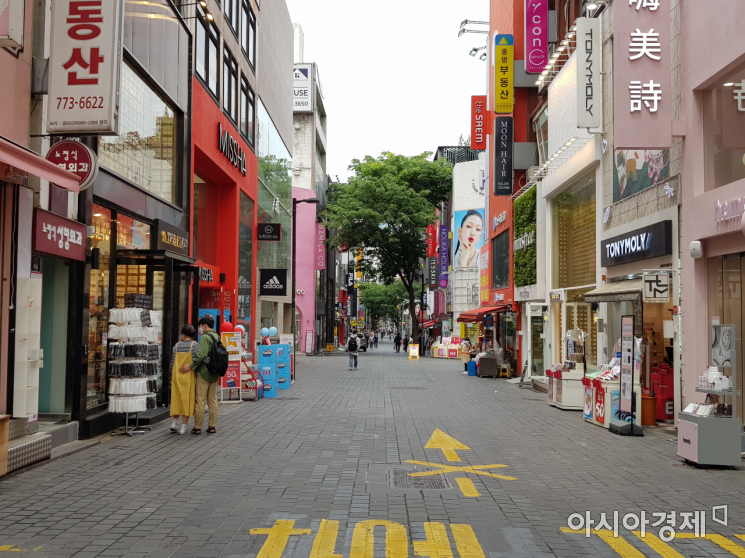
Since last November, it has been reported that more than 9 out of 10 households have applied for the disaster relief funds.
According to the Ministry of the Interior and Safety on the 1st, as of 12 a.m. that day, the number of households applying for the emergency disaster relief funds was confirmed to be 21,323,030 households, accounting for 98.2% of the total. The cumulative application amount was found to reach a total of 13.428249 trillion won.
By payment method, 14,548,340 households, accounting for 67% of the total, applied for and received the funds via credit or debit card charging. In addition, prepaid cards (11.1%) and local love and Onnuri gift certificates (6.9%) followed.
Survey results showed that the perceived economic index of small business owners and traditional markets rose together compared to the previous month due to the distribution of emergency disaster relief funds.
The Small Enterprise and Market Service, commissioned by the Ministry of SMEs and Startups, conducted a market trend survey from the 18th to the 22nd of last month targeting 2,400 small business owners and 1,300 traditional markets. The results showed that the perceived economic index for small business owners and traditional markets last month was 88.3 and 109.2, respectively, which is an increase of 14.5 points and 29.2 points compared to the previous month.
Mr. C, a self-employed person running a restaurant near Euljiro 1-ga Station on Subway Line 2, said, "Many customers use disaster relief funds or Onnuri gift certificates." He added, "Since it’s near an area with many offices, it seems we have suffered relatively less damage," and said cautiously, "Although we have been affected by the COVID-19 situation, there are people in worse conditions than us, so I don’t have much to say."
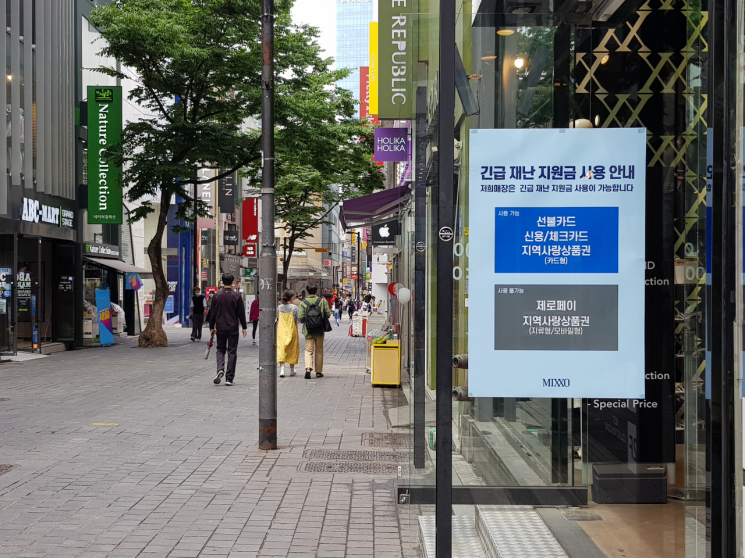 On the afternoon of the 2nd, a store in Myeongdong, Jung-gu, Seoul. An emergency disaster relief fund usage notice is posted at the entrance.
 Photo by Kay Kim katekim221@asiae.co.kr
On the other hand, self-employed people operating businesses in areas with low foot traffic complained that the effect of the emergency disaster relief funds was minimal.
Citizens said, "We understand the purpose of the fund distribution," but also said, "Because the places where the funds can be used are limited, people tend to spend in convenient places."
Mr. D, a worker in his 30s who came out during lunchtime that day, said, "I am using the emergency disaster relief funds well," but added, "I never really thought about going somewhere else to use them. At first, I tried to use them here and there, but there were more restrictions than I expected, so it was inconvenient."
Mr. D continued, "There were a few times when I saw a sign saying 'Emergency disaster relief funds accepted' when I needed something, so I went in and bought it," but added, "Most of the time, I use it to buy groceries near my home."
This situation is clearly observed in areas with a high proportion of domestic and foreign tourists such as Itaewon, Apgujeong, and Myeongdong.
On the 2nd, the Commercial Real Estate Research Institute, a profit-type real estate research and development company, analyzed statistics from the Korea Appraisal Board and found that the average vacancy rate of medium to large commercial properties in Itaewon in the first quarter was 28.9%, an increase of 9 percentage points compared to the previous quarter (19.9%).
In addition, vacancy rates also increased in areas such as Apgujeong (7.5 percentage points), Jangan-dong (5.7 percentage points), Yeongdeungpo (4 percentage points), and Myeongdong (3.1 percentage points). There are concerns that the indicators for these commercial districts will worsen further in the second quarter as the COVID-19 situation prolongs.
Experts suggested that the government needs to take additional measures by analyzing the usage trends of the emergency disaster relief funds.
Professor Lee Eun-hee of the Department of Consumer Studies at Inha University said in a phone interview with Asia Economy on the 2nd, "There are many people, such as traditional markets and small business owners, who do not benefit from the disaster relief funds," but pointed out, "However, the positions of business owners and consumers are naturally different."
Professor Lee said, "There are business owners who do not receive benefits, but from the consumer’s perspective, many do not even know where they can use the funds, and the inconvenience is the priority. That is why they tend to use the funds in convenient places," and advised, "The government should not stop at just distributing the funds but should monitor the ongoing situation and prepare measures to guide consumers if there are places where consumers cannot reach."
© The Asia Business Daily(www.asiae.co.kr). All rights reserved.
![Clutching a Stolen Dior Bag, Saying "I Hate Being Poor but Real"... The Grotesque Con of a "Human Knockoff" [Slate]](https://cwcontent.asiae.co.kr/asiaresize/183/2026021902243444107_1771435474.jpg)













