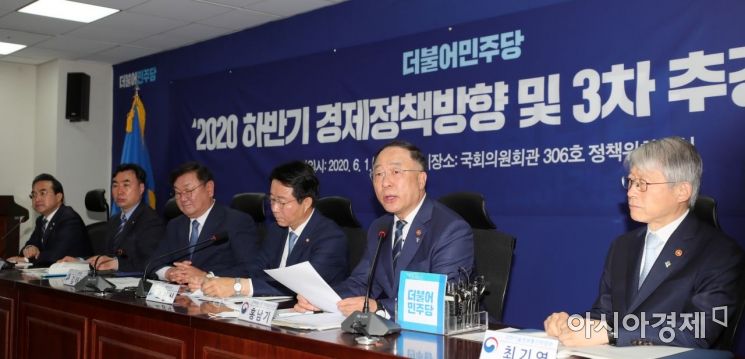
 Hong Nam-ki, Deputy Prime Minister for Economic Affairs, is delivering opening remarks at the 'Second Half Economic Policy Direction and 3rd Supplementary Budget Party-Government Meeting' held at the National Assembly on the 1st. Photo by Yoon Dong-joo doso7@
[Sejong=Asia Economy Reporter Kim Hyunjung] There are criticisms that the government’s 'Korean New Deal' project, which will be carried out with a budget of 76 trillion won, does not properly reflect the urgency of economic stimulus in response to the COVID-19 pandemic. It is explained that because the plan looks too far into the future, support for private companies?where fiscal input effects are large and virtuous cycles of job creation can be expected?regulatory relaxation, and focused support for small business owners and vulnerable groups in crisis situations are rather insufficient.
On the 1st, the government held the 6th Emergency Economic Meeting chaired by President Moon Jae-in and announced the 'Second Half Economic Policy Direction,' which includes investing a total of 76 trillion won over the next five years in the 'Korean New Deal' project divided into digital and green sectors. The main point is to create 550,000 jobs by 2022 through building various infrastructures such as remote education and non-face-to-face medical services, and converting old public rental housing and other infrastructures into eco-friendly ones. First, 31.3 trillion won will be invested over three years, and from 2023 to 2025, a second phase budget of 45 trillion won will be poured in. Through this, the government also presented a blueprint to transform industries such as quarantine and bio into future growth engines, repatriate companies that moved overseas, and attract advanced enterprises.
However, experts agree with the purpose of the government’s plan but diagnose that it is difficult to respond to the economic recession and social problems caused by the spread of COVID-19. While the 'mid- to long-term' direction is correct, it is insufficient to solve the problems occurring immediately. Professor Kim Soyoung of Seoul National University’s Department of Economics said, "It is true that innovation in digital and green sectors is needed in the mid- to long-term and the direction is well set, but effectively creating jobs in preparation for the COVID-19 situation is a different matter," adding, "In the current emergency situation caused by the spread of COVID-19, the results of the New Deal will be limited."
There are also voices calling for 'selective' fiscal input targeting corporate support through regulatory relaxation and vulnerable groups in crisis situations. Professor Kang Sungjin of Korea University’s Department of Economics mentioned the so-called 'reshoring' policy aimed at bringing corporate production facilities back to the country, saying, "It is a necessary measure, but it cannot affect the economy in the second half of this year," and criticized, "They did not even touch regulatory relaxation necessary to bring companies back, including the total volume control system in the metropolitan area." Professor Kang added, "The Green New Deal project is the same; in the current situation, such costly projects can rather be a burden on private companies." Professor Kim Kiheung, emeritus professor of the Department of Economics at Kyonggi University, also explained, "Assuming the worst situation in history, it is necessary to focus support on growth companies with large policy effects and selectively invest fiscal resources targeting self-employed people and vulnerable groups."
There are also criticisms that more concrete plans for securing finances and future fiscal rules should have been presented together. Professor Kang argued, "Ultimately, tax revenue must be secured to match the expanded fiscal spending, and even if there is political burden, the direction on tax increases should be clarified and fiscal rules established." Professor Kim also said, "Although the national debt ratio looks comfortable numerically, a rapid increase of more than 5% per year is dangerous," adding, "Considering that a situation requiring more fiscal resources may arise, discussions on fiscal management and rules should begin."
© The Asia Business Daily(www.asiae.co.kr). All rights reserved.

















