National Institute of Maritime Cultural Heritage and National Jeju Museum 2nd Underwater Cultural Heritage Excavation Survey
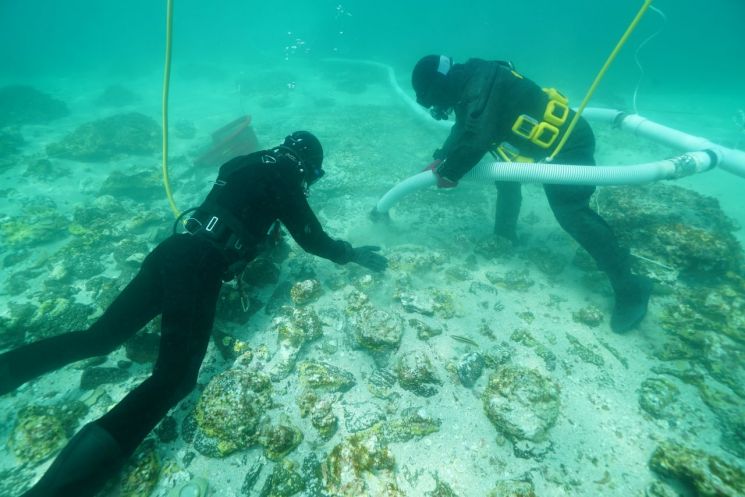
The second underwater cultural heritage excavation will begin in the waters off Sinchang-ri, Jeju City. The National Research Institute of Maritime Cultural Heritage under the Cultural Heritage Administration and the National Jeju Museum announced on the 2nd that they held a water opening ritual (開水祭) to mark the start of the investigation and commenced the joint excavation.
The underwater cultural heritage site in Sinchang-ri became known in March 1983 when a haenyeo (female diver) discovered a gold ornament during her work and reported it. The Cultural Heritage Administration's predecessor, the Cultural Heritage Management Bureau, conducted an underwater survey in April of the same year and found two additional gold ornaments. In 1997, the Jeju National University Museum discovered ceramics from the Southern Song Dynasty of China.
In 2018, the National Research Institute of Maritime Cultural Heritage conducted an underwater survey to identify the specific range where Southern Song Dynasty ceramics were distributed. Last year, the National Jeju Museum and the first excavation survey confirmed 437 pieces of ceramics, two seals, and one seal case. Most of these are celadon produced in the Longquan Kiln (龍泉窯) in Zhejiang Province, China, dating from the late 12th to early 13th century.
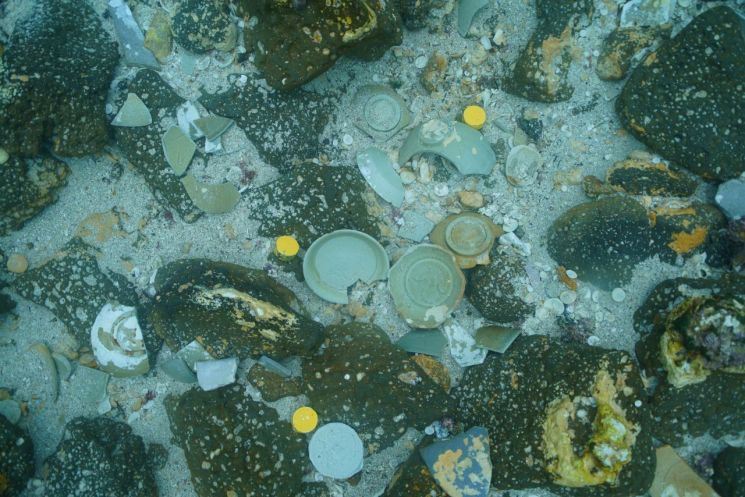
One of the seals bears the inscription ‘謹封 (Geunbong)’, meaning ‘carefully sealed’, on its face along with red seal ink. The Cultural Heritage Administration stated, “It is presumed that an international trading ship traveling the maritime route sank in front of Jeju,” adding, “This has shed light on one aspect of maritime trade at the time.”
This investigation is being conducted as an extension of the first excavation survey. The plan is to understand the distribution pattern of underwater artifacts and to locate the remains of the ship carrying the ceramics to secure more research materials on maritime exchange history.
© The Asia Business Daily(www.asiae.co.kr). All rights reserved.


















