Necessity of 'Consent' in Rape Crime Elements
Continuously Raised Since MeToo Movement
Election Pledges from Justice Party and People Party
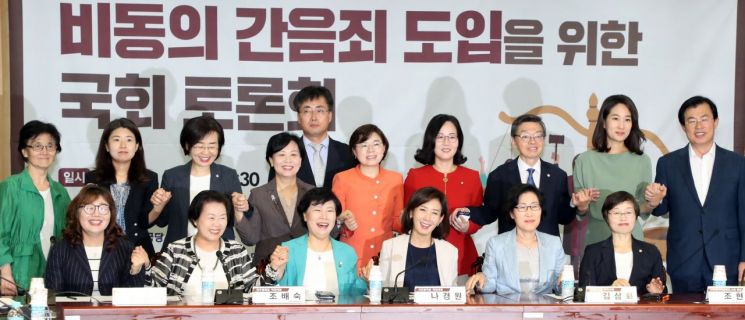
[Asia Economy Reporter Lim Chun-han] Attention is focused on whether the 'non-consensual rape crime,' which allows punishment for sexual acts without consent, can pass the threshold of the 21st National Assembly. Currently, the Justice Party has announced that enacting the non-consensual rape crime law will be its top priority. Interest is also growing in whether lawmakers from both ruling and opposition parties will participate in the bill's proposal on a bipartisan basis, as they did in the 20th National Assembly.
Jang Hye-young, Chair of the Justice Party Innovation Committee, said in a phone interview with Asia Economy on the 2nd, "The non-consensual rape crime is a long-standing issue of the women's rights movement, and I believe it is a bill that has formed broad consensus mainly among female lawmakers." She added, "We plan to proceed with the legislation as quickly as possible. We will ensure that many lawmakers can participate in this bill."
The core of the non-consensual rape crime bill is to amend the Criminal Act to define the elements of rape based on 'consent' rather than violence or threats. The need for this bill has been steadily raised since the Me Too movement. The current law defines the elements of rape as violence or threats, which has been criticized as unfavorable for victim protection. The United Nations (UN) Committee on the Elimination of Discrimination against Women has also recommended defining rape based on the victim's voluntary consent.
During the 20th National Assembly, the non-consensual rape crime bill was proposed several times but was discarded due to expiration of the term without proper discussion. Notably, in 2018, when former Chungnam Governor Ahn Hee-jung, who was tried for sexually assaulting his female secretary, was acquitted in the first trial, 13 female lawmakers from both ruling and opposition parties jointly proposed the bill, drawing public attention.
Looking at the pledges for the April 15 general election, there is a significant difference in stance among political parties. The Democratic Party of Korea is considering introducing the non-consensual rape crime but does not appear to be actively pursuing it. The United Future Party mentioned incidents such as former Governor Ahn’s case, former Blue House administrator Tak Hyun-min’s book controversy, and Won Jong-geon’s Me Too controversy in their women's policy introductions, but no related pledges were found.
On the other hand, the Justice Party and the People’s Party are actively advocating for its introduction. Justice Party lawmaker Ryu Ho-jeong said on the 31st of last month, "The Justice Party has pledged in its general election manifesto to amend the Criminal Act to use the presence or absence of the other party’s consent as the criterion for guilt, rather than violence or threats, which the judiciary interprets narrowly." She emphasized, "Justice Minister Choo Mi-ae also stated that the non-consensual rape crime should be newly established. It can no longer be delayed." People’s Party leader Ahn Cheol-soo said in February, "The global standard is that sexual acts without consent should be punishable," adding, "If an attempt was made to engage in sexual relations in a situation where refusal was expressed or explicit consent cannot be assumed, it will be punished as sexual assault."
© The Asia Business Daily(www.asiae.co.kr). All rights reserved.

















