Ministry of Land Announces 'Housing Survey' Results from Previous Day
House Prices Rose Significantly Last Year but PIR Decreased
Experts Say "There May Be Limitations in the Survey"
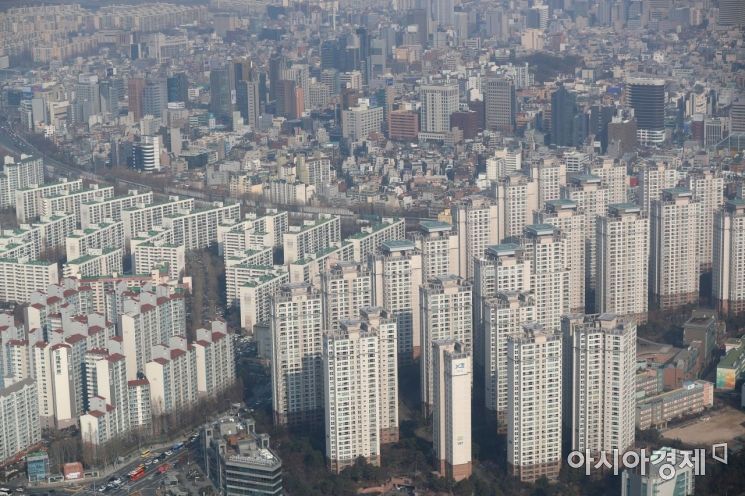
[Asia Economy Reporter Moon Jiwon] The Ministry of Land, Infrastructure and Transport's statistics from last year's 'Housing Survey,' announced on the 1st, have come under scrutiny. This is because the analysis suggested that despite the sharp rise in housing prices, the price-to-income ratio actually decreased. Notably, the government’s published data omitted indicators related to Seoul, where housing prices rose the most, leading to criticism that it is a case of "a deceptive appearance."
According to the Ministry on the 2nd, the 'Price-to-Income Ratio (PIR)' of homeowners in the metropolitan area last year was 6.8, down from 6.9 the previous year, as revealed in the housing survey released the day before. PIR represents the number of years it would take for a household to buy a home if it saved its entire annual income. A lower PIR means either income has increased or housing prices have fallen, reducing the burden of homeownership. The Ministry thus self-assessed that "the overall housing conditions of the people have improved."
However, critics argue that this indicator significantly diverges from the actual experience of prospective homeowners. According to a private research institute, KB Kookmin Bank, the PIR for Seoul apartments in the fourth quarter of last year reached a record high of 11.4. Gyeonggi Province and Incheon recorded 6.9 during the same period. Although this indicator was limited to apartments, the gap with the government’s statistics is substantial.
The government did not even separately disclose key housing market indicators such as the PIR for Seoul. This has led to accusations that the government is inflating policy achievements based on indicators derived from limited samples. Ham Young-jin, head of the Zigbang Big Data Lab, explained, "The housing survey is not a full census but conducted with a sample of 60,000 households. Even with refined sampling, there can be limitations in the survey."
Experts point out that this kind of 'statistical trap' is also evident in the weekly apartment price reports. According to the weekly apartment price trends by the Korea Real Estate Board under the Ministry, Seoul apartment prices have fallen for nine consecutive weeks, but many real estate agents and actual buyers say "there are no cheap listings."
The price decline is concentrated in high-priced redevelopment complexes in the Gangnam area, and the drop rate is only 0.02?0.07%, so the perceived effect is minimal. However, based on statistics alone, it may seem that housing prices have stabilized, causing a significant disconnect. Unlike the Korea Real Estate Board, the private research institute Real Estate 114 reported last week that Seoul apartment prices have turned upward.
Park Won-gap, senior expert at KB Kookmin Bank, said, "Current indicators and statistics differ greatly from the situation on the ground. While most expect real estate prices to show a slight downward trend in the second half of the year, many places have already seen local price increases."
© The Asia Business Daily(www.asiae.co.kr). All rights reserved.
![User Who Sold Erroneously Deposited Bitcoins to Repay Debt and Fund Entertainment... What Did the Supreme Court Decide in 2021? [Legal Issue Check]](https://cwcontent.asiae.co.kr/asiaresize/183/2026020910431234020_1770601391.png)
















