[Asia Economy Reporter Seulgina Jo] "What kind of 'Korean New Deal' is it when even the 'data utilization' emphasized by the president himself is completely blocked by subordinate legislation?" "Without radical regulatory innovation, the same futile situation could repeat itself."
The ICT industry views the Moon Jae-in administration's 'Korean New Deal' project, which is spearheaded by the Digital New Deal, with great concern. This is because, contrary to the government's earlier pledge to open the data economy era, the 'Data 3 Laws (Personal Information Protection Act, Information and Communications Network Act, Credit Information Act)' have been rendered ineffective due to being hampered by enforcement ordinances. There is anxiety that the process might inadvertently produce new regulations.
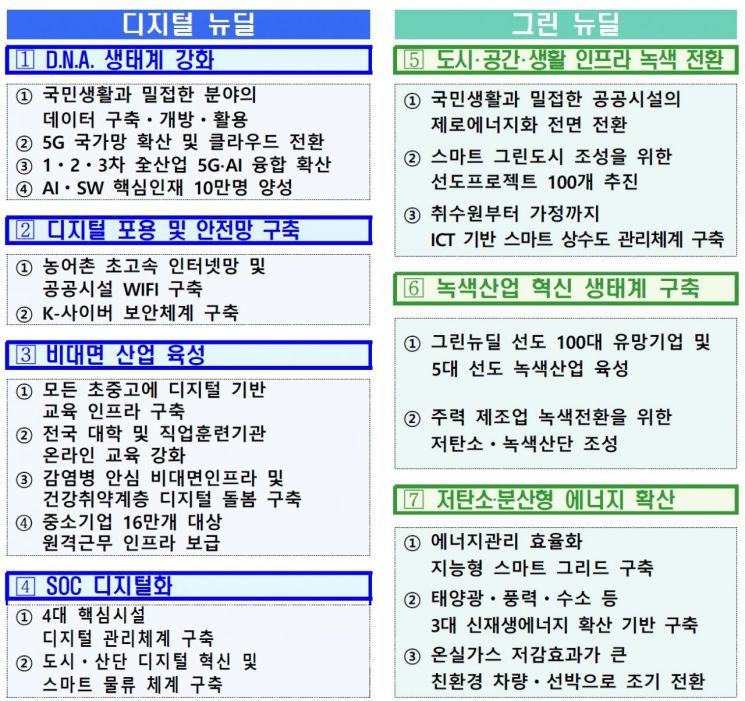
According to government ministries and the industry on the 2nd, the Korean New Deal unveiled by the government the previous afternoon focuses on the Digital New Deal, which involves an investment of 13.4 trillion won in ▲strengthening the Data, Network, and Artificial Intelligence (D.N.A) ecosystem ▲building digital inclusion and safety nets ▲fostering non-face-to-face industries ▲digitalizing SOC. The goal is to create 330,000 jobs. The ministries plan to supplement additional tasks and finalize and announce a comprehensive plan by July.
◆ "No Korean New Deal without radical regulatory innovation" = The ICT industry expresses cautious optimism that the Korean New Deal could accelerate the 4th Industrial Revolution based on 5G, artificial intelligence (AI), and cloud computing, but they do not hide their concerns. They argue that without radical regulatory innovation, no matter how massive the government and corporate investments are, it will be difficult to achieve meaningful results.
An IT industry official said, "The biggest concern in the industry right now is the possibility of new regulations emerging during policy implementation," adding, "For the Digital New Deal and Korean New Deal to succeed, regulations must first be uprooted. Otherwise, it will be a regression."
The Data 3 Laws are cited as a prime example of regression. When passed by the National Assembly earlier this year, they were expected to mark a turning point for the big data industry, but the Ministry of the Interior and Safety made it more difficult to utilize personal information during the revision of the enforcement ordinance of the Personal Information Protection Act, drawing criticism for not aligning with the law's intent.
A representative from a large corporation remarked, "It would be better if it didn't exist at all," pointing out, "The president emphasizes the data economy and data utilization, but the Ministry of the Interior and Safety does not even consider the law's purpose." A startup official also sighed, saying, "President Moon Jae-in has been calling for 'regulatory innovation' since his first message of the new year, but the actual results are like this," and added, "Small and medium enterprises are afraid to even try because they worry about getting caught up in legal disputes."
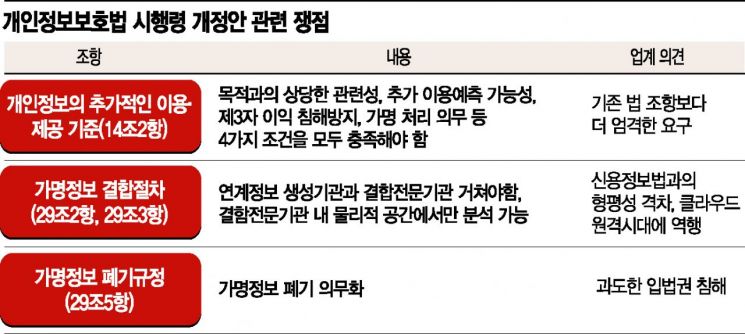
Since the Moon Jae-in administration has repeatedly declared that 'data utilization' must be prioritized for the successful implementation of the Korean New Deal, there are continuous calls to drastically revise key regulations, starting with the enforcement ordinance amendments of the Data 3 Laws, which have become 'toxic' due to inter-ministerial discord. According to market research firm IDC, the data-related market size is expected to grow from $166 billion in 2018 to $260 billion in 2022.
To successfully promote the Korean New Deal, the government identified that, in addition to promoting data utilization and infrastructure development, it is essential to encourage 5G investment, expand smart factories, revise AI legislation, and establish a foundation for the activation of non-face-to-face industries.
◆ "Lack of consideration for regulatory improvement" is regrettable = The Korean New Deal does not include specific measures regarding telemedicine, which has gained public consensus amid the COVID-19 pandemic. This contrasts sharply with countries like the United States, China, and Japan, which have allowed telemedicine and are opening an era of convergence across various industries. The global telemedicine market is expected to reach $41.2 billion in 2021. The digital healthcare market, including smartwatches, is also projected to reach $206 billion.
In this regard, the Korea Information and Communications Planning and Evaluation Institute recently suggested in a report that "it is necessary to leverage world-class ICT infrastructure and medical standards to seize the opportunity to secure global competitiveness in the non-face-to-face medical field, which has seen a surge in interest due to COVID-19." Another ICT industry official said, "Considering the sensitivity of the issue, it is very regrettable," and added, "It would have been better if more detailed content related to regulatory improvements within the Digital New Deal had been included, not just telemedicine."
According to the 'Policy Proposal Report for Startup Ecosystem Activation' by the Asan Nanum Foundation, Google Startup Campus, Startup Alliance, and Korea Startup Forum, 53% (by investment amount) of the top 100 global cumulative investment companies face regulatory hurdles when operating in Korea. Such regulations are seen as a reason why domestic companies with technological capabilities and growth potential turn their eyes overseas. This is why there are repeated criticisms that the Korean New Deal lacks sufficient consideration for regulatory improvement.
Earlier, at an IT industry meeting hosted by the Korea Chamber of Commerce and Industry and the Government Coordination Office's Public-Private Joint Regulatory Improvement Promotion Team, requests were made to ease the application requirements for new industry tax credits and improve overlapping regulations. The limited four-year exemption period under the regulatory sandbox, which fails to provide mid- to long-term momentum, has also been repeatedly raised by industry insiders.
◆ "Repeating existing content... Additional support measures needed to attract investment" = It is also evaluated that large-scale support measures, such as tax incentives that can induce massive corporate investment, are essential for the Korean New Deal to yield results.
A telecommunications industry official said, "We have expectations as the government plans to pour financial support into infrastructure investment," but added, "At this point, it is questionable how much practical support the additional measures will contain." Ultimately, there is a possibility that investments will be squeezed out, becoming a burden on an industry already hit hard by COVID-19.
There is also regret that much of the content included in the Digital New Deal, such as the expansion of the 5G national network and the establishment of public Wi-Fi, merely repeats projects that were already underway.
The government plans to build and open data in 15 big data platform sectors closely related to citizens' lives as part of the Digital New Deal, and accelerate the 5G national network and cloud transition. Furthermore, it will promote seven AI flagship projects, including manufacturing process and quality control, to spread 5G and AI convergence across all industries.
In addition, the government will promote high-speed internet networks in rural areas, public facility Wi-Fi installation, digital infrastructure for all elementary and secondary schools, infection disease-safe non-face-to-face infrastructure and digital care systems for vulnerable health groups, digital safety management systems for four core facilities, and digital innovation in industrial complexes.
© The Asia Business Daily(www.asiae.co.kr). All rights reserved.


















