Cause of Connection Failure Kept Secret, Poor Response Controversy
Telecom Industry Suspected of Traffic Overload Due to Surge in Subscribers and Content
Claim of 'Open Connect' Instead of Paying Network Usage Fees Lacks Persuasiveness
[Asia Economy Reporter Kim Heung-soon] It has been a week since the global online video service (OTT) Netflix experienced about two hours of access errors in South Korea on the 25th of last month. Netflix apologized to its members who experienced inconvenience, stating, "We are investigating the cause of the disruption," but as of the 2nd of this month, it has remained silent about the analysis process and results. Domestic Internet Service Providers (ISPs) said, "It appears to be an error within Netflix itself, not an internet network issue." Although Netflix experienced access errors in the U.S. and Northern Europe last March, this is practically the first time such a problem has occurred domestically. Critics argue that Netflix’s silence despite causing inconvenience to users, while charging monthly subscription fees to provide high-definition video content, is an example of "global corporate bullying."
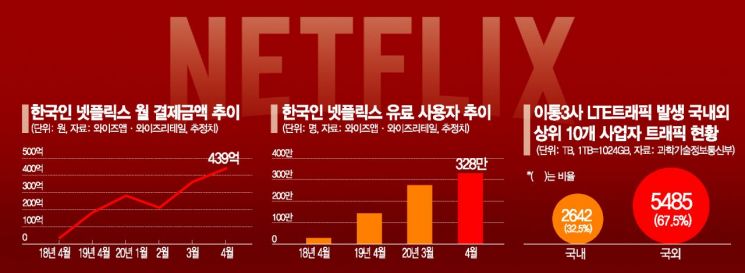
◆ High-definition videos are the main cause of traffic overload= The telecommunications industry speculates that the rapid increase in Netflix subscribers in South Korea and the massive influx of subscribers to large-capacity popular video content likely caused traffic overload. According to the status of LTE data traffic from the three domestic mobile carriers revealed at last year’s National Assembly Science, Technology, Information and Broadcasting Communications Committee audit, video content from the top five overseas Content Providers (CPs), including Google YouTube and Netflix, accounted for 67.5% of the total traffic of domestic ISPs.
Netflix explained, "YouTube overwhelmingly has more video content," and "Compared to that, the traffic generated by Netflix content is estimated to be about 5-10% of that amount." However, a telecommunications industry official rebutted, "Most YouTube video content is standard definition (SD), while Netflix has a significant amount of ultra-high definition (UHD) content," adding, "Since UHD generates up to eight times more traffic than SD, it is not appropriate to compare based on the number of contents."
According to application and retail analysis firms WiseApp and WiseRetail, the number of paid Netflix subscribers in South Korea increased more than tenfold from 280,000 in April 2018 to 3.28 million last April, and the amount paid on Netflix rose from 3.5 billion KRW to 43.9 billion KRW during the same period. Netflix has not disclosed the exact number of domestic members, but industry estimates suggest that roughly 2 to 3 million people are subscribed.
◆ "Customers come last"= According to the amended Telecommunications Business Act passed by the National Assembly on the 20th of last month, from now on, value-added telecommunications service providers, including overseas CPs, that meet criteria such as the number of users and traffic as defined by presidential decree (enforcement ordinance) must secure "service stability measures." They must also take necessary actions to handle domestic users’ requests. Specific guidelines on how to respond when inconveniences such as access errors occur can be established through the enforcement ordinance. It can also clarify whether payment for network usage fees is required to stabilize the service.
Netflix has claimed that instead of paying network usage fees to the ISP in the respective country, it can reduce traffic overload by more than 95% by providing "Open Connect," which stores content close to its service users and streams it for free. However, this claim lost credibility as LG Uplus subscribers, who introduced this system through an exclusive partnership with Netflix, also experienced errors.
Netflix filed a civil lawsuit against SK Broadband on April 13. Netflix explained, "There is a significant difference in position with SK Broadband, and we feared that if the dispute prolonged, customers could continue to suffer damages, so we had no choice but to request the court’s judgment." In response, an SK Broadband official said, "Looking at how Netflix has responded to the access errors that caused inconvenience, we question whether they truly care about their customers." The official added, "We have received the complaint filed by Netflix, are reviewing its contents, and preparing a response. We will also carefully consider whether to file a counterclaim."
© The Asia Business Daily(www.asiae.co.kr). All rights reserved.
![User Who Sold Erroneously Deposited Bitcoins to Repay Debt and Fund Entertainment... What Did the Supreme Court Decide in 2021? [Legal Issue Check]](https://cwcontent.asiae.co.kr/asiaresize/183/2026020910431234020_1770601391.png)
















