Gyeongsangbuk-do Population Policy Committee Discusses Measures to Overcome Population Decline
Multicultural Support Center Director: "Foreign Resident Attraction Requires Residency Incentives"
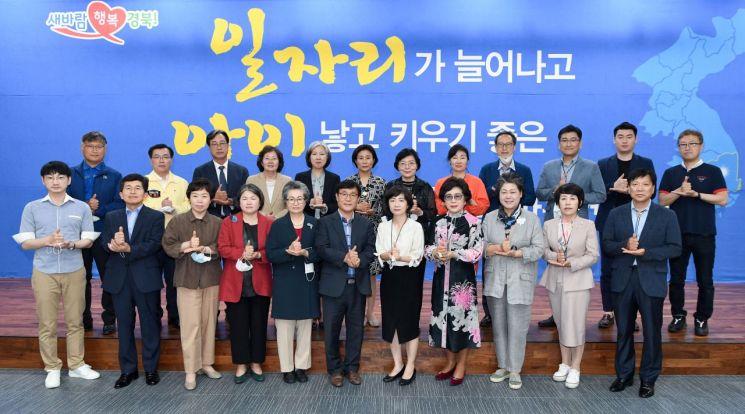 Members of the Gyeongsangbuk-do Population Policy Committee posing for a commemorative photo after concluding the meeting on the 1st.
[Asia Economy Yeongnam Reporting Headquarters Reporter Park Dong-wook] On the 1st, Gyeongsangbuk-do held the 'Gyeongbuk Population Policy Committee,' composed of experts from various fields, to brainstorm solutions to the increasingly serious population issues caused by low birth rates and aging.
The 'Gyeongsangbuk-do Population Policy Committee' consists of 53 experts from fields such as childcare and children, academia, media, religious circles, and civil society organizations. The co-chairpersons are Governor Lee Cheol-woo and Attorney Kim Hee-jung. The meeting proceeded with a report on the 2020 Gyeongbuk population policy direction, followed by a thematic presentation on 'Population Policy and Multiculturalism' by Jang Heun-seong, Director of the Gyeongsangbuk-do Multicultural Family Support Center, and then policy proposals and discussions by the committee members.
While the low birth rate is a nationwide issue, the population decline in Gyeongsangbuk-do is even more severe. As of the end of last year, the population of Gyeongsangbuk-do was 2,665,836, a decrease of 10,995 compared to the previous year.
This year's decline is even more pronounced. According to data released by Statistics Korea on May 27, the population of Gyeongsangbuk-do has already decreased by 14,782 this year. Additionally, issues such as youth outflow and aging are compounding the problem. Until April, there was a net inflow of elderly population (213 people), while the young population experienced a net outflow (9,909 people). The number of deaths (6,131) is nearly 60% higher than the number of births (3,592).
Accordingly, Gyeongsangbuk-do has set concrete goals including ▲job creation ▲establishment of cultural, welfare, and residential conditions ▲construction of a Gyeongbuk-style care environment ▲and establishment of a work-family balance culture, and decided to strengthen practical support policies. Measures are being introduced one after another, such as continuously expanding support for youth startups and young farmers, supporting interest on rental deposits for newlyweds, and reducing parents' burden for using childcare services by 50%.
At the meeting, Jang Heun-seong, Director of the Gyeongsangbuk-do Multicultural Support Center, drew attention by noting the high proportion of births from multicultural families in Gyeongbuk and stating, "Multicultural family policies can become a new population policy, so we must actively respond by attracting foreigners, providing incentives for local residence, and introducing adaptation programs."
Governor Lee Cheol-woo expressed concern, saying, "Population issues are the result of complex causes including our society's economy, culture, systems, and perceptions, and especially the impact of COVID-19 may negatively affect marriage and childbirth," and emphasized, "We will concentrate all provincial government capabilities to create a Gyeongsangbuk-do that is good for having and raising children and a desirable place to live."
© The Asia Business Daily(www.asiae.co.kr). All rights reserved.

















