China Reports Successful Satellite Launch on Same Day... Showcases Indigenous Technology
Russia: "A Strong Competitor Emerges in Space Industry"... Suggests Launch Fee Reduction
Competition Expected to Intensify in Space Defense Fields Including Satellite Interception Technology
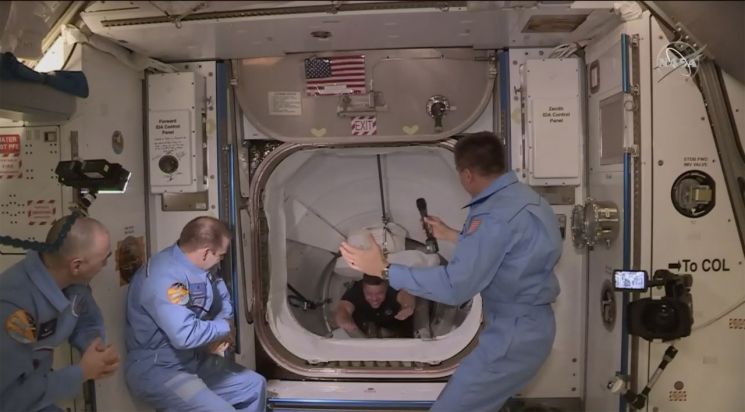 On the 31st of last month (local time), SpaceX's first-ever private manned spacecraft, 'Crew Dragon,' successfully docked with the International Space Station (ISS) after a 19-hour flight. Astronaut Bob Behnken (third from the left), who was aboard Crew Dragon, is entering the ISS after docking.
 [Image source=AP Yonhap News]
[Asia Economy Reporter Hyunwoo Lee] Following the successful flight of SpaceX's first manned spacecraft, China and Russia have immediately shown moves to counter it. China flaunted its own technological capabilities by announcing the successful launch of its satellites, while Russia expressed tension, stating that a strong competitor has emerged in the future space industry. The U.S.-China conflict is expected to escalate into a space war with Russia joining in, as the issue is linked not only to private space ventures but also to defense matters such as space forces.
According to China's state-run Global Times on the 31st, the Chinese government announced that it successfully launched two satellites?the Earth observation satellite Gaofen 9 (GF-9) and the low Earth orbit Internet of Things (IoT) satellite Hede-4?from the satellite launch center located in Gansu Province that afternoon. The Chinese government stated that these satellites will support future land surveying, urban planning, and construction projects related to the Belt and Road Initiative (both overland and maritime Silk Road projects). The day before, the Chinese government also launched two satellites, G and H, from the satellite launch center in Sichuan Province, confirming that they reached their planned orbits.
The Global Times cited a Chinese space development expert saying that China could achieve manned spaceflight by 2025 and that despite U.S. technology controls, China will continue to expand its space industry based on its own technology. This report is interpreted as a move to counter the success of SpaceX’s first manned spacecraft docking with the International Space Station on the same day.
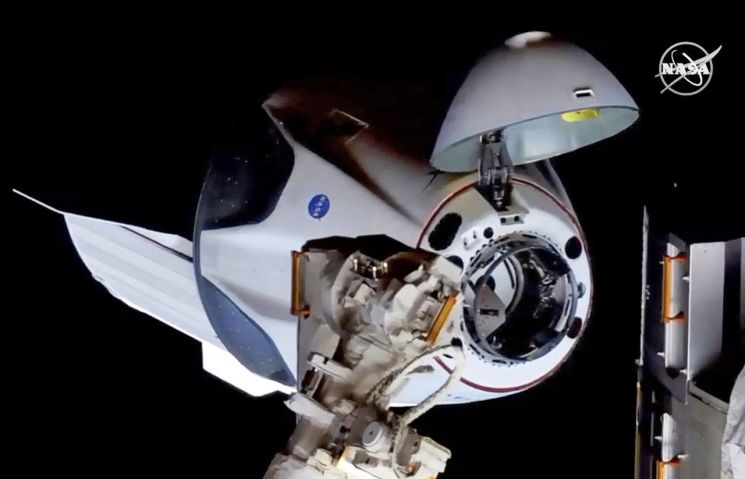
Russia also showed signs of countering the news of SpaceX’s success. The Moscow Times quoted Dmitry Rogozin, head of the Russian Federal Space Agency, at a press conference saying, "With the emergence of SpaceX, a strong competitor has appeared in Russia’s space shuttle business," and added, "We are considering reducing launch fees by 30% going forward."
Vladimir Ustimenko, spokesperson for the Russian Federal Space Agency, also remarked, "It is difficult to understand the hysteria expressed by U.S. President Donald Trump following SpaceX’s successful launch." Earlier, President Trump tweeted after SpaceX’s launch success, "In the past, our leaders had to beg foreign countries to send our astronauts into orbit, but now that is no longer necessary." The phrase "begging foreign countries" refers to the period after the retirement of the space shuttle Atlantis in 2011, when the U.S. rented Russian spacecraft for its astronauts.
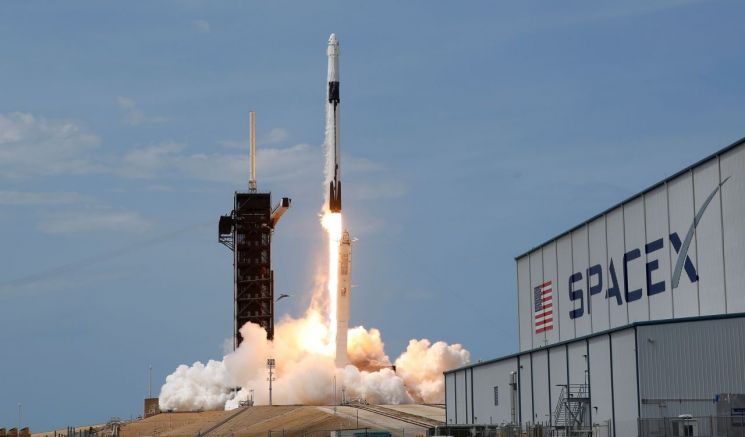
Since 2011, Russia has monopolized the global space market, including NASA’s satellite and probe launch projects, charging over $80 million per astronaut for transportation by rocket. However, since 2014, SpaceX has offered a lower transportation fee of $60 million, significantly reducing Russia’s market share. Currently, SpaceX’s market share is known to be around 70%.
The competition among the three countries is expected to intensify not only in private space ventures but also in defense issues through space forces. In a report released in February, the U.S. Department of Defense’s Defense Intelligence Agency (DIA) pointed out, "China and Russia are developing various means to threaten the United States’ position in space," and noted, "China and Russia are operating laser weapon systems capable of intercepting satellites, and countermeasures against these are necessary."
© The Asia Business Daily(www.asiae.co.kr). All rights reserved.



















