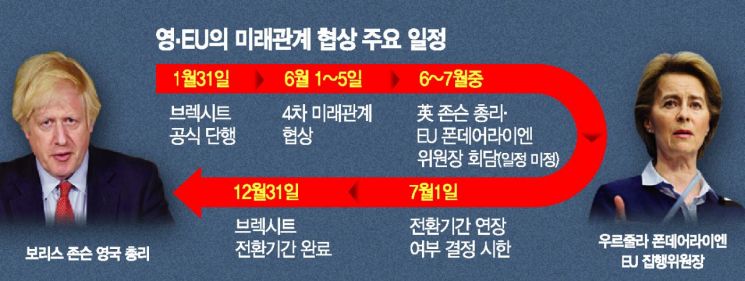
[Asia Economy Reporter Jeong Hyunjin] The UK, which carried out Brexit (the UK's withdrawal from the European Union (EU)), and the EU have reached a fateful June. This is because the deadline to decide whether to extend negotiations to establish future relations in areas such as tariffs, finance, and security must be determined within this month. If the extension is not settled by the end of this month, a 'no-deal Brexit' with no conclusion is expected to become a reality.
According to Bloomberg and other sources, the UK government and the EU Commission will hold the 4th round of future relations negotiations via video conference from June 1 (local time) to June 5. Since March, both sides have held three rounds of negotiations but have failed to reach an agreement. Although both sides have kept the possibility of negotiation open after each meeting, they have exchanged sharp words, and expectations for achievements in this 4th round of talks are not high.
On May 31, a day before the meeting, Michel Barnier, the EU's chief Brexit negotiator, said in an interview with a media outlet, "We clearly want negotiations, but it is difficult to have negotiations without any cost," emphasizing that he would never accept the weakening of the single market. He pointed out that the UK should be more realistic about the negotiations and accused the UK of trying to gain the benefits of membership without accepting the obligations of the EU.
Four days earlier, David Frost, the UK’s chief negotiator and Prime Minister’s Europe adviser, also criticized the current EU negotiation guidelines as unlikely to reach an agreement. He said, "For an agreement to be reached, the EU must advance its position," and predicted that the originally expected fisheries-related agreement would not be reached within June.
As the gap between the two sides' positions remains wide, the most urgent issue is whether to extend the negotiation deadline scheduled for the end of this month. According to the agreement between the two sides, the UK and the EU can extend the future relations negotiation deadline once, for up to two years. Since there are many issues to discuss, such as trade issues like fisheries and financial services and security matters, it is difficult to reach all agreements within six months. Considering this, the EU recently proposed extending the deadline for up to two years, but the UK government responded, "Not extending is the government's firm policy, and even if requested, we will not agree."
If the negotiations end without a deal, economic and social damages on both sides are inevitable. The UK think tank Social Market Foundation (SMF) stated in its report on "The Economic Impact of COVID-19 and Brexit" that if the transition period ends without an agreement, "there will be a significantly negative impact, and if a free trade agreement (FTA) level agreement is reached, there will be a medium-scale negative impact." In particular, it predicted that most regions, including London, would suffer a "double hit" amid the already severe economic damage caused by COVID-19.
Foreign media are focusing on the expected meeting this month between UK Prime Minister Boris Johnson and EU Commission President Ursula von der Leyen. The UK media Express reported, citing UK government sources, that while the UK government wants to proceed with negotiations quickly, the EU side is not moving at the same pace, and the deadlock is expected to be resolved only after the two leaders meet.
© The Asia Business Daily(www.asiae.co.kr). All rights reserved.

















