Ministry of Industry Announces 'May Export-Import Trends'... Export Decline at Financial Crisis Level
Major Items Except Semiconductors Halved... Trade Balance Turns Surplus
Government Says "Rebound When Major Economies Recover"... Experts Advise "Conservative Outlook Needed"
[Asia Economy Reporters Kim Bo-kyung and Moon Chae-seok] Due to the shock of the novel coronavirus infection (COVID-19), our exports have sharply declined by over 20% for two consecutive months. The government is optimistic that exports will rebound once the COVID-19 pandemic subsides. However, with the unpredictable extent and impact of COVID-19 on the global economy and the escalating US-China conflict surrounding Hong Kong, dark clouds are gathering over our exports.
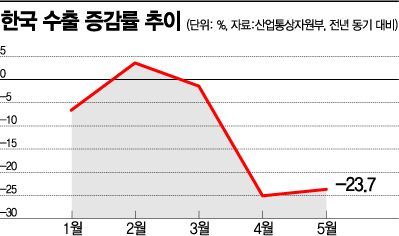
◆ Continued Decline in Exports... Trade Balance Turns Surplus = As a result of the COVID-19 impact, our export value in May fell by 23.7% compared to the same month last year, returning to levels seen a decade ago. This marks the first time since the 2009 financial crisis that exports have recorded a decline of over 20% for two consecutive months.
According to the 'May Export-Import Trends' released by the Ministry of Trade, Industry and Energy on the 1st, exports last month amounted to $34.86 billion, down 23.7% year-on-year. This is the lowest monthly figure since February 2010 ($33 billion). Imports were $34.42 billion, down 21.1%. Consequently, the trade balance turned to a surplus of $440 million after one month. The number of working days last month was 1.5 days fewer than the same period last year. Adjusted for working days, the average daily export was $1.621 billion, down 18.4% year-on-year.
Due to the global economic recession and reduced trade volume caused by COVID-19, our exports have continued a three-month streak of negative growth. In March and April, the declines were -1.4% and -25.1%, respectively. Although the decrease slightly narrowed in May compared to the previous month, exports still recorded a decline of over 20% for two consecutive months, delivering a direct blow to second-quarter exports. The last time exports fell by over 20% for two consecutive months was about 11 years ago during the financial crisis in July (-22.1%) and August (-20.9%) 2009. An official from the Ministry of Trade, Industry and Energy explained, "May exports declined due to the global economic downturn caused by COVID-19, a sharp drop in global demand, and a shortage of working days (1.5 days)."
◆ Despite Negative Streak... Government Says "Exports Will Rebound When Economy Recovers" = Looking at major items, 11 out of the top 15 export items decreased. Automobiles (-54.1%), petroleum products (-69.9%), and auto parts (-66.7%) were reduced by more than half compared to last year, and petrochemicals (-34.3%), general machinery (-27.8%), and home appliances (-37.0%) also showed poor performance. However, semiconductors, the largest export item, performed well by turning to growth in both total exports (7.1%) and average daily exports (14.5%) for the first time in 18 months. Biohealth exports such as diagnostic kits (59.4%) and computers (82.7%), which benefited from COVID-19, also showed strong performance. By country, major export destinations such as China (-2.8%), the United States (-29.3%), Japan (-28.8%), the Association of Southeast Asian Nations (ASEAN, -30.2%), the European Union (EU, -25.0%), and the Middle East (-25.7%) all showed negative growth.
The Ministry of Trade, Industry and Energy expects that the export slump in April and May is not due to a competitiveness problem of Korea, so export performance will improve as the economies of major countries recover. Minister Sung Yun-mo said, "The recent export slump is not due to structural problems such as a weakening of Korea's competitiveness," and added, "We believe exports will rebound when the economies of major importing countries recover." He further stated, "Exports to China have returned to pre-COVID-19 levels," and "Other countries such as the US and EU are also expected to recover to normal levels once the COVID-19 situation stabilizes."
◆ Experts Caution Against Optimism: "We Should Adopt a Conservative Outlook" = However, experts present a 'crisis theory,' arguing that the government’s optimism overlooks the need to fundamentally revise trade principles. This is because the global demand decline and trade contraction caused by COVID-19, along with the US-China conflict, are increasing uncertainty in the trade market. The US and China recently clashed over responsibility for COVID-19, and the relationship worsened further after the Chinese government pushed through legislation on the Hong Kong National Security Law. Additionally, since the government has not resolved the export restrictions issue with Japan, there is a prevailing opinion that rosy forecasts of export improvement should be approached with caution.
Professor Heo Yoon of Sogang University Graduate School of International Studies said, "The government seems to have been optimistic under the assumption that a series of events such as the US-China first phase agreement in January and the Hong Kong clashes would not worsen," adding, "Given that issues like the US-China conflict and a potential second COVID-19 pandemic can occur regularly, the government should adopt a more conservative outlook and take the lead in improving the overall situation."
Professor Jung In-kyo of Inha University’s Department of International Trade said, "This is a critical time to consider the worsening US-China conflict and the possibility of disruption in the China-centered global production system, so expecting export growth from the recovery of US and Chinese domestic markets is excessive," and pointed out, "Even if the Korean government files a complaint against Japan at the World Trade Organization (WTO) over export restrictions, the outcome is uncertain and it is difficult to be confident of winning."
There are also forecasts that Korea’s trade volume this year will struggle to reach $1 trillion (approximately 1,238 trillion KRW). The record of 'annual trade volume of $1 trillion' achieved for three consecutive years until last year is expected to be broken. According to a report released by the Bank of Korea on the same day, the annual trade volume this year is projected to decrease by 9.1% from last year to $950 billion (customs clearance basis). The Bank of Korea expects annual exports to decline by 8.5% to $496 billion (approximately 614 trillion KRW) and imports to fall by 9.8% to $454 billion (approximately 562 trillion KRW).
© The Asia Business Daily(www.asiae.co.kr). All rights reserved.


















