Social Venture Company Widaehan Sangsa Proposes Startup Sharing Time and Space
Focus on Reducing Startup Costs
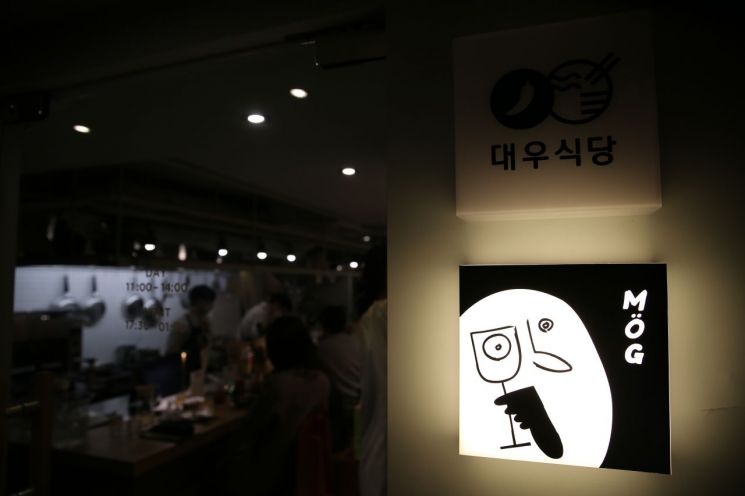
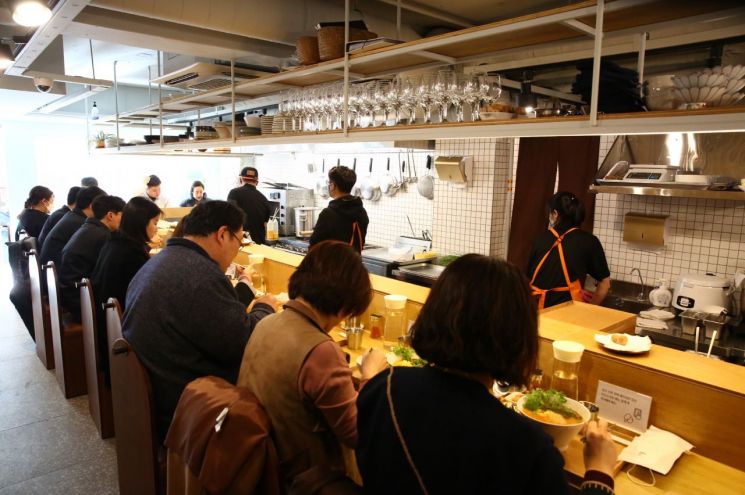 The shared restaurant in Seongdong-gu, Seoul, operated by the social venture company Widaehan Sangsa, welcomes customers as "Daewoo Sikdang," serving Jang Kalguksu during the day, and in the evening, it lights up the sign of the wine bar "Mog."
'Daewoo Sikdang' near Seongsu Station in Seongdong-gu, Seoul. Located in the heart of Seongsu-dong's cafe street, which is lined with newly opened cafes, this place is different by day and night. During the day, Daewoo Sikdang serves Gangwon-do style Jang Kalguksu (knife-cut noodle soup), and in the evening, the wine bar 'Mog' welcomes guests. After lunch service, simply sliding open the display cabinet door transforms the interior of the noodle restaurant into a wine bar. This business model, where two restaurants coexist in one establishment, was created by the social venture company Widaehan Sangsa. Widaehan Sangsa is also planning a 'shared restaurant' where five self-employed operators coexist in one space, including three delivery-only restaurants. Moving beyond shared kitchens to shared restaurants, they are presenting a new alternative in the dining startup market through various attempts to share the idle time and space of restaurants.
On the 1st, Kim Yugu, CEO of Widaehan Sangsa, said in an interview with Asia Economy, "We will continuously expand the shared restaurant model this year," adding, "We plan to open up to the 4th branch in Gangnam, Gwanghwamun, Jeju Island, etc., in the first half of the year, and aim for at least 10 branches by the end of this year." The business model of 'Nanuda Kitchen,' the shared restaurant brand operated by Widaehan Sangsa, is broadly divided into two types. One is sharing the space of a restaurant that operates only in the evening with entrepreneurs who want to operate during lunch hours. Nanuda Kitchen's role is to connect existing restaurants that want to utilize their closed lunch hours with self-employed entrepreneurs hoping to start a business. The other method is like Daewoo Sikdang and Mog, where different restaurants open and operate in the same place depending on the time of day. Since launching a time-based shared kitchen platform service in 2018, they have accumulated nearly 100 cases of sharing time and space in one restaurant for lunch-only shared restaurants. CEO Kim explained, "The lunch-only shared restaurant will surpass 100 branches next month," adding, "We receive 300 to 500 startup inquiries and 200 to 300 space rental inquiries every month."
As lunch-only shared restaurants have taken root, Nanuda Kitchen has expanded its business area this year to restaurants operated based on 'sharing' as the core foundation. Instead of renting space from other existing restaurants, they directly lease space and have two different restaurants open at different times in one place. CEO Kim explained, "The idea started from wanting to create a restaurant where multiple entrepreneurs can coexist beyond spatial constraints." The shared restaurant in Seongsu-dong, where Daewoo Sikdang and Mog share day and night, opened as the first branch in February. Although it was during the time when COVID-19 began to spread fiercely, the restaurant quickly established itself. Kim introduced, "The directly operated Daewoo Sikdang serves about three lunch shifts, and Mog has become a local hotspot among residents."
CEO Kim is developing the shared restaurant model with the determination to solve the widespread problem of space inefficiency in the dining industry. He explained, "Although a lot of cost is spent to prepare dining spaces, their utilization was not efficient," adding, "We focused on connecting idle spaces to those who need them to create value and reduce costs for entrepreneurs challenging the dining industry." This is why they are planning a model where five self-employed operators share one space, including two restaurants and three delivery-type kitchens.
Nanuda Kitchen not only arranges sharing but also provides operational solutions for entrepreneurs. They develop and provide brands and recipes for lunch operations and use IT technology based on deep learning to offer data on commercial district analysis, expected sales, appropriate rentals, and things to avoid. Recently, they launched a 'shared kitchen startup matching platform service' that allows entrepreneurs to check store conditions and commercial district analysis information and select stores and startup brands themselves. This service incorporates machine learning-based commercial district analysis exclusively for shared kitchens, based on nationwide licensing data, national pension subscription business records, small business data, Ministry of Land, Infrastructure and Transport real estate transaction data, and KB Card sales data.
Through this shared economy model, CEO Kim's strategy is to pioneer a pre (preliminary) startup market where entrepreneurs can try with small capital before full-scale startup. They aim to establish themselves as a shared-based retail management company that provides a testbed for consumer startups to minimize initial risks. CEO Kim emphasized, "Initial costs and risks of dining startups can be reduced by optimizing space," adding, "Since dining startups are a difficult and complex market, a market where one can test and prove business models before moving on to full startup stages must be created to foster a healthy dining startup culture."
© The Asia Business Daily(www.asiae.co.kr). All rights reserved.


















