COVID-19 New Cases Today 35... Below 50 for Three Consecutive Days
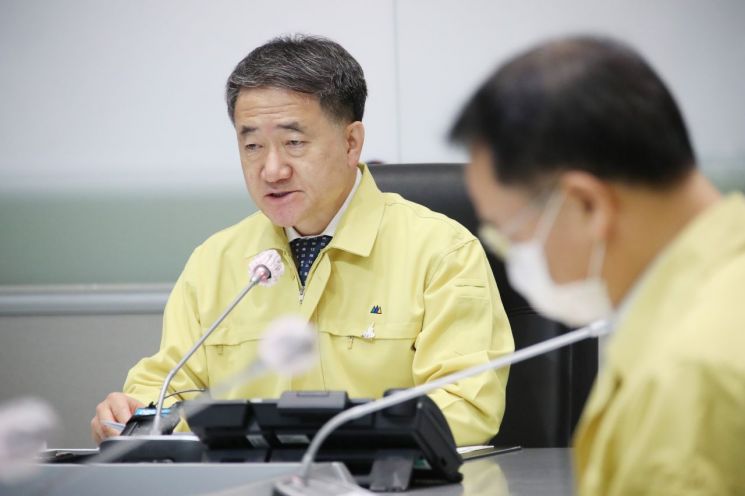 Park Neung-hoo, First Deputy Head of the Central Disaster and Safety Countermeasures Headquarters (Minister of Health and Welfare), is speaking at the Central Disaster and Safety Situation Room Seoul Situation Center in the Government Seoul Office Building during the COVID-19 response meeting on the morning of the 1st.
 [Asia Economy Reporter Choi Dae-yeol] The number of new confirmed cases of the novel coronavirus infection (COVID-19) in South Korea has remained below 50 for three consecutive days. After the cluster infection at the Bucheon Coupang logistics center was confirmed, the daily new cases rose to 79 but have since been on a downward trend. However, the government emphasized that it is not a situation to be complacent about, as similar incidents could occur at any time.
According to the Central Disaster and Safety Countermeasures Headquarters on the 1st, the number of newly identified COVID-19 patients in the previous day was 35, maintaining below 50 for three consecutive days following 39 cases on the 30th and 27 cases on the 31st of last month. Having fewer than 50 new cases per day is one of the criteria for maintaining social distancing in daily life, also known as the daily quarantine system.
Before the meeting on the 1st, Park Neung-hoo, the first head of the Central Disaster and Safety Countermeasures Headquarters, said, "Although the number of confirmed cases has somewhat decreased after the report of the cluster infection at the logistics center, it is still not a situation to be relieved," adding, "Cases with unclear transmission routes are increasing, and sporadic infections are occurring in academies, religious small gatherings, and so on." He continued, "It is a tense phase where cluster infections similar to the logistics center case can occur unexpectedly at any time."
At the Coupang logistics center, after the first patient was identified on the 23rd of last month, more than 100 cases were confirmed within six days, spreading into a large-scale cluster infection. However, compared to the cluster infection incident at the Itaewon clubs in Seoul earlier this month, contact tracing was conducted more quickly, and it is evaluated that the authorities have brought the situation somewhat under control.
To strengthen quarantine management, the government started a pilot project for an electronic entry log system from this day to more quickly identify visitors to high-risk facilities, and discussed operating regional emergency support teams for screening clinics at the meeting. The electronic entry log system collects personal information of visitors to facilities with high risk of cluster infections, such as clubs, karaoke rooms, and indoor sports facilities, using QR codes. The pilot will be applied in Seoul, Incheon, and Daejeon for one week and then expanded nationwide after the 10th.
The regional emergency support teams for screening clinics are organizations that provide support when a cluster infection occurs in a specific area and a large number of diagnostic tests need to be conducted within a short period. In cases like the Itaewon clubs or Coupang logistics center, thousands of people may need to be tested after identifying initial patients with potential cluster infections, and existing screening clinics alone may struggle to handle the sudden increase in testing volume. Park said, "If emergency support teams operate according to the conditions of each province and city, it will be possible to respond more swiftly immediately after a situation arises."
© The Asia Business Daily(www.asiae.co.kr). All rights reserved.

















