Ministry of Industry "Will Soon Announce Government Position on Japan's Regulations"
Expert "Cannot Guarantee Victory Even at WTO... Time to Present New Trade Principles"
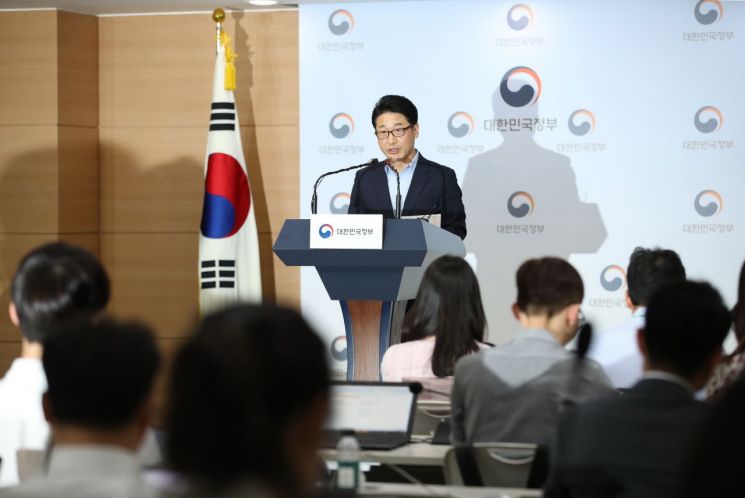 Lee Ho-hyun, Director General for Trade Policy, Ministry of Trade, Industry and Energy. (Photo by Yonhap News)
[Asia Economy Reporter Moon Chaeseok] Our government requested a response by the 31st of last month regarding the lifting of export regulations, but Japan remained silent. There is a possibility that South Korea will resume the World Trade Organization (WTO) litigation process, which was suspended last year. However, experts point out that the effectiveness of WTO litigation is limited and that the government has few cards to play.
On the 1st, a Ministry of Trade, Industry and Energy official stated, "Until the 31st of last month, the Japanese government did not provide any particular response to the South Korean government's urging," adding, "The government will soon announce its position on Japan's regulations."
On the 12th of last month, our government urged Japan to present a concrete position by the end of this month on easing regulations on three items?EUV resist, fluorinated polyimide, and hydrogen fluoride (transitioning from individual licensing to general licensing)?and on resolving issues related to South Korea's removal from Japan's whitelist (countries receiving preferential export screening for security reasons).
When Japan began export regulations in July last year, it cited three reasons: suspension of Korea-Japan policy dialogue, inadequate catch-all controls on conventional weapons, and insufficient export control organization and personnel. Our government pressured Japan, stating that all issues raised by Japan had been improved, so there was no justification to continue the strengthened export regulations.
Experts believe that Japan is unlikely to take a proactive stance in the near future. Since Japan's measures began as retaliation for the South Korean Supreme Court's ruling on forced labor compensation during the Japanese colonial period, it is difficult to expect a change in Japan's attitude without resolving the diplomatic issue.
This has increased the South Korean government's concerns. For now, since Japan has not provided any response, there is a possibility that South Korea will file a complaint with the WTO.
In July last year, when Japan started export regulations, South Korea filed a complaint with the WTO, claiming Japan violated free trade principles, but suspended the litigation process in November of the same year when the Korea-Japan General Security of Military Information Agreement (GSOMIA) termination was deferred.
If South Korea, as the complainant, requests the WTO to establish a panel, the process will restart, and it usually takes about two years to reach a first-instance ruling. If both countries reject the panel report, the Appellate Body makes the final decision. However, six of the seven WTO appellate body members are vacant, effectively paralyzing the appellate body, and since the U.S. strongly demands reform of the appellate body, it is expected to take considerable time before normalization.
Going a step further, the government could also consider reactivating the GSOMIA termination card it had deferred, but since the U.S. opposes this, re-pursuing it does not seem easy.
According to major foreign media, U.S. President Donald Trump expressed on the 30th of last month (local time) his intention to postpone the Group of Seven (G7) summit, originally scheduled for the end of this month, to around September and expressed a desire to invite South Korea as well.
Experts observe that in a situation where U.S.-China conflicts are expanding and prolonging not only in trade but also in security, finance, currency, and technology, it will be difficult for South Korea, which is at the center of the U.S. 'Indo-Pacific' security strategy, to ignore these developments.
Professor Jung In-gyo of Inha University's Department of International Trade said, "Even if we file a WTO complaint, winning is a separate issue, and it is hard to be confident that we will win," adding, "Japan is linking the individual licensing system for the three major regulated items with political issues such as 'forced labor' to pressure South Korea, so it is difficult to resolve the 'strategic materials' issue separately. Therefore, it is time to establish clear trade principles at the national level, considering the process of reorganizing the international order."
© The Asia Business Daily(www.asiae.co.kr). All rights reserved.

















