Economic Policy Directions for the Second Half of 2020
IMF: Rebound Not as Large Compared to Right After the Financial Crisis
Experts Say "Nike-Shaped Rebound Rather Than V-Shaped"
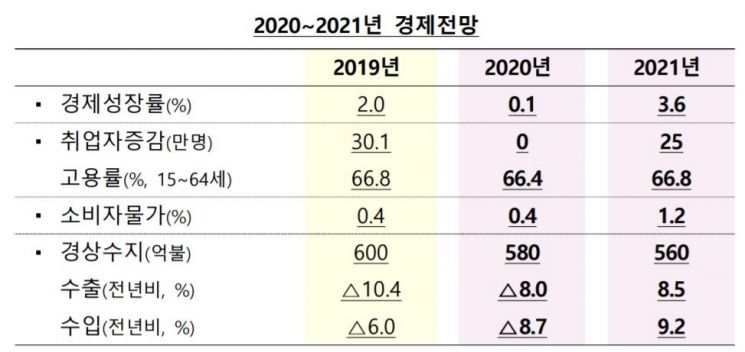
[Asia Economy Reporter Kim Eun-byeol] The government forecasted that South Korea's economic growth rate will barely maintain a positive figure this year despite the impact of the novel coronavirus disease (COVID-19), but it estimated a rebound to 3.6% next year. This projection indicates a higher growth rate compared to this year as well as last year.
On the 1st, the government announced in the "2020 Second Half Economic Policy Direction" that the economic growth rate for this year is expected to be 0.1%. This represents a sharp decline compared to last year's growth rate of 2.0%. While global investment banks (IBs) and financial institutions predicted a negative growth rate for South Korea, the government expects a barely positive growth.
However, unlike the pessimistic economic outlook for this year, the growth rate is expected to rise next year. The government’s forecast for next year’s growth rate is 3.6%, higher than last year.
Earlier last week, the Bank of Korea projected this year’s economic growth rate at -0.2% and expected next year’s growth rate to be 3.1%. The government’s estimate is more optimistic than the Bank of Korea’s forecast for next year.
Consumer prices are expected to rise by 1.2% next year, indicating a sharp increase in inflation. This inflation forecast is slightly higher than the Bank of Korea’s projection of 1.1% for next year. Employment is expected to increase by 250,000 people annually, and the current account balance is projected to reach $56 billion.
Although the government expects next year’s growth rate to rebound compared to this year, it is difficult to interpret this as a "V-shaped recovery."
Looking at the annual growth rate trends during previous crises, the growth rate typically rebounded much more sharply the year after the crisis passed. During the 1998 Asian financial crisis, the growth rate was -5.1%, but it surged to 11.5% in 1999. During the global financial crisis, the growth rate was 0.8% in 2008, but it jumped to 6.8% in 2009.
Lee Hwan-seok, Deputy Governor and Director of the Research Department at the Bank of Korea, explained at the economic outlook briefing, "(Next year’s economic recovery) is a base effect resulting from this year’s sharp decline in growth due to the impact of COVID-19," adding, "it is difficult to consider this a so-called V-shaped recovery." He further stated, "Although the growth rate is expected to be -0.2% this year and 3.1% next year, it is hard to see this as a rapid recovery. Numerically, it looks high, but it mainly reflects a rebound from this year’s decline."
Experts expect that even if the spread of COVID-19 subsides, overseas countries such as the United States and Europe will gradually lift lockdown measures, so South Korea’s private consumption and exports will also ease gradually and recover moderately from the third quarter onward. This is the so-called "Nike-shaped" recovery.
The Korea Development Institute (KDI), a government-affiliated policy research institute under the Ministry of Economy and Finance, forecasted that South Korea’s growth rate will fall to 0.2% this year but rebound to 3.9% next year. This projection assumes that the spread of COVID-19 will slow down domestically from the first half of the year and globally from the second half, with economic activities gradually normalizing. The import price of crude oil (Dubai crude) is expected to fall about 45% this year to around $35 per barrel and to be around $40 next year. The Korean won is expected to depreciate about 4% this year with little fluctuation next year, based on which the forecast was estimated.
The International Monetary Fund (IMF) predicted South Korea’s growth rate to be -1.2% this year but projected a 3.4% growth rate next year. The IMF’s forecast for this year’s growth rate in South Korea shows a smaller decline compared to other countries, but the rebound in growth rate next year is not large. This reflects South Korea’s economic structure with a high export ratio. The IMF expects the global economy to grow 5.8% next year, with the United States (4.7%), Germany (5.2%), the United Kingdom (4%), and Japan (3%) all achieving growth rates above 3%.
The IMF’s forecast is based on the assumption that COVID-19 will subside after the second half of this year and that the international community will endure the crisis through close cooperation and active fiscal and monetary policies. The government also added a caveat to its economic outlook, stating that growth rates could change depending on the COVID-19 situation. The government said, "If cluster infections of COVID-19 reoccur or a second large-scale outbreak occurs in winter, it could act as an additional downside risk to the growth trajectory."
© The Asia Business Daily(www.asiae.co.kr). All rights reserved.

















