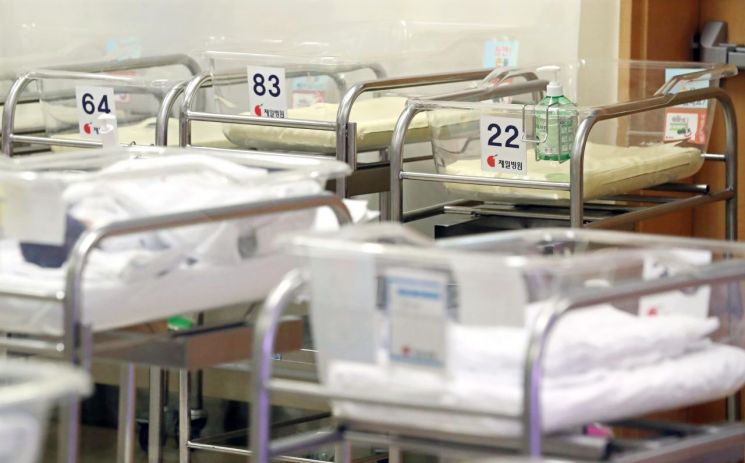
[Asia Economy Reporter Kim Hyunjung] This year, South Korea's population is expected to decline for the first time in history. With the number of births plummeting and the number of deaths increasing relatively faster, this year is likely to mark a turning point for the natural decrease in the domestic population.
According to Statistics Korea on the 31st, the number of births nationwide in March was 24,378, a decrease of 2,738 (10.1%) compared to the previous year, continuing a year-on-year decline for 52 consecutive months since December 2015. Births are heavily influenced by seasonal factors, so comparisons are usually made month-to-month. The 24,378 births in March represent the lowest number recorded since related statistics began in 1981. For the first quarter, the number of births was also the lowest on record at 74,050, a sharp drop of 9,179 (11.0%) compared to the previous year.
On the other hand, the number of deaths in March was 25,879, an increase of 895 (3.6%) from a year earlier. The number of deaths was also the second highest ever recorded for March since 1983, following 2015 (26,493). For the first quarter, deaths totaled 79,769, up 4,494 (6.0%) from the previous year.
As a result, the natural population increase, calculated by subtracting deaths from births in March, was -1,501 (-0.3%), marking the first time since statistics began in 1983 that the figure declined (for March). The natural population increase has been negative for five consecutive months since November last year, the first such occurrence since the statistics began in 1983.
The total fertility rate, which represents the expected number of children a woman will have in her lifetime, was 0.90 in the first quarter of this year, down 0.12 from the same period last year. This is the lowest level recorded for the first quarter since 2009. Last year, the total fertility rates were 1.02 in Q1, 0.92 in Q2, 0.89 in Q3, and 0.85 in Q4. South Korea's total fertility rate remains less than half of the 2.1 rate needed to maintain the population. South Korea is the only country among the OECD where the total fertility rate has fallen below 1.0 for two consecutive years.
The number of marriages in March was 19,359, down 190 (1.0%) from the previous year, while divorces numbered 7,298, a decrease of 1,773 (19.5%) during the same period.
If the current trend continues, the population is likely to experience a natural decrease for the first time in statistical history this year. Kim Jin, head of the Population Trends Division at Statistics Korea, said, "The natural decrease in population in the first quarter is unprecedented," adding, "There is a high possibility that the annual population will experience a natural decrease for the first time this year."
© The Asia Business Daily(www.asiae.co.kr). All rights reserved.
!["The Woman Who Threw Herself into the Water Clutching a Stolen Dior Bag"...A Grotesque Success Story That Shakes the Korean Psyche [Slate]](https://cwcontent.asiae.co.kr/asiaresize/183/2026021902243444107_1771435474.jpg)
















