Discussion on the Global Impact of COVID-19 and Alternative Prospects
Comprehensive Support for Developing Countries Needed to Eradicate Infectious Diseases
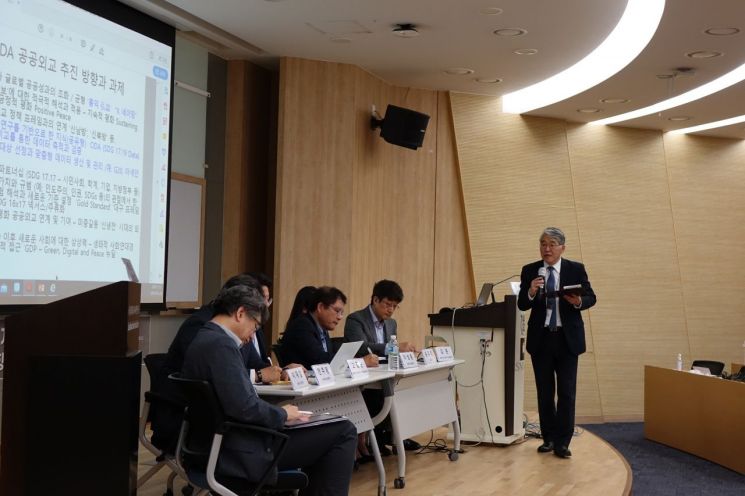
[Asia Economy Reporter Lim Cheol-young] An academic conference was held to comprehensively assess the global impact of the novel coronavirus disease (COVID-19) and to derive South Korea's public diplomacy and international development cooperation strategies in the post-COVID era.
KOICA (Korea International Cooperation Agency) and the Seoul National University COVID Research Network jointly held an academic conference on the 29th under the theme "COVID-19, Global Impact and Alternative Prospects," the two organizations announced on the 31st.
In April, the two organizations held academic conferences on the formation and prospects of disaster governance, and in May on cluster infections and responses in Asia and Africa. At this conference, experts from key fields such as health, politics, and society gathered to explore the impact of COVID-19 on the restructuring of the global economic and social systems and to seek alternative prospects based on the outcomes of previous conferences.
The first session was chaired by Professor Jeong Geun-sik and consisted of expert diagnoses on the domestic and international impacts of COVID-19 on society. Professor Kim Hyun-jung proposed an untact (non-face-to-face) fever management method that can proactively respond to infectious diseases, while Professor Park Jong-hee explored the crisis of globalization caused by the spread of COVID-19 and the future direction of South Korean diplomacy. Professor Lee Jae-yeol presented on the themes of publicness and risk governance. Professor Koo In-hoe assessed various social protection measures in the context of an infectious disease outbreak. Professor Yoo Myung-soon examined the social and psychological distances created by COVID-19, and Professor Kim Joon presented the triple challenges and prospects of COVID-19 response from a complex systems perspective.
The second session was moderated by Director Song Jin-ho of KOICA’s Social Value Management Headquarters. KOICA researcher Yoon Yu-ri raised the necessity of development cooperation projects utilizing innovative technologies of the Fourth Industrial Revolution. Cheon Joo-hwan, head of the Global Development Cooperation Division at the Korea International Health and Medical Foundation, examined the impact of the COVID-19 pandemic on international development cooperation in the health sector. Professor Ko Gil-gon introduced reconstruction strategies for developing countries through policy innovation after COVID-19, and Professor Lee Sung-hoon explored the direction of ODA and public diplomacy post-COVID-19.
KOICA researcher Yoon Yu-ri, who presented on the Fourth Industrial Revolution and international development cooperation, stated, “With the shift to a non-face-to-face society due to COVID-19, such as telecommuting and online classes, the era of the Fourth Industrial Revolution utilizing innovative technologies and data will be accelerated. Although the use of innovative technologies in development cooperation is still insufficient, it is now necessary to have concrete discussions on technology transfer to developing countries alongside the development of projects using advanced technologies of the Fourth Industrial Revolution.”
Cheon Joo-hwan, head of the Global Development Cooperation Division at the Korea International Health and Medical Foundation, noted that since the outbreak of COVID-19, global quarantine capacities have been concentrated on COVID-19, resulting in decreased budgets and supply of medicines for other infectious diseases. He emphasized, “Rather than focusing support intensively on specific areas, comprehensive support is needed to strengthen health care systems in connection with existing development cooperation projects.”
Professor Ko Gil-gon explained, “Due to COVID-19, the economies of emerging countries have deteriorated, which will have a negative impact on South Korea, which is highly dependent on international trade. After COVID-19, not only economic damage but also political and social shocks will be significant.”
Professor Lee Sung-hoon said, “We should not approach COVID-19 simply as a virus but consider how to respond within the existing SDGs* framework. There are already formulas within the SDGs that link health and well-being (SDG 3) goals related to infectious disease eradication with governance (SDG 16) and partnerships (SDG 17), so international responses referencing these are necessary.”
Director Song Jin-ho of KOICA’s Social Value Management Headquarters, who moderated the second session, emphasized, “It is important to enhance capabilities for global resilience in the post-COVID era through systematic database (DB) management such as accumulation and verification of data from development cooperation sites.”
Meanwhile, to comply with social distancing due to COVID-19, this academic conference was broadcast live online and can be viewed again on the Seoul National University Asia Center website.
© The Asia Business Daily(www.asiae.co.kr). All rights reserved.
![User Who Sold Erroneously Deposited Bitcoins to Repay Debt and Fund Entertainment... What Did the Supreme Court Decide in 2021? [Legal Issue Check]](https://cwcontent.asiae.co.kr/asiaresize/183/2026020910431234020_1770601391.png)
















