Strengthening Strategic Global Partnership for Reuse of Electric Vehicle Battery Energy Storage Systems
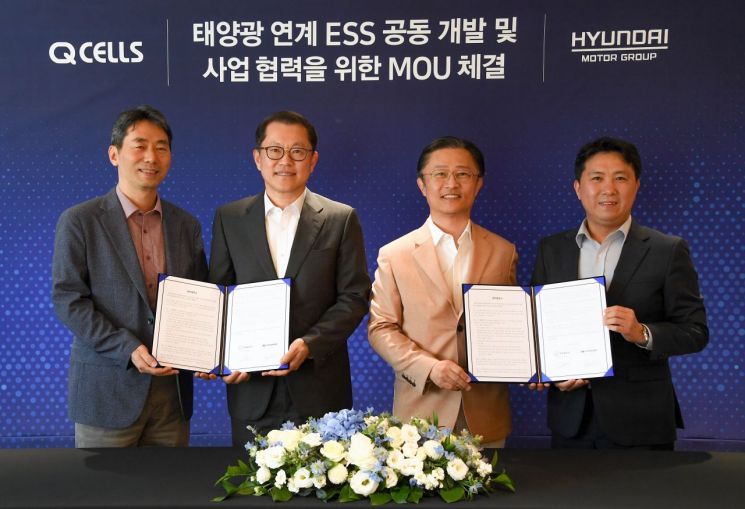 From the left, Oh Jae-hyuk, Executive Director of Hyundai Motor Group; Kim Hee-chul, President of Hanwha Q CELLS; Ji Young-jo, President of Hyundai Motor Group; and Hong Jeong-kwon, Executive Director of Hanwha Q CELLS are posing for a commemorative photo. (Photo by Hyundai Motor Group)
[Asia Economy Reporter Kim Ji-hee] Hyundai Motor Group and Hanwha Q CELLS are promoting strategic cooperation for the joint development and global business of solar power-linked energy storage systems (ESS) based on reused electric vehicle batteries.
Hyundai Motor Group and Hanwha Q CELLS announced on the 31st that they signed a business agreement for "joint development and business cooperation of solar power-linked ESS" at the Hanwha Group headquarters building in Jung-gu, Seoul on the 29th. The signing ceremony was attended by executives including Ji Young-jo, President of Hyundai Motor Group, and Kim Hee-chul, President of Hanwha Q CELLS. This agreement focuses on new business cooperation linking batteries recovered from electric vehicles with solar power systems. The core elements include joint development of home and power ESS products based on reused electric vehicle batteries, demonstration projects using solar power plants at Hanwha Q CELLS’ research center in Germany, pilot sales utilizing both companies’ customers and infrastructure, and joint discovery and execution of large-scale solar power-linked ESS projects.
As the share of renewable energy such as solar power increases worldwide, the demand for ESS, which helps efficiently use renewable energy, is also growing. According to Bloomberg New Energy Finance (BNEF), with the share of renewable energy generation expected to expand to 40% by 2040, the global ESS market, which was about 3 GWh (gigawatt-hours) in 2017, is projected to grow approximately 128 times to around 379 GWh by 2040. The high price of ESS using existing lithium-ion batteries has been somewhat a barrier to initial system adoption.
The ESS jointly developed by Hyundai Motor Group and Hanwha Q CELLS is a solution that can significantly reduce system construction costs by reusing electric vehicle batteries, enabling large-scale ESS distribution. Hyundai Motor Group expects to contribute to the spread of renewable energy in the future by launching a price-competitive system through this cooperation.
President Ji Young-jo said, "Through this cooperation, we will effectively minimize the variability of renewable energy supply, activate large-scale dissemination of renewable energy, and maximize the reuse of electric vehicle batteries to complete the eco-friendly value chain of electric vehicles." President Kim Hee-chul stated, "Through this cooperation, we will share excellent R&D capabilities between the two companies and strengthen our position in the global energy market as a total energy solution company providing everything from solar modules to ESS through competitive product development."
Simultaneously with the MOU, the two companies signed a Joint Development Agreement (JDA) to begin joint development of solar power-linked home and power ESS targeting the European and North American markets. Hyundai Motor Group plans to develop products with secured performance and safety through interface design of each facility and joint design of protection cooperation control.
Jae-hyuk Oh, Executive Director of Hyundai Motor Group’s Future Technology Research Division, said, "Through this JDA, the two companies will secure solar power and other eco-friendly renewable energy-linked ESS products with safety, customer convenience, and price competitiveness, and accelerate entry into the global market."
© The Asia Business Daily(www.asiae.co.kr). All rights reserved.

















