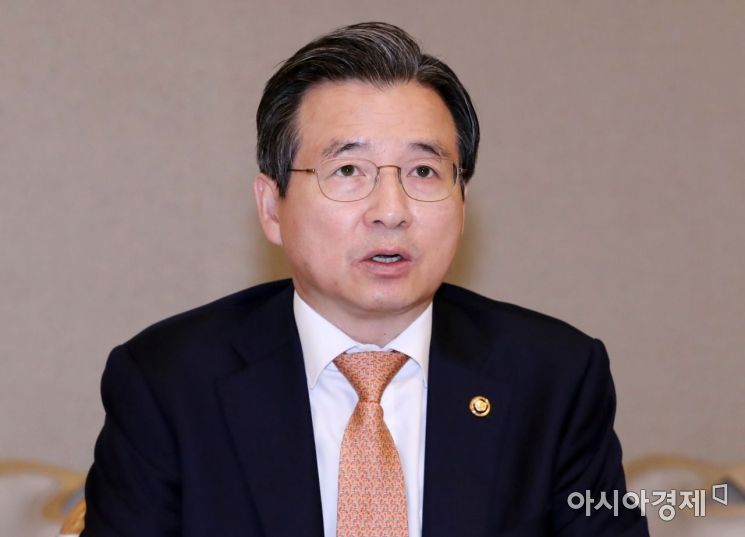
 Kim Yong-beom, the 1st Vice Minister of the Ministry of Economy and Finance, is delivering opening remarks at the "12th Innovation Growth Strategy Review Meeting and Policy Review Meeting" held at the Government Seoul Office in Jongno-gu, Seoul on the 29th. Photo by Kang Jin-hyung aymsdream@
[Asia Economy Reporter Kim Hyunjung] Kim Yongbeom, the 1st Vice Minister of the Ministry of Economy and Finance, stated on the 30th regarding the economic crisis caused by the spread of the novel coronavirus infection (COVID-19), "The best scenario for now is a rebound after about two quarters of negative growth."
He said on his Facebook that day, "The COVID-19 pandemic is a once-in-a-century event, and the deep recession of the global economy is inevitable with the shock so far," emphasizing, "What we really need to avoid is the risk of a prolonged recession."
However, he expressed concerns about the situation that may arise if the economy does not recover even after the unprecedented temporary support programs by governments through fiscal measures. He wrote, "The temporary support programs urgently introduced by many countries will expire after a few months," adding, "If the economy does not properly recover after that, the difficulties of households running out of cash will become a harsher reality." He continued, "That will be the true test of whether the economy has the strength to withstand the COVID-19 shock and whether the financial markets will maintain a solid flow," stressing, "If large-scale support programs are extended further, the economic shock will decrease, but even in that case, there will inevitably be a fundamentally different debate about the limits of fiscal policy and who will share the enormous burden."
He also assessed that, as a result of the record-scale fiscal injections by countries around the world, fortunately, the COVID-19 crisis has not escalated into a financial crisis. Vice Minister Kim said, "There are claims that the COVID-19 crisis is a bigger shock than the Great Depression, but fortunately, it has not yet turned into a financial crisis," adding, "There are chilling testimonies emerging gradually after the fact that the global financial markets were on the verge of cardiac arrest in mid to late March, when it felt like we were at war, but the global financial markets have overcome the worst crisis and are now in a stabilization phase."
He credited "the bold and agile policy responses of central banks and fiscal authorities of each country," mentioning the economic adaptability and resilience based on the US $1,200 disaster relief payments and unemployment benefits system, the €750 billion European rescue fund under discussion in Europe, and the crisis response capabilities of emerging countries.
Introducing some forecasts that anticipate the end of globalization due to the COVID-19 aftermath, he said, "Watching the conflict unfolding between the US and China right before our eyes, such observations do not sound like empty words," but emphasized, "However, I believe in the inertia and resilience that the whole world, after initial confusion in the unprecedented pandemic shock, has upgraded the institutions built over time in a short period to cope." He further diagnosed, "The world is already too deeply and complexly intertwined to return to a fortress society where each lives on its own."
Vice Minister Kim added, "The second quarter, which is expected to be the most economically difficult quarter, has already passed two months and June is just ahead," saying, "We welcome the new month with mixed feelings of excitement that discharge is not far off and worries that the pain may return once the effect of painkillers wears off."
© The Asia Business Daily(www.asiae.co.kr). All rights reserved.
![Clutching a Stolen Dior Bag, Saying "I Hate Being Poor but Real"... The Grotesque Con of a "Human Knockoff" [Slate]](https://cwcontent.asiae.co.kr/asiaresize/183/2026021902243444107_1771435474.jpg)
















