May 1, 'May Export-Import Trends' Announcement Ahead
Must First Resolve Comprehensive Settlement with Japan on '3 Major Items'
Attention Also on Late June GVC Restructuring Measures Announcement
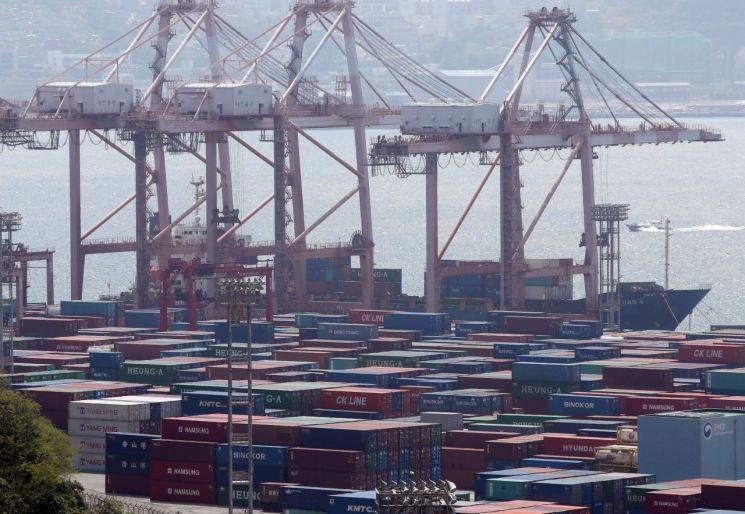
[Asia Economy Reporter Moon Chaeseok] South Korea's export and trade sector must deliver results in June through trade negotiations with Japan and the restructuring of the global value chain (GVC). There is a continuous call for rigorous reforms to elicit concrete declarations from companies aiming to reorganize the GVC, often referred to as 'de-Chinaization.'
According to related government departments on the 31st, the Ministry of Trade, Industry and Energy will announce last month's export-import performance on the 1st. Both the entire month of April and the period from the 1st to the 20th of last month showed a decline of over 20% compared to the same period last year.
The outlook is not very optimistic. On the 29th, Statistics Korea released the 'April Industrial Activity Trends,' signaling that the impact of the novel coronavirus disease (COVID-19) is spreading significantly in the manufacturing sector.
Manufacturing production decreased by 6.4% compared to the previous month, marking the largest drop since December 2008, right after the global financial crisis, when it fell by 10.7%.
Disappointing performances in semiconductors and automobiles were particularly painful. Semiconductor production, including DRAM memory chips, dropped by 15.6%, the largest decline since December 2008's -16.9%. Recently, negative signals have appeared, such as semiconductor spot prices falling more than 10% month-over-month.
If COVID-19 persists, the overall performance for the second quarter could also remain negative. The automobile sector also stayed at -13.4%, affected by lockdowns and shutdowns in the US and Europe.
Experts generally agree that monthly performance is difficult to improve quickly due to global demand contraction and the pandemic's effects. The key will be how well the second quarter performs and whether there will be a 'V-shaped' rebound or a 'Nike swoosh-shaped' recovery in the third quarter and beyond.
Attention inevitably focuses on the government's mid- to long-term strategies. This includes how much the government can encourage corporate reshoring to avoid 'China risks' such as pandemics and guanxi (relationship-based networks), and further, whether it can promote job creation and win-win management between large corporations and SMEs, as well as among SMEs themselves. This is also where the government is pouring its utmost efforts to revive South Korea's economy.
As the government plans to announce GVC restructuring measures by the end of this month, corporate and market interest in easing regulations in the Seoul metropolitan area and corporate tax cuts is rising sharply.
Although some say the government has pulled out the card of easing factory location regulations in the metropolitan area, the government has not yet made any definitive policy announcements. According to related departments, the Ministry of Economy and Finance is reportedly reluctant regarding corporate tax cuts.
Turning to trade, the key is how much solidarity can be expanded with neighboring negotiating countries. Last month, achievements were made, including agreements on essential personnel movement with China, Vietnam, Singapore, Canada, Australia, and New Zealand. The next focus is Japan, but although the South Korean government demanded the restoration of Japan's export regulations by 'the end of this month,' no clear response has been received.
Experts explain that the 'stage is set' as the US is building the Economic Prosperity Network (EPN), often called the 'anti-China economic bloc,' drawing South Korea and Japan into an 'anti-China economic alliance.'
Even if Japan does not fully lift all export regulations, if it provides solutions regarding the three regulated items?EUV photoresists, fluorinated polyimide, and hydrogen fluoride?and the removal of South Korea from its whitelist (a preferential export screening list for security reasons), economic cooperation between the two countries could be unlocked.
The core justification for South Korea's demand for the 'lifting of export regulations' is that Japan changed the three items from a general licensing system to an individual licensing system on July 4 last year, and more than ten months of export transaction records have now accumulated.
South Korea has urged Japan to make a decision to revert to the general licensing system to minimize uncertainty for companies in both countries.
The Ministry of Trade, Industry and Energy is withholding comments on a 'Plan B' if Japan does not respond or rejects the demand by the end of this month. It is also cautious about the issue of filing a complaint with the World Trade Organization (WTO).
An official from the Ministry said, "We will continue communication efforts to induce a change in Japan's stance by the end of this month."
© The Asia Business Daily(www.asiae.co.kr). All rights reserved.
![From Hostess to Organ Seller to High Society... The Grotesque Scam of a "Human Counterfeit" Shaking the Korean Psyche [Slate]](https://cwcontent.asiae.co.kr/asiaresize/183/2026021902243444107_1771435474.jpg)
















