[Asia Economy Reporter Kim Yuri] The Seoul Metropolitan Government has completely overhauled the standards for establishing 'District Unit Plans,' which had been operated with an emphasis on urban development and securing infrastructure. This is the first revision in 20 years since the District Unit Plan was legislated in 2000.
The revision addresses the limitations of the previous plans, which were uniform regulations and flat plans, and reflects the paradigm shift in urban management from development to regeneration. It focuses on producing future-oriented plans that respond to new social issues such as climate change including heatwaves and fine dust, gentrification (dungjinaemollim), and balanced regional development.
Currently, a total of 466 District Unit Plan zones (98㎢) are designated and managed within Seoul. This accounts for 26% of Seoul’s urbanized area (372㎢), excluding green spaces. District Unit Plans are urban management plans systematically managing areas such as station zones, planned development sites, and regions with favorable environmental characteristics. They serve as an urban spatial management tool complementing the existing zoning system and have become a universal spatial planning guideline by being linked with various project plans such as redevelopment projects. Nevertheless, they have often been seen as regulations rather than planning tools and lacked responsiveness to changes in urban and social conditions.
When establishing and managing individual District Unit Plans, the 'Seoul District Unit Plan Establishment Standards' must be followed. This administrative guideline applies when constructing buildings within designated District Unit Plan zones. It serves as the standard for residents to request decisions or changes to the District Unit Plan and is used as a review (consultation) criterion by the Urban Architecture Joint Committee during the decision-making process.
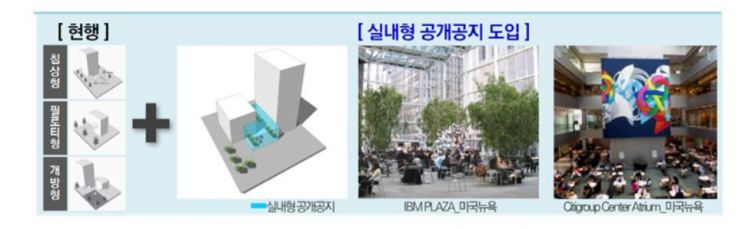
Going forward, when establishing District Unit Plans, it will be necessary to predict the future appearance of the area after development and present integrated goals and visions that encompass the entire region to ensure consistent development and management. Public open spaces, which were conventionally provided outdoors, can now also be created indoors to respond to heatwaves and fine dust.
The concept of 'Local Contribution Facilities,' which recognizes facilities with guaranteed public nature such as village libraries or childcare centers operated and owned by capable private entities as public contributions, will be introduced for the first time in Korea. This is expected to reduce the burden of donation and acceptance for private developers and the management and operation costs for the public sector, respectively.
On the 31st, Seoul announced that it will fully implement the revised 'Seoul District Unit Plan Establishment Standards' based on these contents and establish District Unit Plans as a sustainable urban management tool in the era of urban regeneration.
The main contents of the new 'Seoul District Unit Plan Establishment Standards' include ▲ establishment of an integrated district basic plan ▲ introduction of disaster safety and local (historical) asset preservation and utilization plans ▲ introduction of indoor-type public open spaces ▲ introduction of local management and resident proposal operation standards ▲ introduction of local contribution facilities ▲ increase in standard floor area ratio for semi-residential and commercial areas and restriction on non-residential ratios in semi-residential areas ▲ establishment of building coverage ratio plans, among others.
When establishing District Unit Plans, an 'Integrated District Basic Plan' will be created to comprehensively present the future vision of the entire district and the development goals of the area, ensuring predictability of the plan and inducing region-specific development.
New provisions have been added to establish a 'Disaster Safety Plan' that responds to climate change and a 'Local (Historical) Asset Preservation and Utilization Plan' that preserves the identity of the region, addressing new urban paradigms such as low growth and urban regeneration. Management and operation standards for post-monitoring have also been prepared. The 'Disaster Safety Plan' identifies areas vulnerable to disasters such as frequent flooding or fires in advance and establishes customized plans. In areas densely populated with wooden buildings such as hanok, plans can be made to secure sufficient firefighting facilities and enhance disaster resistance by treating exterior materials. The 'Local (Historical) Asset Preservation and Utilization Plan' requires investigation of cultural assets, industrial heritage, and historical cultural assets during the establishment of District Unit Plans and preparation of various preservation and utilization measures according to preservation value and utilization type.
Public open spaces, which must be installed for buildings above a certain size for public use, are mostly exposed outdoors. Seoul has newly introduced 'indoor-type public open spaces' that create resting areas in the form of building structures or inside buildings to provide shelter from heatwaves and fine dust.
'Local Management,' where local residents participate in maintaining or revitalizing the area, has also been introduced. This involves using public open spaces within the area to hold festivals or events. Residents who know the area well can propose management plans themselves or request the public to establish plans through newly established 'Resident Proposal Management and Operation Standards.' 'Local Management' is a plan where private parties such as land and building owners and residents establish and execute operation plans for maintenance and revitalization of the area themselves, concretizing cooperation with the public. The 'Resident Proposal Operation Standards' will be piloted and institutionalized as a bottom-up District Unit Plan operation method where the public supports residents’ requests for plan establishment, especially in plan management and preservation regeneration type District Unit Plans that require maintenance of existing urban organizations.
The 'Local Contribution Facilities,' introduced for the first time nationwide, allow private ownership of facilities that have public nature but are more efficiently operated by private capabilities than by public ownership. The public contribution burden rate will be eased within a 5% range, reducing the burden on both public and private sectors.
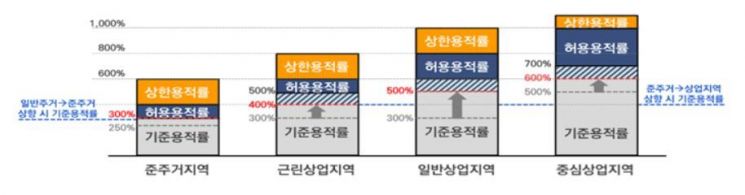
In response to criticisms of excessive floor area ratio differences within the same zone and land use area, which lacked fairness and effectiveness, the standard floor area ratios for semi-residential and commercial areas will be increased by 50-200% to reflect reality. Regardless of whether the land use area is upgraded, the residential ratio in semi-residential areas will be raised to 90% to reduce difficulties caused by vacant commercial spaces and enhance the effect of urban housing supply. The standard floor area ratio for semi-residential areas will be adjusted from 250-300% to 300%, and for general commercial areas from 300-600% to 500-600%. For semi-industrial areas, where it was difficult to apply floor area ratio incentives for plan inducement, standards have been established to link public open space installation with public-oriented plans and apply maximum floor area ratios to improve fairness.
The 'Building Coverage Ratio Plan' has been codified in District Unit Plans to actively induce regeneration and development by relaxing building coverage ratios in commercial streets densely populated with small lots or areas requiring street revitalization. Additionally, 'Special Planning Zones,' which were designated at excessively large scales or lacked subdivision implementation standards, reducing plan feasibility, will have their designated areas reduced (vacant lots and relocation sites from 5,000㎡ to 3,000㎡, small lot joint development from 3,000㎡ to 1,000㎡) to promote active development and management.
Seoul has prepared the fully revised 'Seoul District Unit Plan Establishment Standards' in the form of a manual to make it easier to understand and enable diverse use by the 25 autonomous district offices, private urban planning companies, and general citizens. It can be accessed on the Seoul Urban Planning Portal.
In addition to these improvements, Seoul plans to actively discover and continuously promote institutional improvements such as introducing cash donations for balanced development and relaxing building coverage ratios to revitalize low-rise streets. If necessary, after review and consultation among related services, institutions, and departments, legal and guideline revisions will also be pursued.
Mayor Park Won-soon of Seoul said, "Although District Unit Plans are urban management tools that greatly affect citizens' lives and the city's future, they have long been trapped in past paradigms. This time, Seoul will take the lead in completely overhauling the standards for establishing District Unit Plans and provide detailed explanatory manuals to strengthen the execution power of plans." He added, "We expect this to be an opportunity for District Unit Plans to leap from development-era regulation-centered plans to region-customized plans in the urban regeneration era."
© The Asia Business Daily(www.asiae.co.kr). All rights reserved.