Received a Plaque of Appreciation from the National Health Insurance Service for Contributing to Health Promotion and Life Stability of Vulnerable Groups... Targeting Those Aged 65 and Over, Single Parents, and Disabled with Monthly Insurance Premiums Below 15,410 Won in the Region
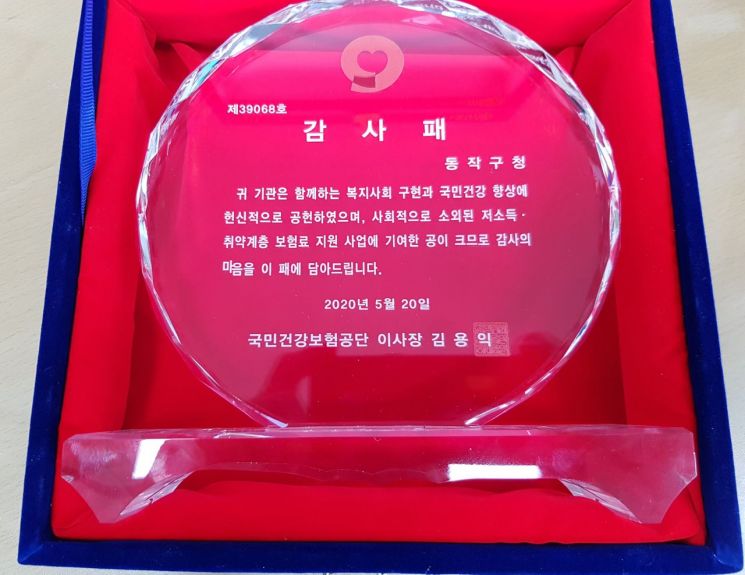
[Asia Economy Reporter Jongil Park] Dongjak-gu (Mayor Changwoo Lee) announced on the 29th that it received a plaque of appreciation on the 28th from the National Health Insurance Service for actively promoting the National Health Insurance premium support project for low-income and vulnerable groups.
This award was given to 12 local governments selected among 226 nationwide for their significant contributions to realizing a welfare society together, improving public health, and supporting insurance premium projects for socially disadvantaged groups.
Last year, the district revised the Ordinance on Support for National Health Insurance Premiums for Low-Income Residents of Dongjak-gu, Seoul, and is providing full monthly premium support from district funds to eligible recipients.
The eligible recipients are Dongjak-gu regional subscribers whose premium assessment amount is 15,410 KRW or less per month, including households with seniors aged 65 or older, single-parent families, persons with disabilities, and chronic disease patients. Last year, support was provided to 25,119 households totaling 203.72 million KRW.
The district received high evaluations for expanding premium support for low-income groups through the ordinance revision and contributing to health promotion and livelihood stability for low-income residents.
Going forward, the district plans to actively identify vulnerable groups facing difficulties with premiums and continuously expand the scope and amount of premium support.
Additionally, the district operates a Medical Benefits Case Management project. By employing three skilled medical benefits managers, it establishes step-by-step safety measures and analyzes the medical usage patterns of 8,200 medical benefits recipients. Through phone and in-person consultations and education, it contributes to improving recipients’ health and reducing medical benefit expenses.
Last year, the district also held “Medical Benefits System Briefings” for new recipients in the first and second halves of the year to enhance their health management capabilities.
The medical benefits managers provided essential information such as ▲ medical benefits usage procedures ▲ approval for extension of benefit days ▲ the choice of medical institutions system, while professional pharmacists educated on potential issues from drug misuse and proper medication intake methods.
Choi Hogyu, Director of the Social Welfare Division, stated, “We will continue to strengthen protection for low-income and vulnerable groups and strive to improve welfare for residents living in medical blind spots to ensure their healthy and happy lives.”
© The Asia Business Daily(www.asiae.co.kr). All rights reserved.