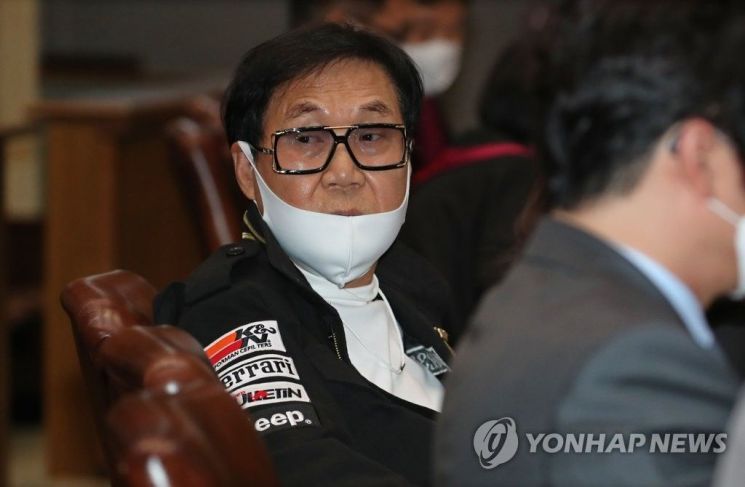
 Jo Young-nam attending the public hearing held at the Supreme Court in Seocho-dong, Seoul on the 28th.
[Asia Economy Reporter Choi Seok-jin] Jo Young-nam (75), who was indicted for selling paintings created by others and was found guilty in the first trial but acquitted in the second trial, tearfully pleaded for leniency during his final statement at the public hearing of the Supreme Court appeal trial held on the 28th, saying, "Please consider me so that I can become a true artist who contributes to society."
The Supreme Court's First Division (Presiding Justice Kwon Soon-il) held a public hearing for the appeal trial of Jo and others, who were indicted on charges of fraud, at 2 p.m. at the Supreme Court courtroom in Seocho-gu, Seoul.
During the approximately two-hour public hearing held until 4 p.m., Presiding Justice Kwon Soon-il briefly summarized the progress of the case so far and read it aloud, after which the prosecution outlined the summary of the charges, the issues of the case, and the reasons for the appeal.
Following the defense's response to the reasons for appeal, expert witnesses representing both sides gave their opinions, and a Q&A session with the witnesses was conducted. The hearing concluded with the prosecution's and defense's final arguments, followed by the defendant Jo's final statement.
◆ Prosecution vs. Defense emphasizing the logic of the first and second trial rulings respectively = The prosecution argued that Jo committed fraud by deceiving buyers into believing that paintings created by others were entirely his own work and selling them as such.
They contended that Song, who painted on Jo's behalf, and others cannot be simply regarded as 'assistants' performing technical support roles but should be considered independent 'artists.' Whether the works sold by Jo were personally created by him throughout the entire production process is an essential factor for buyers in deciding whether to purchase and at what price. Therefore, the prosecution argued that Jo had an obligation to inform buyers in advance that the works were not entirely painted by himself.
Ultimately, the prosecution claimed that Jo's failure to fulfill this duty of disclosure constitutes deception by omission, which is necessary for establishing fraud under criminal law.
In contrast, Jo's defense argued that the idea for the paintings based on Hwatu (Korean card game) was Jo's original creation, and Song was merely a technical assistant, i.e., an 'assistant,' who helped realize the work. They also argued that since there was no obligation to disclose as claimed by the prosecution, there was no deception by omission based on such an obligation.
◆ Divergent opinions from expert witnesses = Shin Je-nam, chairman of the Korea Professional Artists Association, who appeared as a prosecution witness, stated, "Completing artworks such as paintings is solely a creative activity carried out by the artist through the entire process." He added, "Jo, who neither majored in art nor had much time to study art due to his busy career as a singer, hiring professional artists as assistants to merely provide ideas and have them paint his works is unreasonable."
He particularly criticized Jo's working method shown on broadcasts, saying, "Artists do not work with paintings already framed. When touching up a painting, it is common to remove it from the frame first." He continued, "However, Jo was repeatedly seen working with the frame placed on the easel, which is nothing more than putting on a show by making slight touch-ups or signing others' paintings as if he painted them himself."
Shin also added, "Selling works with minor touch-ups as one's own, leveraging fame gained through singing, is unfair to those who have studied art for a long time and engaged in artistic activities."
On the other hand, Pyo Mi-seon, former president of the Korea Gallery Association and a witness for Jo, argued, "It is common for artists to hire assistants to complete works when it is difficult to meet demand within limited time."
She also emphasized, "Jo's artistic activities are closer to conceptual work rather than realistic work. There is a difference between the era dominated by 15th-16th century portrait paintings and modern art, where thought or conceptual work became possible."
◆ Final arguments by the chief prosecutor and public defender = No Jeong-hwan, head of the Public Trial Department at the Supreme Prosecutors' Office, who delivered the prosecution's final argument, said, "The essence of this case is not about the defendant's painting ability or using assistants because he was busy." He pointed out, "The core issue is that the defendant sold paintings painted by assistants as if he painted them himself."
No emphasized that the criminal law evaluation of whether buying paintings painted by a ghost artist for 100,000 won and selling them for 10 million won constitutes fraud is the essence of this case.
He added, "His claim that using assistants is an art world practice has deeply hurt many artists. If the defendant is acquitted, other celebrities, politicians, or wealthy individuals might exploit their wealth and fame to earn high profits, and the position of painters will be narrowed."
Finally, No urged, "For the protection of the rights of victims who paid high prices for the paintings and to maintain order in the Korean art world, please overturn the lower court's acquittal."
Kim Seung-nam, defense attorney delivering Jo's final argument, first pointed out problems with the prosecution's indictment.
He said, "According to the prosecution's logic, assistants like Song, who would be accomplices to fraud, were not even investigated as suspects. While the prosecution has discretion to indict or not, this is an abuse of prosecutorial discretion."
Kim also stated, "The prosecution did not even mention copyright infringement charges in the indictment and seems to have inadequately investigated the art world's circumstances."
He expressed concern, "The prosecution excessively expanded criminal punishment based on unclear disclosure obligations, which could broaden the punishability of quasi-omission offenses."
Lastly, he pointed out, "According to the prosecution's logic, world-famous painters who hire assistants would be strangely punished for fraud only in Korea."
◆ Jo, who read a prepared letter for his final statement, eventually choked up with tears = Jo, delivering his final statement, apologized, saying, "First, I am sorry for causing such a commotion over the past five years."
He continued, "Although I have been a singer all my life, I liked art so much that I served as the art club president at Yongmoon High School and studied painting, especially modern art, self-taught for over 50 years. I held more than 40 exhibitions at places like the Gwangju Art Biennale, the Seoul Arts Center, and the Sungkok Art Museum, becoming known as the 'Hwatu painting artist.'"
Jo said, "Inspired by Andy Warhol's success with ordinary Coca-Cola bottles, I translated Hwatu paintings into pop art. I also hired assistants and showed the process on TV because I thought it was necessary to inform everyone about my working method."
He emphasized, "I realized that music and art are completely different. Music by Bach, Beethoven, and Mozart requires strict rules and forms such as pitch and rhythm, but art surprisingly has no rules or methods. Modern art is a 100% battle of creativity and freedom."
He added, "You can paint on canvas or order canvases with frames; there are no restrictions on painting methods. Please pay attention to the titles attached to each Hwatu painting."
He also said, "My art is close to conceptual art, so debating whether the painting is well or poorly done is like the feeling before the invention of old cameras."
During the hearing, Jo showed signs of choking up as he reflected on his experiences during the investigation and trial over many years.
He said, "My feeling after experiencing this case over the past five years is that the Korean legal system is very elegant and perfect. I earnestly ask you to consider me so that I can refine myself in the remaining years of my life, practice more humility, and become a true artist who contributes to society."
He added, "I sincerely thank the justices for creating this opportunity today. The elders used to say that playing Hwatu leads to ruin, and I guess I have played Hwatu for too long."
Jo concluded his final statement by saying, "Please clear my innocence."
Following Jo, Jang, the head and manager of Jo's agency, who gave a final statement, said, "The teacher liked talking about and painting pictures more than singing. We hope for a wise judgment so that this matter can be resolved without injustice."
Justice Kwon said, "The sentencing date will be decided and notified separately," concluding the public hearing.
Jo was indicted on charges of fraud for paying painter Song, whom he had known since 2009, 100,000 won per painting to paint his existing collage works as paintings, to replicate his existing paintings, or to paint based on ideas he provided, and then selling 21 such paintings to 17 victims for a total of 153.55 million won.
In the first trial, Jo was found guilty of fraud for deceiving buyers by selling paintings created by others as if he painted them all himself and was sentenced to 10 months in prison with a two-year probation.
In the second trial, conducted after appeals by both Jo and the prosecution, the court overturned the first trial's ruling and acquitted Jo, judging that he had merely engaged in normal artistic activities using technical assistants.
© The Asia Business Daily(www.asiae.co.kr). All rights reserved.

















