[Asia Economy Reporter Hwang Yoon-joo] POSCO took the initiative in cultivating sea forests on the 28th in Ulleungdo ahead of Sea Day (May 31).
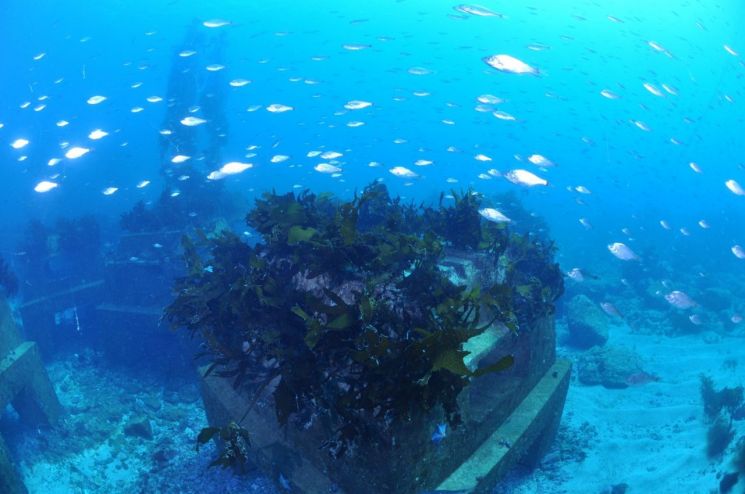
In mid-May, POSCO installed 100 Triton artificial reefs (Triton, an artificial reef brand made from POSCO steel slag) approved by the Ministry of Oceans and Fisheries, along with 750 Triton blocks, underwater off the coast of Namyang-ri in southern Ulleungdo, creating a sea forest covering approximately 0.4 hectares. The 100 Triton units were installed along the outer edge of the sea forest to promote the growth of seaweed, while the 750 Triton blocks were piled like a mountain in the center to serve as habitats and spawning grounds for fish.
About 20 people attended the sea forest creation ceremony, including Kim Byung-su, Ulleung County Governor, the head of the Namyang-ri fishing village cooperative and local fishermen, POSCO President Jang In-hwa, and Yoo Sung, Director of the Pohang Institute of Industrial Science and Technology (RIST), inspecting the sea forest site where the artificial reefs were installed.
Since 2000, POSCO, together with RIST, a research institute under the group, developed Triton artificial reefs using steel slag, a byproduct generated during steel manufacturing, and has provided a total of 6,559 units of steel slag for Triton free of charge to over 30 sea forests nationwide. For the Ulleungdo sea forest project, POSCO completed not only the provision of steel slag but also the production and installation of Triton.
The main material of Triton, steel slag, contains higher amounts of minerals such as calcium and iron, which are beneficial to marine ecosystems, compared to general aggregates. This promotes the growth and photosynthesis of seaweed, helping to restore damaged marine ecosystems and fishery resources in a short period, while also contributing to biodiversity of marine organisms. Additionally, steel slag’s high density and strength characteristics make it resistant to damage from typhoons and tsunamis, and its corrosion resistance in seawater is enhanced by not using rebar.
The creation of sea forests using Triton is POSCO’s flagship corporate citizenship project aimed at marine ecosystem restoration, and it also has a Blue Carbon effect by absorbing and storing carbon dioxide on the seabed through marine plants and sediments. According to research by RIST and related institutions, one hectare of sea forest can store 3 to 16 tons of carbon dioxide annually.
Since December last year, POSCO conducted underwater surveys around Ulleungdo to select the optimal location for sea forest creation, and in April carried out detailed investigations of the seabed and existing biological habitats. This month, Triton was transported to Ulleungdo and settled underwater. Going forward, POSCO and Ulleung County will continue post-management activities such as monitoring biological status and water quality, replenishing seaweed, and eradicating harmful invasive species that threaten fishery resources.
In the future, POSCO plans to contribute to marine ecosystem restoration and increased fishermen’s income not only through sea forest creation activities using Triton but also by developing eco-friendly sea fertilizers using steel slag and new types of artificial reefs.
© The Asia Business Daily(www.asiae.co.kr). All rights reserved.

















