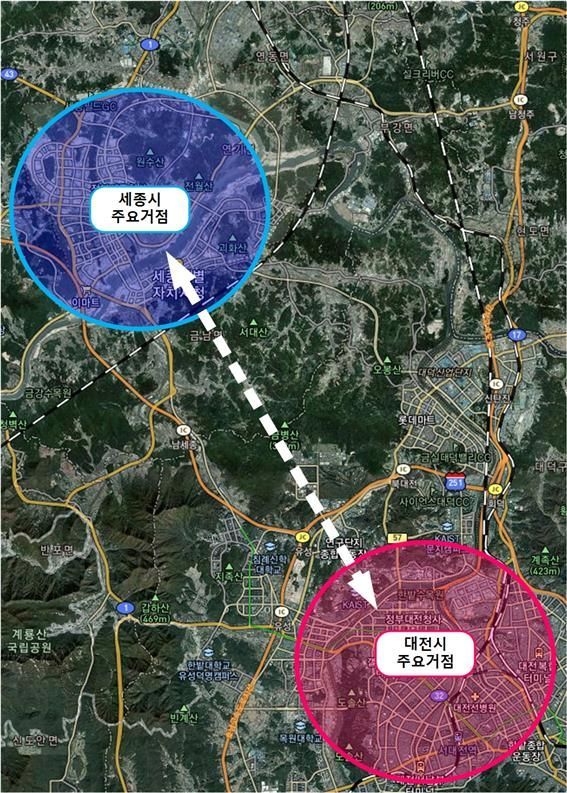
 Sejong City is promoting the introduction of the 'M-Bus' between Sejong and Daejeon, aiming to operate it in the second half of next year. Sejong is the first region outside the metropolitan area to promote the introduction of the M-Bus. Photo by Sejong City
[Asia Economy (Sejong) Reporter Jeong Il-woong] Sejong City has announced the ‘2020 Public Transportation Reform Promotion Plan,’ which includes the introduction of Metropolitan-Bus (M-Bus) and other measures.
According to the city on the 29th, the promotion plan focuses on the introduction of M-Bus, pilot operation of internal circulation Bus Rapid Transit (BRT) auxiliary routes, and the rationalization of city bus fares.
First, the city plans to introduce and operate M-Bus in the second half of next year. Once introduced, the M-Bus will serve to connect Sejong and Daejeon in the shortest time without intermediate stops. The introduction of M-Bus will be the first among regions outside the metropolitan area, starting in Sejong.
Since its launch in 2012, the city has steadily expanded metropolitan routes connecting nearby areas such as Daejeon. However, recently, issues such as increased transit sections due to residential area development and frequent traffic congestion have arisen, leading to growing demands for the establishment of express routes.
In response, the city explained that it plans to introduce M-Bus as a public transportation means that stops at limited bus stops to enable rapid movement between metropolitan cities (Sejong-Daejeon). The city intends to develop and operate an optimal route connecting major points between Sejong and Daejeon using National Road No. 1, in a direction that does not overlap with the existing metropolitan BRT routes.
To this end, the city plans to submit M-Bus demand survey opinions to the Metropolitan Transport Committee under the Ministry of Land, Infrastructure and Transport (hereinafter referred to as the Metropolitan Committee), which holds the license for M-Bus route selection, and then obtain the Metropolitan Committee’s feasibility review to lead the decision on the establishment of M-Bus.
The city expects that if the M-Bus introduction procedure proceeds as planned, M-Bus operation will be possible in the region by the second half of next year.
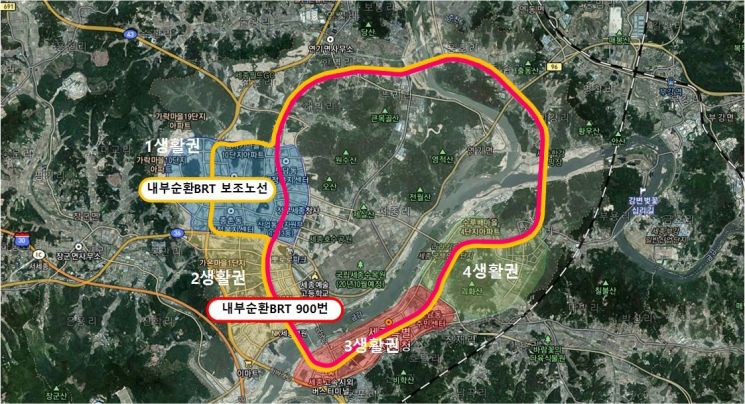
Along with this, the city will begin pilot operation of internal circulation BRT auxiliary routes by the end of this year. In January, Sejong fully opened the internal circulation BRT route No. 900, establishing a ring-shaped urban structure BRT system (a network of general roads composed of roads and sidewalks arranged concentrically around the city center).
However, areas near National Road No. 1, which are far from the BRT exclusive roads, have relatively limited access to the benefits of BRT routes. Therefore, the city plans to operate an internal circulation BRT auxiliary route passing through Sejong Chungnam Hospital, Sejong City Library, and Eojin Intersection, joining the BRT exclusive road.
The strategy is to make the BRT routes denser within the region and to improve public transportation convenience both inside and outside the area by newly introducing M-Bus routes that enable rapid movement between metropolitan areas.
Additionally, the city plans to abolish the additional fare charges outside the city boundary applied to city buses and to reform the transfer time system to significantly extend transfer times, allowing round-trip travel with a single payment. Currently, Sejong imposes additional fares outside the city boundary on seven bus routes traveling to adjacent areas such as Daejeon, Gongju, and Cheonan.
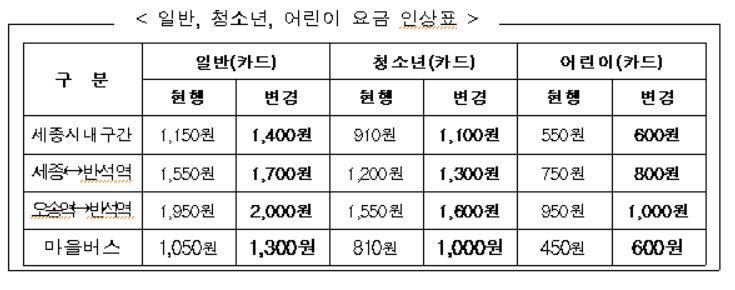
The promotion plan also includes a measure to raise local city bus fares (based on card payment) from 1,150 won to 1,400 won starting July 1.
Sejong raised fares once from 1,100 won to 1,150 won in 2012 and has kept fares frozen since then. Thanks to this, local city bus fares (based on card payment) are 100 to 250 won cheaper compared to Daejeon (1,250 won), Cheongju (1,400 won), Cheonan (1,350 won), and Gyeryong (1,250 won), making them among the lowest nationwide among local governments.
However, the city explained that due to rising transportation costs, a decrease in passengers caused by the prolonged COVID-19 pandemic, and increased quarantine expenses, the financial burden on public transportation has reached a critical point, making fare rationalization inevitable.
Kim Tae-oh, head of the city’s Transportation Division, said, “We will strive to make Sejong a convenient and safe public transportation-centered city,” adding, “Based on this promotion plan, the city will continue to expand bus routes and improve services.”
© The Asia Business Daily(www.asiae.co.kr). All rights reserved.
![Clutching a Stolen Dior Bag, Saying "I Hate Being Poor but Real"... The Grotesque Con of a "Human Knockoff" [Slate]](https://cwcontent.asiae.co.kr/asiaresize/183/2026021902243444107_1771435474.jpg)


















