[Post-Corona, Era of Great Transformation] <10> Growing Concerns Over the 'Big Brother' System
Western Societies Emphasizing Individual Freedom
[Asia Economy Reporter Lee Gwan-joo] Western modernization was a role model for the entire world. The core of the modernization they achieved was securing 'individual freedom.' In contrast, the modernization process in East Asia, which focused relatively more on industrialization and scientific advancement, placed less emphasis on the 'individual' compared to the West. So, how did the East and West react differently to the infringement of personal information by public authorities amid the spread of the novel coronavirus infection (COVID-19)? First, South Korea placed a significantly higher value on public interest compared to individual protection.
As could be expected, European countries, which prioritize individual privacy, voiced criticism of South Korea's disclosure of movement paths. For example, Virginie Pradel, a well-known French lawyer, wrote in a local media article last month that "Taiwan and South Korea's establishment of tracking devices is an unfortunate outcome," and criticized, "These two countries are not role models for individual freedom but rather among the worst." She particularly targeted South Korea, stating, "It is the second worst country in the world for surveillance and denunciation," and claimed, "They have long disregarded individual freedom."
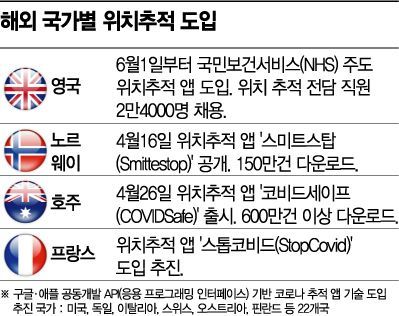
However, Europe changed. As of 9 a.m. on the 27th of this month, seven of the top ten countries with the highest number of COVID-19 confirmed cases are in Europe. Given this situation, European countries also began large-scale collection and management of personal location data in the name of infection prevention. The start was Norway, which had over 8,300 confirmed cases. On the 16th of last month, Norway became the first European country to release a contact tracing application. This app sends a warning message if a user has been within 2 meters of a COVID-19 infected person for more than 15 minutes. Upon receiving the message, the person can enter self-quarantine to limit transmission.
In the UK, where COVID-19 deaths have exceeded 37,000, a location tracking app is scheduled for full implementation on the 1st of next month. Earlier this month, the UK government piloted the app on the Isle of Wight, which has a population of 140,000, and half of the residents installed the app. In preparation for the app launch, the UK government hired 24,000 location tracking staff.
France, which had the strongest opposition to the Korean-style location tracking, is also pushing for a system to track confirmed patients' locations at the government level. On the 26th of last month, France's data protection authority, the National Commission on Informatics and Liberty (CNIL), judged that the government’s proposed contact tracing app complies with data protection regulations considering the crisis situation. However, due to public backlash, it appears that the introduction of the app in France will take some time.
Many countries have decided to use the contact tracing technology jointly developed by global IT companies Google and Apple. Several European countries, including Germany, Italy, Switzerland, Austria, and Finland, as well as the United States, have actively adopted it. However, there is a slight difference in the system compared to government-led apps. Since the central government does not manage the data, concerns about privacy invasion are minimized, but it is also difficult to trace the infection spread routes. Despite system differences, the essence of location information tracking remains the same. This symbolically shows how Europe's attitude toward privacy has significantly changed due to COVID-19.
© The Asia Business Daily(www.asiae.co.kr). All rights reserved.
![User Who Sold Erroneously Deposited Bitcoins to Repay Debt and Fund Entertainment... What Did the Supreme Court Decide in 2021? [Legal Issue Check]](https://cwcontent.asiae.co.kr/asiaresize/183/2026020910431234020_1770601391.png)















