During Financial Crisis, Actual Growth Was Positive
Uncertainty Factors Increasingly Expanding
This Time, Negative Growth Expected to Widen
[Asia Economy Reporters Kim Hyewon and Jang Sehee] The Bank of Korea has significantly revised down its economic growth forecast for this year to -0.2% as the economic shock caused by the novel coronavirus disease (COVID-19) crisis intensifies.
In the economic outlook report released on the 28th, the Bank of Korea lowered its growth forecast for this year by 2.3 percentage points from the previous 2.1% to -0.2%. This is the first time in 11 years since April 2009 (-2.4%) and July 2009 (-1.6%), during the financial crisis, that the Bank of Korea has issued a negative growth forecast. However, the real gross domestic product (GDP) growth rate that year recorded 0.2%, showing a relatively strong performance.
The real GDP growth rate has recorded negative figures twice since the Bank of Korea began compiling GDP statistics in 1953: in 1980 (right after the second oil shock) at -1.6%, and in 1998 (financial crisis) at -5.1%. If this year's forecast is realized, it will mark the first negative growth rate in 22 years. The Bank of Korea's growth forecast for this year appears to consider the economic damage caused by the spread of COVID-19, including the slowdown in domestic export growth and the decline in China's growth rate. Earlier in February, the Bank of Korea had already lowered its expected growth rate for this year from 2.3% to 2.1% once.
However, experts point out that with domestic and international uncertainties still present, a precise diagnosis of upward and downward economic factors will likely result in an even larger negative margin.
In fact, the International Monetary Fund (IMF) projected South Korea's economic growth rate this year at -1.2%. Additionally, the three major global credit rating agencies also forecast negative growth: Moody's at -0.5%, Standard & Poor's (S&P) at -0.6%, and Fitch at -1.2%. Professor Kim Soyoung of Seoul National University's Department of Economics said, "Although the Bank of Korea's growth forecast has been revised downward, -0.2% is still an optimistic projection." She added, "The second quarter will suffer more damage than the first quarter, and especially if the export impact worsens, the decline could be greater than -0.2%."
Researcher Lee Miseon of Hana Financial Investment said, "With the first quarter figures already out, there is no assumption that the recovery speed in the third and fourth quarters will be better than usual," adding, "Even among advanced countries, both the U.S. and Europe are experiencing negative growth." She further stated, "If significant GDP damage occurs, it will take time to recover."
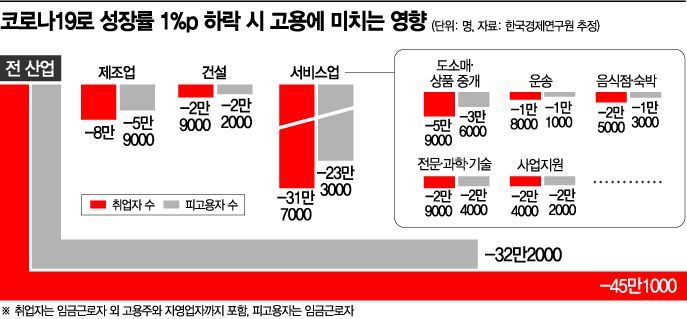
As economic growth increasingly impacts employment following the global financial crisis, an analysis suggests that a 1 percentage point drop in economic growth rate could reduce the number of employed persons by 451,000. The Korea Economic Research Institute (KERI) revealed this in its report titled 'Analysis of the Impact of Growth Contraction Due to COVID-19 on Employment and Implications' released on the same day.
Moreover, KERI's analysis of the impact of GDP changes on unemployment rates by economic cycle phase showed that during recession phases, the increase in unemployment rate is more than twice the decrease in unemployment rate during expansion phases. When the GDP cycle value is 1 trillion won below zero?the threshold between economic expansion and contraction?the unemployment rate rises by 0.055 percentage points, whereas when it is 1 trillion won above zero, the unemployment rate falls by only 0.021 percentage points. This indicates that the economic downturn caused by COVID-19 could lead to a major employment disaster.
© The Asia Business Daily(www.asiae.co.kr). All rights reserved.
![User Who Sold Erroneously Deposited Bitcoins to Repay Debt and Fund Entertainment... What Did the Supreme Court Decide in 2021? [Legal Issue Check]](https://cwcontent.asiae.co.kr/asiaresize/183/2026020910431234020_1770601391.png)















