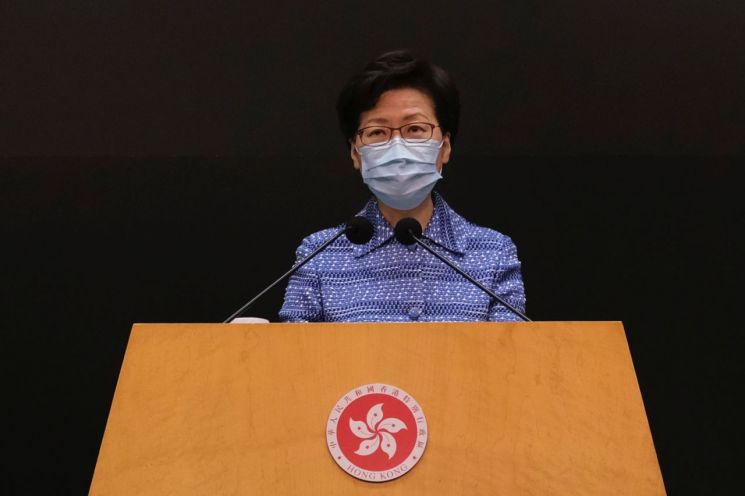
[Asia Economy Reporter Hyunwoo Lee] Ahead of the Chinese government's enactment of the Hong Kong National Security Law, Hong Kong Chief Executive Carrie Lam's ability to respond has once again come under scrutiny. Lam faced dismissal rumors last year for her failure to handle protests against the extradition bill, and many pro-China figures in Hong Kong have since turned away from her. There are speculations that she might follow the path of Tung Chee-hwa, the first Hong Kong Chief Executive who resigned after large-scale protests erupted in 2003 when attempting to enact a security law.
According to foreign media including the South China Morning Post (SCMP) on the 28th, Lam is reportedly under final pressure from Chinese President Xi Jinping regarding the handling of the Hong Kong Security Law. One foreign media outlet cited experts saying, "President Xi is exerting pressure on Chief Executive Lam." However, criticism dominates that Lam merely echoes the Chinese government's logic without demonstrating any substantial response capability.
On the 26th, Lam emphasized that the Hong Kong Security Law would bring stability to Hong Kong, contrary to the claims of Hong Kong protesters and the pro-democracy camp, which provoked Hong Kong citizens. The Hong Kong Bar Association, along with the pro-democracy camp and protesters, opposed the enactment of the security law, which corresponds to Article 23 of Hong Kong's Basic Law, arguing that it should be enacted within Hong Kong and that the Chinese government has no authority over it. Over 300 citizens have been arrested amid large-scale protests.
Last month, Lam also faced criticism from the entire Hong Kong political spectrum, including both pro-China and pro-democracy camps, for raising her own salary amid the severe COVID-19 pandemic. Her salary for next year was set at HKD 5.21 million (approximately 51.5 million KRW), an increase of HKD 120,000 (about 1.9 million KRW) from the previous year. Public sentiment worsened further as the economic situation was already poor due to the COVID-19 crisis.
Lam pushed forward with the extradition bill last year, which triggered massive protests involving over 2 million people. However, her failure to respond effectively led to rumors of her dismissal. In the Hong Kong District Council elections held at the end of last year, the pro-China camp suffered a crushing defeat, winning only 60 out of 452 seats, resulting in a loss of trust even among pro-China factions in Hong Kong. Some speculate that she might resign like Tung Chee-hwa, who stepped down in 2005 after being held responsible for large-scale protests related to the attempted enactment of a security law.
Lam's family, who still hold British nationality, also face controversy. Lam held British nationality until 2007, when she renounced it. However, her husband, Professor Siu-po Lam of Beijing Normal University, and their two sons still retain British nationality. Professor Lam attended the 20th anniversary ceremony of Hong Kong's handover with Chief Executive Lam on December 20 last year but did not sing the Chinese national anthem or applaud, drawing criticism from pro-China supporters.
© The Asia Business Daily(www.asiae.co.kr). All rights reserved.

















