[Asia Economy Reporter Junho Hwang] A diagnostic technology has been developed that can determine the presence of a virus using only the lysate of virus-infected cells. This technology rapidly detects infection by targeting double-stranded RNA, which is specifically present in viruses. It is expected to be spotlighted as a next-generation diagnostic technology because it can diagnose not only various viral infectious diseases but also infections by new and emerging viruses.
KAIST announced on the 28th that a joint research team led by Professors Li Sheng and Kim Yusik from the Department of Biological Sciences and Chemical Engineering developed a universal diagnostic technology capable of detecting various types of viruses by utilizing viral characteristics.
The research team focused on the fact that the human body recognizes external substances and triggers immune responses by using morphological features such as the length and terminal structure of double-stranded RNA.
They developed a technology that detects double-stranded RNA by utilizing these morphological features, such as length and terminal structure, which the human body recognizes as external substances to initiate immune responses.
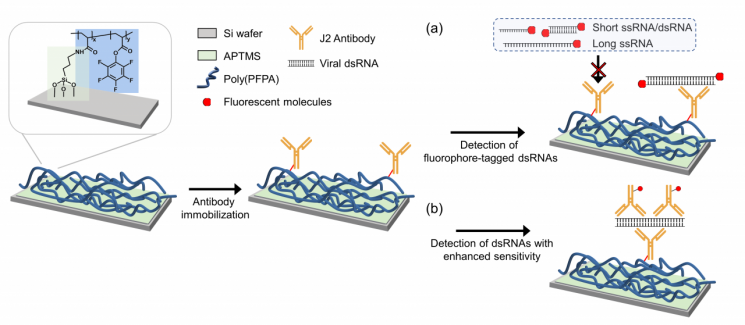
On the surface of a silica substrate, pentafluorophenyl acrylate (PPFPA) reactive polymers were coated to efficiently and quickly immobilize antibodies that recognize ‘double-stranded RNA.’ Using this developed substrate, they were able to detect ‘double-stranded RNA’ longer than 76 bp (base pairs, a unit indicating the number of nucleotide pairs) that triggers immune responses.
The research team further confirmed the potential for viral infection diagnosis by showing that single-stranded RNA found in uninfected cells and short double-stranded RNA of 19 bp were not detected at all.
The sample preparation process was also greatly simplified so that viral double-stranded RNA could be detected using only the lysate of infected cells without isolating or purifying RNA from the cells. The team applied this technology to cells infected with hepatitis A and hepatitis C viruses and confirmed the presence of viral double-stranded RNA.
Professor Li Sheng said, "Although this study detected only hepatitis A and C dsRNA, viral dsRNA is found in various types of viruses. The dsRNA detection technology developed this time can be applied to various viruses and can evolve into a universal infectious disease diagnostic technology. In particular, it will be useful in establishing effective quarantine measures by enabling easy and rapid detection of infectious diseases in public places such as airports and schools."
© The Asia Business Daily(www.asiae.co.kr). All rights reserved.

















