GBC Groundbreaking and Development Boosts, Rapid Sale Transactions Push Prices Up
Dongjak-gu Turns to Uptrend... Yangcheon-gu Also Narrows Decline
Apartment Prices Continue Rising in Incheon, Gyeonggi-do, and Sejong
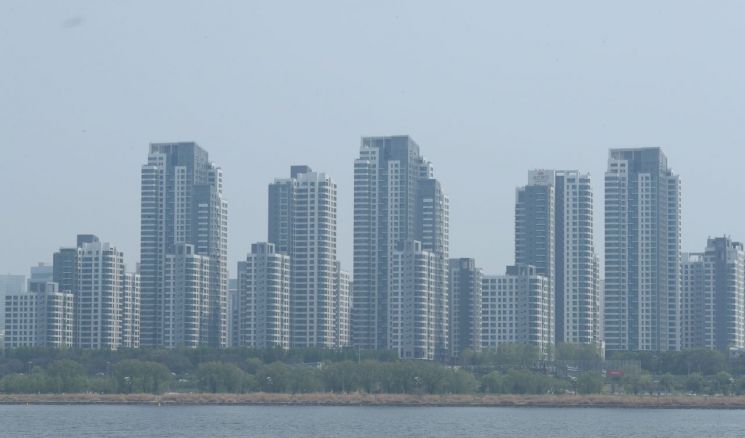
[Asia Economy Reporter Moon Jiwon] The decline in apartment prices in Seoul and the four Gangnam districts (Gangnam, Seocho, Songpa, and Gangdong) all narrowed compared to last week. This is interpreted as a result of renewed buying sentiment due to various development prospects and the rise in asking prices as many urgent sale properties were traded.
According to the "Weekly Apartment Price Trend for the 4th Week of May 2020" released by the Korea Real Estate Board on the 28th, apartment prices in Seoul fell by 0.02% as of the 25th, narrowing the decline compared to the previous week (-0.04%).
The Korea Real Estate Board explained, "The decline narrowed slightly mainly in some areas where there are development prospects such as the groundbreaking of the Samsung-dong Global Business Center (GBC) or where urgent sale properties have been exhausted."
However, concerns about an economic recession persist as the economic growth forecast worsens and unemployment benefits increase, causing apartment prices in Seoul to fall for nine consecutive weeks.
Although the decline continued in the four Gangnam districts, the decline narrowed compared to last week as Gangnam-gu (-0.08%) saw asking prices rise mainly in some reconstruction and popular complexes where urgent sale properties were exhausted, and Songpa-gu (-0.04%) saw asking prices rise mainly in some complexes affected by development prospects.
Outside the four Gangnam districts, Dongjak-gu (0.02%) turned to an upward trend as prices rose in apartment complexes priced below 900 million KRW, and Yangcheon-gu (-0.01%) saw a narrowing decline as urgent sale properties were exhausted mainly in Mok and Sinjeong-dong.
North of the Han River, the decline also slowed in many areas. In Mapo-gu (-0.05%), the decline continued as buying demand decreased mainly for high-priced houses, but the drop narrowed compared to the previous week (-0.06%). Yongsan-gu (-0.03%) also continued to decline due to the designation as a land transaction permission zone, but the decline slowed.
While the decline in Seoul narrowed, apartment prices rose in the metropolitan area including Incheon and Gyeonggi-do, as well as in provincial metropolitan cities.
In Incheon, prices rose 0.19% compared to the previous week (0.22%). Seo-gu (0.24%) saw an expanded rise mainly in Cheongna-dong, where there are transportation benefits such as the extension of Line 7, and Bupyeong-gu (0.34%) rose mainly in station-area complexes with expectations for redevelopment projects or good accessibility to Seoul.
In Gyeonggi-do, prices rose 0.15% compared to the previous week (0.13%), further increasing the rise. Ansan-si (0.58%) saw a significant price increase mainly in areas with expectations for redevelopment projects and transportation benefits. Gwangju-si (0.42%) saw an expanded rise mainly in Taejeon District and station-area complexes along the Gyeonggang Line.
Guri-si (0.34%) rose mainly around the planned stations of Line 8 (Byeollae Line). In Suwon, Paldal-gu (0.34%) and Yeongtong-gu (0.24%) rose mainly in newly built station-area complexes or relatively undervalued complexes amid transportation benefits and new housing supply.
Sejong also increased its rise to 0.28% compared to the previous week (0.24%). Goun-dong, where there is additional expectation for BRT routes, and the outskirts of the Happy City, including Jochiwon-eup and Geumnam-myeon, which had previously seen smaller rises, showed an upward trend.
© The Asia Business Daily(www.asiae.co.kr). All rights reserved.
![User Who Sold Erroneously Deposited Bitcoins to Repay Debt and Fund Entertainment... What Did the Supreme Court Decide in 2021? [Legal Issue Check]](https://cwcontent.asiae.co.kr/asiaresize/183/2026020910431234020_1770601391.png)
















