SKT Managers Eom Woo-hyun and Jo Seung-hyun Participated in Developing Galaxy A Quantum
Developed Smartphone Chipset Reduced to One-Quarter Size of Existing Chipsets
Enhanced Security Using Unpredictable, Patternless Random Number Technology
Quantum Cryptography Research Since 2011, First Applied to Smartphones
Providing 'Quantum OTP' Service for T ID and SK Pay
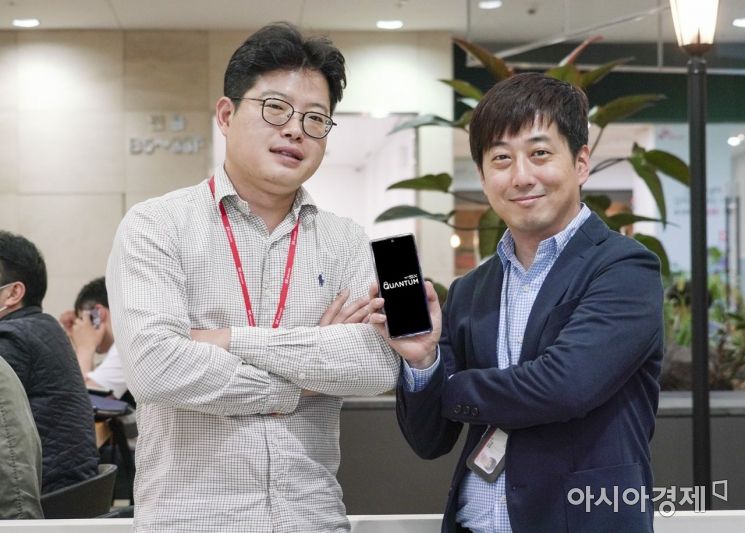 Eom Woo-hyun, Manager of SK Telecom Quantum Growth Promotion Team (left), and Cho Seung-hyun, Manager of Smart Device Headquarters PM Team (right), who participated in the development of the world's first quantum cryptography 5G smartphone, Galaxy A Quantum. Manager Eom developed the Quantum Random Number Generator (QRNG) chip, and Manager Cho was responsible for collaborating with Samsung Electronics to apply the QRNG chip to the smartphone.
[Asia Economy Reporter Han Jinju] "The Galaxy A Quantum was realized when Park Jung-ho, CEO of SK Telecom, proposed it to Go Dong-jin, CEO of Samsung Electronics, at MWC 2018. Since then, over a year and a half, the chip size was reduced to a quarter." (Eom Woo-hyun, Manager of SK Telecom Quantum Growth Promotion Team)
The Galaxy A Quantum smartphone, the world's first to incorporate quantum encryption technology, was a project initiated by Park Jung-ho, known as the 'Quantum Encryption Evangelist,' who proposed it to Samsung Electronics. It holds special significance as the first product to introduce quantum encryption technology, which SK Telecom has invested in for nearly a decade, to general consumers.
On the 27th, we met with Eom Woo-hyun, manager at SK Telecom, and Jo Seung-hyun, manager of the Smart Devices Division, who participated in the development of Galaxy A Quantum at SK Telecom headquarters. Both said, "Galaxy A Quantum is the cornerstone for bringing quantum encryption technology to the public and the fruit of 10 years of investment."
Thanks to quantum encryption technology, the Galaxy A Quantum, known for its excellent security, was released on the 22nd. Samsung Electronics manufactured the smartphone, while SK Telecom and its partners developed the chipset that integrates quantum encryption technology. Manager Eom explained, "From the summer of 2018, we prepared with Samsung Electronics' security department and working-level staff. The QRNG (Quantum Random Number Generator) chip made at that time was too large to apply to devices, so we developed it for smartphones over a year and a half, reducing its size to a quarter."
Quantum random numbers refer to unpredictable and patternless random numbers. They are used to create difficult-to-crack encryption. SK Telecom implemented this technology into a smartphone chipset. SK Telecom began researching quantum encryption technology in 2011. At that time, SK Telecom's Technology Institute had an organization dedicated to quantum encryption research called the 'Quantum Tech Lab.' Later, in 2018, SK Telecom acquired the Swiss quantum encryption communication company IDQ, and based on IDQ's technology, domestic partners and SK Telecom-affiliated researchers commercialized the QRNG chipset.
The QRNG chipset embedded in the Galaxy A Quantum measures 2.5mm by 2.5mm, smaller than one-tenth the size of a fingernail. Manager Jo explained, "The core of quantum encryption technology is creating unpredictable random numbers that cannot be traced, and we embedded this technology inside the chip." When undergoing secondary authentication in services like T ID, SK Pay, and Initial (a blockchain-based mobile verification service), encryption keys are generated using quantum encryption technology. These generated encryption keys are considered the safest with current technology.
SK Telecom plans to expand quantum encryption technology not only to smartphones but also to the Internet of Things (IoT) overall, including autonomous vehicles. According to Market Research Media, the quantum encryption communication market size is expected to grow from 6.4 trillion KRW this year to approximately 26.9 trillion KRW by 2025. Manager Eom said, "QRNG technology can be applied to fields like autonomous vehicles where hacking must be prevented," adding, "We are also cooperating with affiliates such as ADT Caps, SK Infosec, and SK Hynix to create synergy within the group."
© The Asia Business Daily(www.asiae.co.kr). All rights reserved.


















