[Asia Economy Reporter Seulgina Cho] "We will listen to opinions from the field and convey them to the government to ensure that the amendment of the Data 3 Act continues according to its original intent."
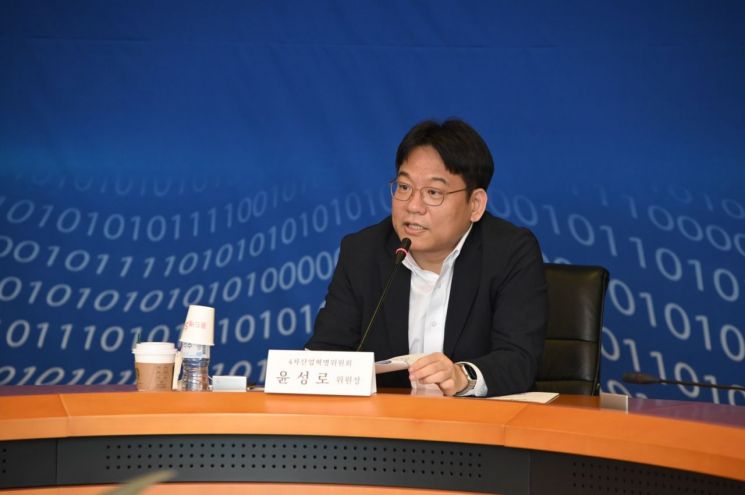
On the 28th, Yoon Sung-ro, Chairman of the Presidential Committee on the Fourth Industrial Revolution, stated at an information and communication sector meeting related to the Data 3 Act (Personal Information Protection Act, Information and Communications Network Act, Credit Information Act) held at T Tower in Euljiro, Seoul, "If necessary, we will create a forum for discussion through the 4th Industrial Revolution Committee's hackathon."
This remark came in response to repeated criticisms that the enforcement decree of the Personal Information Protection Act, a subordinate law ahead of the Data 3 Act enforcement in August, is being drafted excessively strictly, which goes against the purpose of the legislation.
Following the financial sector, this second on-site meeting was attended by representatives from the three major mobile carriers SK Telecom, KT, and LG Uplus, portal companies such as Naver and Kakao, platform companies, big data firms, and related associations. At this meeting, participants shared the government's preparation status regarding the Data 3 Act and conveyed industry suggestions on the enforcement decree and guidelines. They also discussed measures for the development of the data economy.
Companies positively evaluated that the amendment of the Data 3 Act has opened the door for the activation of data utilization. However, they emphasized the need to clearly present the scope of data use, methods of use, and restrictions through enforcement decrees, enforcement rules, and guidelines to minimize uncertainty in the field.
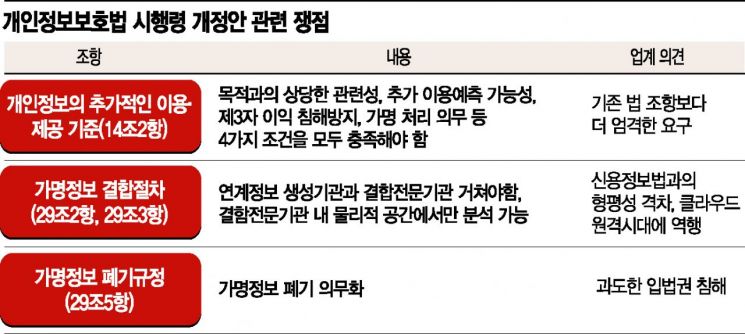
Specifically, opinions were raised that certain parts of the Personal Information Protection Act enforcement decree amendment, such as ▲criteria for additional use and provision of personal information (Article 14, Paragraph 2) and ▲limiting data integration institutions (Article 29, Paragraph 2), require supplementation, and concerns were expressed about confusion due to differences between the enforcement decrees of the Personal Information Protection Act and the Credit Information Act.
The Data 3 Act, passed by the National Assembly earlier this year, introduced the concept of 'pseudonymous information' for the first time to revitalize the data economy in line with the Fourth Industrial Revolution era, expanding the scope for individuals and companies to utilize it. It is also a foundational law for the 'Korean New Deal' proposed by President Moon Jae-in.
However, reviewing the draft amendment of the Personal Information Protection Act enforcement decree announced for public comment until early this month reveals that, contrary to the original legislative intent, the use conditions and pseudonymous information integration procedures are regulated too strictly, thereby hindering data utilization.
In particular, both inside and outside the industry point to ▲criteria for additional use and provision of personal information (Article 14, Paragraph 2) and ▲pseudonymous information integration procedures (Article 29, Paragraphs 2 and 3) as problematic clauses. According to the disclosed amendment, when a company uses or provides personal information additionally without the data subject's consent, it must meet all four conditions: ▲significant relevance to the original purpose ▲predictability of additional use ▲prevention of third-party interest infringement ▲obligation of pseudonymization. This is much stricter than the European Union's General Data Protection Regulation (GDPR), which is recognized as a global standard. Moreover, ambiguous terms such as 'significant relevance,' 'in light of practice,' and 'third party's interest' are used frequently, further increasing confusion among companies.
Companies expressed hope that opinions from the field gathered through this meeting will be reflected in future subordinate law work. Chairman Yoon emphasized, "We will continuously listen to opinions from the field and serve as a channel to convey them to the government so that the amendment of the Data 3 Act can lead to safe data utilization according to its original intent."
The 4th Industrial Revolution Committee plans to hold future meetings related to data in the medical and distribution sectors and compile the results reflecting field opinions for discussion at the full committee meeting in June to promote the development of the data economy.
© The Asia Business Daily(www.asiae.co.kr). All rights reserved.


















