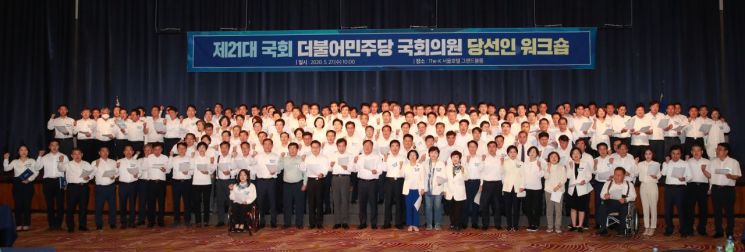
[Asia Economy Reporter Park Cheol-eung] The Democratic Party of Korea is demonstrating the power of its 177-seat 'absolute ring,' which can do everything except constitutional amendments. Contrary to some concerns about fiscal soundness, it is announcing a strong third supplementary budget (supplementary budget) and boldly declaring that it will take all the standing committee chair positions, citing the public sentiment from the general election. Regarding the controversy over elected representative Yoon Mi-hyang, the party is clearly determined to push through, stating that the facts have not been confirmed.
The Democratic Party is pressuring the United Future Party daily, insisting that the 21st National Assembly must convene as scheduled under the National Assembly Act. On the 28th, Kim Tae-nyeon, the Democratic Party floor leader, said at the policy coordination meeting, "The public sentiment from this general election is to create a new National Assembly," adding, "We must boldly discard outdated customs and evils that do not fit the times. The convening of the Assembly is not negotiable." He also said, "Standing committees should be allocated according to established principles, and the Assembly should convene on the scheduled date."
The immediate 'fire on the stove' is the allocation of standing committee chairs, and the party reiterated the 'principle.' According to the National Assembly Act, standing committee chairs are elected through a plenary session vote, but there is no explicit provision for allocation. Since the 13th National Assembly, it has been customary for the ruling and opposition parties to divide the positions of the Speaker and the Chair of the Legislation and Judiciary Committee through negotiation, but this time the Democratic Party has declared it will take all positions. They emphasize 'public sentiment' as the basis.
Yoon Ho-jung, the Democratic Party secretary-general, said right after the Supreme Council meeting the previous day, "In cases where an absolute and stable majority is secured as now, it is the basic principle of National Assembly operation that the majority party takes responsibility for the operation by holding both the Speaker and standing committee chairs," adding, "Regardless of the Legislation and Judiciary Committee or the Budget and Accounts Committee, the majority party taking responsibility for all standing committees is the meaning the people gave by creating an absolute majority party in this general election."
Kim Young-jin, the Democratic Party senior deputy floor leader, also mentioned at the meeting, "There is a saying to return to principles in difficult times. Commanders say that in war or difficult times, following the manual means survival, and not following it means death."
There is a view that the strong threat to take all the chair positions of the contentious Legislation and Judiciary Committee and Budget and Accounts Committee is a tactic, but many also expect it to be actually implemented. Since it is according to the majority rule principle, the opposition has no means to control it. However, the 21st National Assembly will have to start amid extreme conflict.
Joo Ho-young, floor leader of the United Future Party, immediately opposed, saying, "It is an attempt to overturn the National Assembly," and Ahn Cheol-soo, leader of the People’s Party, also fiercely criticized at the Supreme Council meeting that day, saying, "What is different from returning to the Yushin era and the Fifth Republic when the National Assembly was a rubber stamp for the Blue House?"
The Democratic Party is putting forward the justification that prompt convening is essential to handle the third supplementary budget and other measures to respond to the novel coronavirus disease (COVID-19) crisis. However, it seems that negotiations between the ruling and opposition parties will not be easy.
Cho Jung-sik, chairman of the Democratic Party Policy Committee, said that day, "Expansionary fiscal policy is the most effective means to overcome the economic crisis," and "The party and government will promptly prepare the third supplementary budget and submit it immediately upon the convening of the National Assembly." President Moon Jae-in emphasized a bold fiscal role by describing the situation as a 'wartime situation' at the National Fiscal Strategy Meeting on the 25th. The Democratic Party is actively emphasizing the supplementary budget with the logic of preventing a decrease in the denominator of the debt ratio, the gross domestic product (GDP). Since the United Future Party has emphasized the principle of minimizing fiscal burden in previous supplementary budget discussions, fierce debate is inevitable. For now, it seems likely that the Democratic Party will push it through with the power of its majority seats.
Meanwhile, regarding elected representative Yoon Mi-hyang, whom 70% of the public want to resign according to polls, the party is emphasizing the principle of 'fact verification first.' The previous day, Lee Hae-chan, leader of the Democratic Party, said, "There are many controversies related to the Justice and Memory Foundation," adding, "The 30 years of activities testifying to the lives of victims of Japanese colonial rule and reaching this point cannot become a subject of political strife, malicious slander, or partisan abuse." Although some within the Democratic Party have suggested the need for internal investigation and organization, Lee firmly established the guideline at the Supreme Council meeting, saying, "We must base it on facts and not succumb to suspicion-raising attacks that resemble personal attacks."
© The Asia Business Daily(www.asiae.co.kr). All rights reserved.

















