[Asia Economy Reporter Bu Aeri] If gaming addiction is classified as a disease, it is projected that the related industry will shrink, resulting in an annual loss of approximately 5 trillion KRW and the loss of jobs for about 34,000 people.
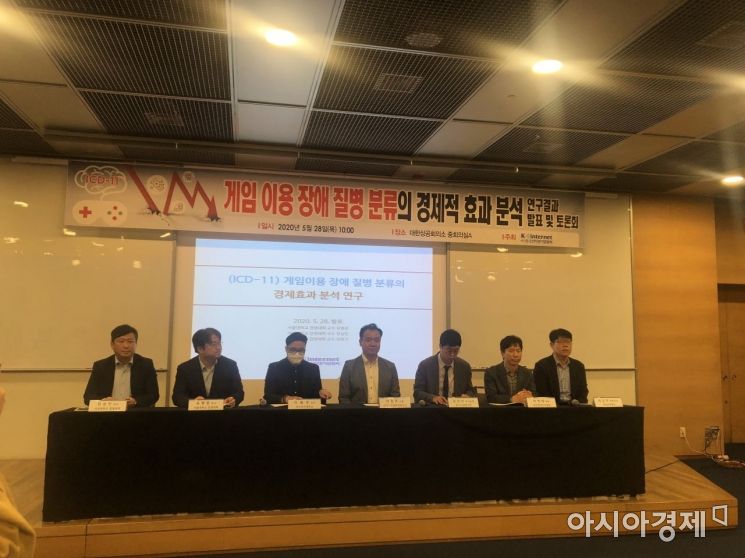
Professor Yoo Byung-jun of Seoul National University’s Business Administration Department stated at the "Economic Impact Analysis Forum on the Classification of Gaming Disorder as a Disease," hosted by the Korea Internet Corporations Association on the 28th, that "If gaming addiction is classified as a disease, the annual total production scale of the related industry will decrease by 5.2526 trillion KRW."
According to a survey conducted by Professor Yoo’s research team targeting 503 game users, if gaming addiction is registered as a disease, the average gaming expenditure is expected to decrease by 28.45%. Professor Yoo applied this figure to the production inducement coefficient calculation method to arrive at this result. The production inducement coefficient refers to the increase in sales of related industries when the sales of a specific industry increase by 1. The production coefficient of the gaming industry is about 1.4. Considering the annual sales of the gaming industry amount to 13.1423 trillion KRW, the related sales scale is estimated at 18.4624 trillion KRW (13.1423 trillion KRW × 1.4). Based on this, calculating a 28.45% reduction results in a loss of 5.2526 trillion KRW, according to Professor Yoo’s explanation.
Professor Yoo also analyzed that this ripple effect would cause 34,007 people to lose employment opportunities. Considering the average age of workers in the information and communication industry is 37.6 years, the contraction of the gaming industry could lead to youth unemployment issues. Professor Yoo expressed concern, saying, "The average age of employees in the gaming industry is in the early to mid-30s, mostly young adults. The contraction of the gaming industry will exacerbate youth unemployment problems."
Professor Yoo’s research team also mentioned that if gaming addiction is classified as a disease, mandatory contributions similar to those in the tobacco industry will arise, along with social costs for treatment. Professor Yoo estimated that additional social costs such as medical budgets and treatment contributions would exceed 700 billion KRW. He advised, "Considering the industrial contraction and increased social costs caused by the classification of gaming addiction as a disease, a sober review is necessary."
Meanwhile, the World Health Organization (WHO) classified gaming addiction as a disease in May last year, and this classification will take effect from January 2022. Considering the revision timing of the five-year cycle "Korean Standard Classification of Diseases and Causes of Death (KCD)," gaming addiction is expected to be officially recognized as a disease in Korea as early as January 2026.
© The Asia Business Daily(www.asiae.co.kr). All rights reserved.

















