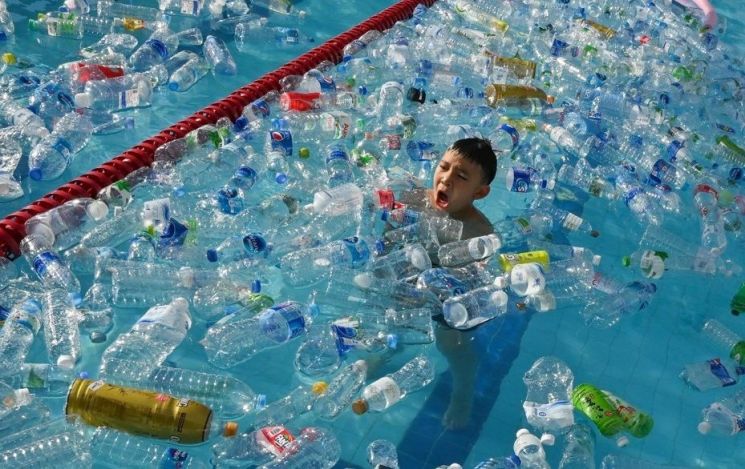
[Asia Economy Reporter Junho Hwang] Recently, due to the price drop caused by the novel coronavirus disease (COVID-19), recycling collection companies have been reluctant to collect plastic bottles (see the May 26 issue of this paper article). A plankton that consumes these plastic bottles has been developed. It is expected to make a significant contribution not only to solving our society's waste disposal problem but also to preventing the aquatic ecosystem plastic chain pollution, which causes plastic bioaccumulation.
Development of Plankton That Consumes PET Bottles
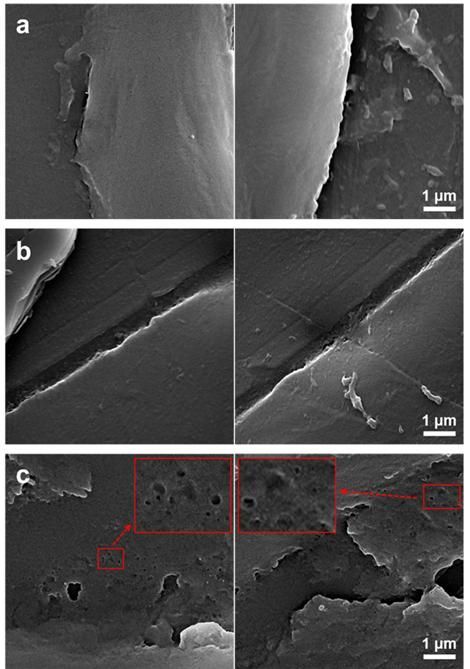 This is the result of observing the plastic decomposition process of plankton under an electron microscope at 20,000 times magnification. (a) shows the result of decomposition over 4 weeks using regular plankton. Next, (b) shows the result after 2 weeks, and (c) after 4 weeks of decomposition using plastic-decomposing plankton. The red boxes magnify the holes and dents that appear on the surface during the decomposition process.
The Korea Research Institute of Bioscience and Biotechnology announced on the 28th that the research team led by Dr. Yongjae Lee and Dr. Heesik Kim from the Cell Factory Research Center developed plant-based plankton with PET-degrading enzymes through gene synthesis. The research results were published in the international journal 'Microbial Cell Factories.'
The research team synthesized genes suitable for plant plankton by using the amino acid sequence of PET-degrading enzyme (PETase) in Chlamydomonas reinhardtii, a representative green microalga. Through this, they developed plant-based plankton 'CC-124_PETase' that decomposes PET bottles. Chlamydomonas is an eco-friendly green microalga that consumes carbon dioxide and produces oxygen.
The research team applied this plankton to commercially available beverage PET bottles. As a result, they observed the decomposition process of the PET bottles through an electron microscope. They also confirmed that the PET bottles were completely decomposed into monomers harmless to the human body.
Although a foreign research team discovered an enzyme that decomposes PET bottles from bacteria in 2016, there had been no cases of applying this to plant-based plankton.
Will It Prevent Microplastic Bioaccumulation?
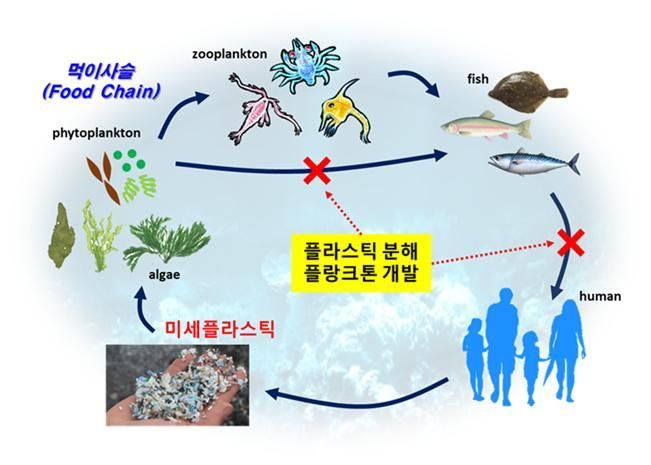
The research team evaluated this as a technology that could help remove microplastics. Aquatic organisms such as shellfish tend to mistakenly ingest microplastics as food. This can cause plastic bioaccumulation throughout the ecosystem via the food chain. As primary producers in the aquatic ecosystem, plant-based plankton decomposing plastics is expected to fundamentally block plastic pollution in aquatic ecosystems.
Dr. Heesik Kim stated, "This research achievement is the world's first development of green microalgae that decomposes plastics," adding, "This technology presents a new paradigm that can solve environmental pollution caused by plastics." He further predicted, "By providing a clue to technology that can fundamentally block microplastic bioaccumulation through the food chain, it can be widely used in various fields such as natural restoration and aquaculture through additional research."
© The Asia Business Daily(www.asiae.co.kr). All rights reserved.



















