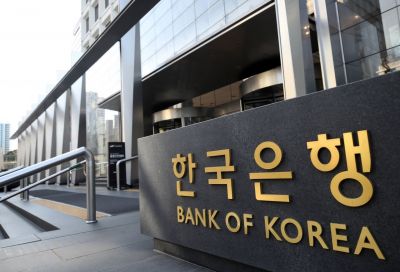
[Asia Economy Reporter Jang Sehee] The Bank of Korea has decided to lower the base interest rate to 0.5% per annum. This decision was made based on the assessment that consumption and investment performance have been sluggish due to the prolonged COVID-19 pandemic, and that major countries are already implementing near-zero interest rate policies.
However, with this rate cut, the possibility of further reductions within the year has become even lower.
On the 28th, the Monetary Policy Board of the Bank of Korea, chaired by Governor Lee Ju-yeol, held a meeting to decide the monetary policy direction and decided to cut the base interest rate to 0.5%. In March, the base rate was sharply reduced by 50 basis points (1bp=0.01 percentage point) from 1.25% to 0.75%, and in April, the Monetary Policy Board kept the rate unchanged. Then, in May, the rate was lowered again by 0.25 percentage points, bringing the base rate to a historic low of 0.5%.
This is interpreted as a response to the ongoing economic recession caused by COVID-19, which has led various economic indicators to decline. In fact, exports this month have decreased by more than 20% due to the COVID-19 shock. According to the Korea Customs Service on the 21st, exports from the 1st to the 20th of this month amounted to $20.318 billion, down 20.4% from $25.498 billion in the same period last year. The average daily export value, considering working days, also shrank from $1.89 billion to $1.51 billion.
Additionally, the Business Survey Index (BSI) for the manufacturing sector in May was 49, down 3 points from the previous month. This is the lowest figure since February 2009 (43), when the global financial crisis had an impact.
It was also taken into account that major countries such as the United States have interest rates effectively at 0%, leaving room for further rate cuts.
Jo Young-moo, a research fellow at LG Economic Research Institute, said, "Lowering interest rates and directly injecting money to respond to COVID-19 is a global trend. Only countries experiencing severe capital outflows will choose to raise interest rates."
There is also analysis that this will create a policy mix effect in conjunction with the government's third supplementary budget.
Lee Mi-seon, a researcher at Hana Financial Investment, analyzed, "The government is emphasizing expansionary fiscal policy, and the fact that major countries worldwide have lowered interest rates has had an influence." She added, "If the rate had been kept unchanged, the real interest rate would have risen, increasing the burden of debt on companies."
© The Asia Business Daily(www.asiae.co.kr). All rights reserved.

















