[Asia Economy New York=Correspondent Baek Jong-min, Beijing=Correspondent Park Sun-mi] The United States' 'Hong Kong Special Status,' which has allowed Hong Kong to receive special treatment different from other regions of China in trade, tariffs, investment, and visa issuance, is facing the threat of revocation after 28 years. If the U.S. proceeds with revoking Hong Kong's special status leading to direct sanctions, a domino effect of economic damage to both Hong Kong and China is inevitable.
Despite political changes in Hong Kong, the U.S. has recognized Hong Kong's special status distinct from mainland China based on the Hong Kong Policy Act enacted in 1992, even after Hong Kong's sovereignty was returned to China. However, U.S. Secretary of State Mike Pompeo, just hours before the Chinese National People's Congress passed the Hong Kong Security Law, stated, "I have reported to Congress that Hong Kong is no longer sufficiently autonomous from China," delivering his final pressure card. Pompeo's report to Congress is based on the U.S. Hong Kong Human Rights and Democracy Act established last year.
David Stilwell, U.S. Assistant Secretary of State for East Asian and Pacific Affairs, mentioned in a briefing that the U.S. measures will be decided by President Trump, citing visa and economic sanctions. Since President Trump has already questioned Hong Kong's role as a financial hub, the possibility of financial sanctions is high. The issuance of U.S. visas to Hong Kong residents may also be tightened to the same level as for Chinese nationals.
If the special status disappears, exports from Hong Kong to the U.S. may face retaliatory tariffs of up to 25%, just like mainland China. Access to advanced U.S. technology for Hong Kong companies is also expected to become more difficult. However, even if China votes to pass the draft of the Hong Kong Security Law, it is uncertain whether the U.S. will immediately revoke Hong Kong's special status, and it is more likely that all measures will be implemented selectively and in stages rather than all at once.
On the 28th, the Hong Kong South China Morning Post (SCMP) reported, "Pompeo's report to Congress does not immediately lead to the termination of the U.S. special status for Hong Kong," but added, "U.S. officials, including President Trump, will now consider sanctions or other policy measures against Hong Kong."
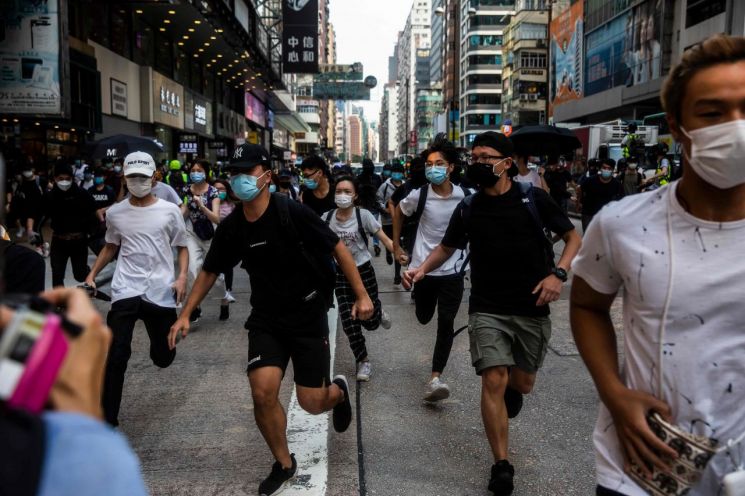
Additional economic damage to Hong Kong and China, already hit by the trade war, Hong Kong protests, and the spread of COVID-19, has become inevitable.
If the U.S. revokes Hong Kong's special status, the risk of further credit rating downgrades for Hong Kong will increase. In September last year, global credit rating agency Fitch was the first to downgrade Hong Kong's credit rating from 'AA+' to 'AA' and changed the rating outlook to 'negative.' The reason Fitch cited for the downgrade was the loosening of Hong Kong's governance system under 'one country, two systems,' weakening its distinction from China. Subsequently, Fitch further downgraded Hong Kong's rating to AA- in April this year. Moody's also lowered Hong Kong's rating outlook to 'negative' in September last year for similar reasons and downgraded Hong Kong's credit rating from 'Aa2' to 'Aa3' in January this year.
The possibility of large-scale capital outflows from Hong Kong is also open. Hong Kong has been a place where mainland Chinese wealthy individuals concentrated their escape cash due to its financial market openness different from China. For traders, it served as a stable cash investment destination where they could earn higher interbank market interest rates than in the U.S. If the capital outflow situation worsens, the dollar peg system adopted by Hong Kong may be shaken. The Hong Kong Monetary Authority fixes the Hong Kong dollar to the U.S. dollar at 7.75?7.85 HKD per USD through the U.S.-Hong Kong dollar peg system, and maintaining a stable dollar peg requires abundant dollar liquidity, but capital flight could reduce foreign exchange reserves.
China's economy will also inevitably be hit. Hong Kong currently accounts for just under 4% of China's total Gross Domestic Product (GDP). This is much lower than the 18% it accounted for when Hong Kong's sovereignty was first returned to China in 1997. However, Hong Kong has served as China's offshore financial center, contributing to China's economy through trade and investment foothold activities. Last year, 70% of China's foreign direct investment inflow of $138 billion, amounting to $96.3 billion, was conducted through Hong Kong. This means that if the revocation of Hong Kong's special status leads to direct financial and trade sanctions, it could directly impact China's economy.
Amid the upcoming vote on the Hong Kong Security Law, financial markets are already reflecting concerns about Hong Kong's status. On this day, the Hong Kong stock market opened with the Hang Seng Index down 0.36% at 23,301.36 compared to the previous day. Although the People's Bank of China lowered the yuan reference rate against the dollar after four trading days, the offshore yuan exchange rate in Hong Kong surged sharply reflecting market conditions. Last night, the offshore yuan exchange rate against the dollar in Hong Kong surged intraday by 0.7% to 7.1964 yuan. This is the highest level since the Hong Kong offshore market was established in 2010, indicating the yuan's value has plummeted to an all-time low.
© The Asia Business Daily(www.asiae.co.kr). All rights reserved.












