Ministry of Industry Announces 'Gas Cooling Expansion Plan'
Support Limit per Applicant Increased from 100 Million to 300 Million KRW
Expanding Mandatory Public Institutions
Promoting Domestic Technology Development for Core Components
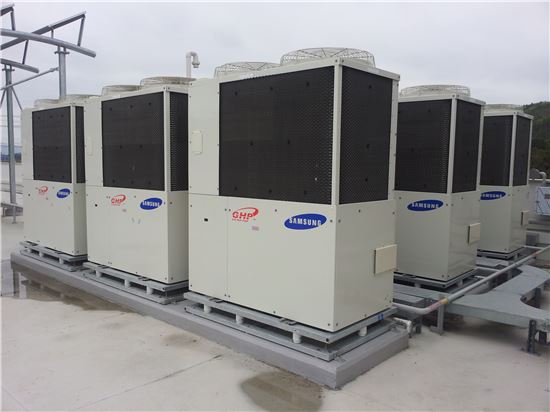 Gas air conditioners attracting attention as a countermeasure for summer electricity peak demand. (Photo by Asia Economy DB)
[Asia Economy Reporter Moon Chaeseok] The government announced plans to increase the adoption of gas cooling systems to respond to summer electricity peak demand. This year, the installation support unit price and applicant support limit will be raised, and next year, the mandatory target for public institutions will be expanded. In 2022, the government will promote the development of core component localization technologies.
On the 28th, the Ministry of Trade, Industry and Energy announced the "Plan to Expand Gas Cooling Adoption." Gas cooling is gaining attention as an effective response method when cooling demand surges due to its higher supply flexibility compared to electric cooling, but its adoption has stagnated since 2016.
First, starting next month, the support system will be improved to enhance economic feasibility. The support unit price and limit will be adjusted upward.
From this year, the installation support unit price for gas cooling will be increased by an average of 20%. The support limit per applicant will be raised from 100 million KRW to 300 million KRW. The Ministry explained that since gas cooling has higher initial investment costs than electric cooling, the support unit price and limit are being expanded to complement economic feasibility.
A new policy will be introduced to provide substitute contributions when gas cooling exceeding the recommended operating standard is used during peak hours from 2 to 5 p.m. in summer. Detailed implementation plans will be prepared in the second half of the year and will be enforced from next year. Contributions are planned to be fully paid starting in 2022.
The Ministry expects that the payment of contributions will enhance the effectiveness of electricity substitution by gas cooling during summer. Consumers are expected to save on gas cooling maintenance costs, which occur every five years at 1.2 to 1.8 million KRW.
From next year, the mandatory target for non-electric cooling in public institutions will also be expanded. According to the regulation on rational energy use promotion for public institutions (Ministry of Trade, Industry and Energy notice) announced in July 2011, when constructing or expanding buildings with a total floor area of 1,000㎡ or more, at least 60% of the cooling facilities must be non-electric.
The government plans to promote the introduction of non-electric systems for a certain proportion of individual units (for example, over 50%). It also plans to include donated buildings that were privately constructed and later transferred to public institutions as new mandatory targets for non-electric cooling.
In 2022, technology development will be promoted to localize core components such as compressors and improve engine efficiency.
Compressors and engines account for 50% of the total equipment price. It is expected that reducing the cost of these components through research and development (R&D) will further strengthen the competitiveness of gas cooling.
The Ministry explained that lowering the price of gas cooling by 10% through R&D would have the effect of increasing the current subsidy by 60%.
From the second half of this year, joint marketing will be promoted together with Korea Gas Corporation and the industry. A tentative brand called "Cool Gas" will be created to improve awareness.
Korea Gas Corporation and the Korea Gas Association will handle promotion, city gas companies will discover potential customers, and gas cooling equipment companies will manage customer contact points.
An official from the Ministry said, "Through this measure, we will be able to respond more effectively to the rapid increase in cooling demand," adding, "It will contribute to the efficient operation of gas storage facilities by improving the gas demand pattern, which is high in winter and low in summer."
© The Asia Business Daily(www.asiae.co.kr). All rights reserved.
















