Monitoring for Conservation of 'White-necked Stint' Population and Habitat... Operating About 1000㎡ Habitat of Tail Silk Moth Caterpillar's Food Plant, Rattan Vine
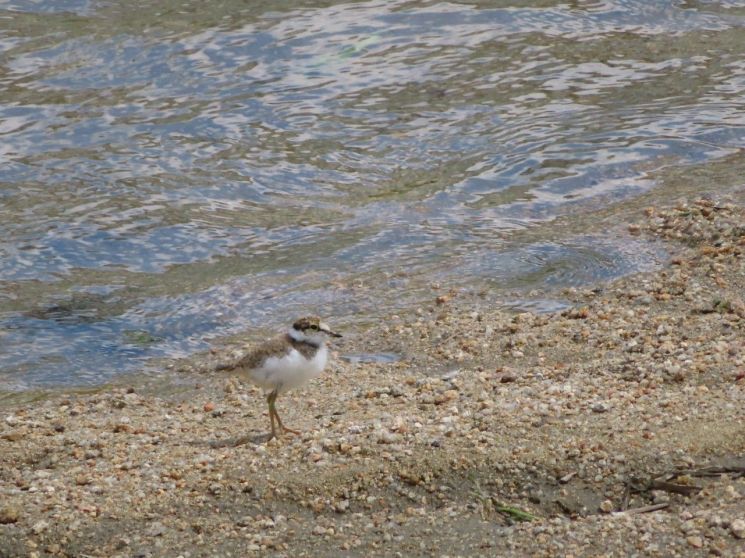
[Asia Economy Reporter Jong-il Park] Dobong-gu (Mayor Dong-jin Lee) has united the public and government to protect the endangered species ‘Huinmok Waterbird’.
Since May, the district has launched a monitoring project as part of its local ecological environment conservation efforts to preserve the population and habitat of the ‘Huinmok Waterbird’ living in Jungnangcheon Stream.
The ‘Huinmok Waterbird’ is a bird about 20 cm in length, belonging to the order Charadriiformes and family Scolopacidae. It is a resident bird that mainly breeds on sandy or gravelly riverbanks. In the past, it was a bird commonly seen around us, but due to habitat loss caused by river channelization and dredging, its habitat has gradually decreased. Currently, it is classified and protected as a species of Least Concern (LC) on the IUCN Red List of threatened species.
According to the International Union for Conservation of Nature (IUCN) report, it is estimated that about 10,000 ‘Huinmok Waterbirds’ remain worldwide. Approximately 2,000 are known to inhabit the Korean Peninsula. In Seoul, Jungnangcheon Stream is the only known habitat.
To this end, the district formed a monitoring team centered on members of environmental organizations with extensive experience in ecological environment conservation and biodiversity monitoring. The monitoring team completed training on the ecological habits of the Huinmok Waterbird, habitat characteristics, and precautions during monitoring activities. Starting this month, they began surveys on population numbers, habitat conditions, and breeding and incubation activities, focusing on the sandbar habitat of the Huinmok Waterbird in Jungnangcheon Stream.
Additionally, the district plans to develop phased solutions for habitat conservation, including promotional activities, breeding site creation, and continuous preservation measures to raise residents’ awareness of the Huinmok Waterbird.
In this regard, since 2017, the district has selected the ‘Tail-spotted Swallowtail Butterfly,’ ‘Korean Salamander,’ and ‘Great Egret’ as representative species of the region’s land, aquatic, and aerial ecosystems (ecological faces, flagship species), and has been promoting conservation projects along with inauguration ceremonies.
In particular, for the Tail-spotted Swallowtail Butterfly, designated as an endangered species by the Ministry of Environment, the district has secured about 1,000 square meters of habitat in areas such as Jungnangcheon Stream and Ssangmun-dong by continuously expanding the habitat of its larval host plant, the Creeping Euonymus.
Along with ongoing education and promotional activities, these efforts have significantly increased local residents’ interest, achieving meaningful results in protecting endangered species and conserving the ecological environment.
Moreover, ecological activity surveys have been conducted on the Korean Salamander, which inhabits small streams and parks, from spawning to growth environments, accumulating knowledge and experience on various species.
This year, the district has strengthened professionalism by hiring experts in related fields as New Deal job workers.
Furthermore, the private monitoring team continuously observes the Great Egret inhabiting Jungnangcheon Stream, monitoring seasonal population numbers, habitat characteristics, and feeding activities to study its living environment.
Mayor Dong-jin Lee of Dobong-gu stated, “There are many species around us, such as the Tail-spotted Swallowtail Butterfly and Huinmok Waterbird, that require protection and attention, but due to people’s indifference, they are becoming increasingly rare. For example, in Southeast Asia, 28% of species have disappeared over the past 100 years.” He added, “We will devote ourselves to protection activities so that the Huinmok Waterbird, which has come to Jungnangcheon Stream?the only remaining habitat in Seoul?can live alongside us for a long time.”
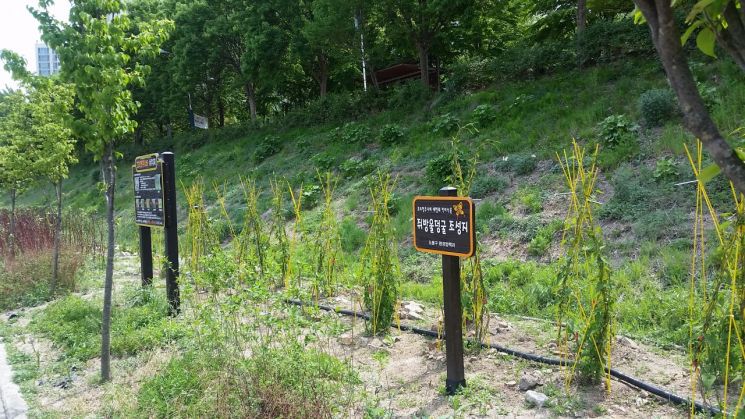 Dobong-gu, Habitat of Japanese Spangle Caterpillar's Food Plant, Antigonon leptopus along Jungnangcheon Stream (2020. 5. 4.)
© The Asia Business Daily(www.asiae.co.kr). All rights reserved.


















