[Asia Economy Reporter Hwang Junho] "A spark of innovation is igniting in South Korea's research and development (R&D) sector, which has been centered around the government and conglomerates."
Nature Index (hereafter Nature) published a special edition on the 28th (local time) highlighting the current state of South Korea's R&D. Nature annually analyzes the proportion of papers published in major natural science journals and weighted scores by field to rank countries. This is the first time in over 26 years since 1993, when the Daejeon Expo drew a blueprint for a "Science and Technology Korea," that Nature has focused intensively on South Korea.
The Strength of Top-Down Korean-Style R&D
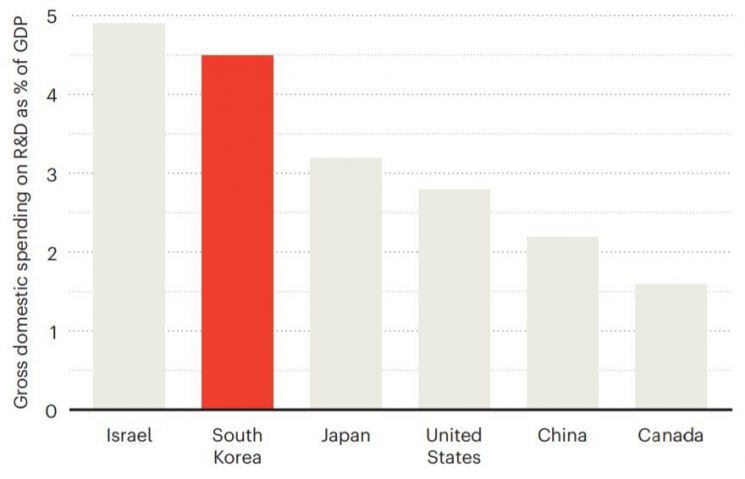 South Korea was ranked as the second country with the highest research expenditure relative to GDP, following Israel.
Nature paid attention to the consistency of South Korea's R&D. South Korea has ranked within the top 10 countries over the past four years. The publication evaluated, "South Korea dropped from 8th to 9th place in 2016 but maintained its position amid the tsunami of research papers from China." Notably, South Korea ranks second in the world for R&D expenditure as a percentage of gross domestic product (GDP) (2018). With 4.9%, Israel ranks first, followed by South Korea at 4.5%.
The main contributor was found in the government's top-down R&D approach. David Swinbanks, a developer of Nature Index, said, "South Korea's top-down approach has built strong ties among industry, academia, and research institutes, enabling it to become a leader in information and communication technology and innovation." He also emphasized that recently, the government's proactive response to the novel coronavirus infection has produced globally noteworthy results.
Nature also focused on the 'chaebols' active in the private sector, which also follow a top-down approach. President Park Chung-hee established a five-year economic development plan, and the government pressured chaebols to invest in R&D while protecting them from competition. This served as a turning point for the growth of industries such as heavy chemical, automobile manufacturing, and shipbuilding. In particular, Nature highlighted Samsung's development history, noting that Samsung Group's Nature Index score ranked 28th (10.36), achieving higher research accomplishments than its competitor LG (1.99).
Fostering Bottom-Up R&D: A Glimpse of Creativity
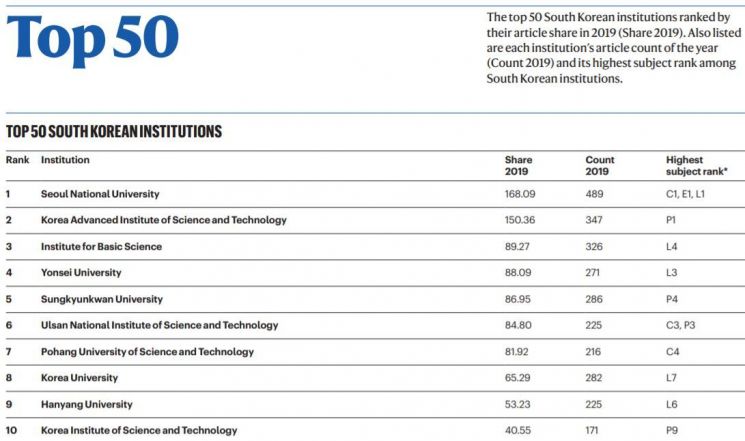
However, Nature stated that South Korea is entering a new phase of change. The strategy is shifting from being a 'fast follower'?pursuing R&D directly beneficial to catching up with global competitors or economic development?to a 'first mover' strategy that seeks to create new markets through basic scientific research. This strategic shift is found in the government's intention to foster bottom-up R&D. The current administration aims to double the proportion of researcher-centered R&D projects by 2022 compared to 2017, increasing the budget to 2.5 trillion won.
Meanwhile, Nature also pointed out another perspective regarding South Korea's R&D achievements. It noted that South Korea has maintained its position among the world's top 10 countries for several years partly due to increased joint research with China, which is producing a large volume of research papers. Nature revealed that joint research between China and South Korea has increased by 140% from 2015 to the present (2018), making China the second-largest partner for joint research after the United States. Previously, this position was held by Japan.
© The Asia Business Daily(www.asiae.co.kr). All rights reserved.
![Clutching a Stolen Dior Bag, Saying "I Hate Being Poor but Real"... The Grotesque Con of a "Human Knockoff" [Slate]](https://cwcontent.asiae.co.kr/asiaresize/183/2026021902243444107_1771435474.jpg)


















