[Asia Economy Reporter Hwang Yoon-joo] Economic organizations have demanded that sufficient additional liquidity support be provided regardless of company size to overcome the crisis caused by the novel coronavirus disease (COVID-19) pandemic.
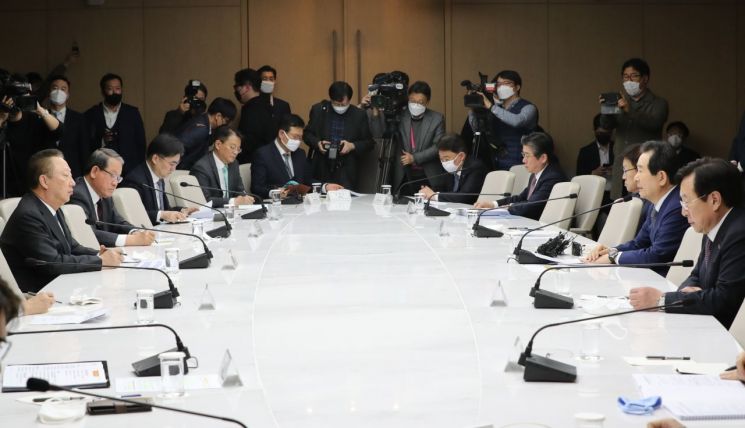
On the 27th, 30 economic organizations affiliated with the Economic Organizations Council held their regular general meeting at the Chosun Hotel in Seoul and adopted the "Economic Organizations' Proposal on the National Economic Policy Direction to Overcome the Management Crisis Caused by COVID-19 and Revitalize the Economy."
They stated that effective support should be provided regardless of company size so that companies can endure even if the global economic crisis continues for a considerable period.
Specifically, they requested that national taxes, local taxes, social insurance premiums, electricity, and facility usage fees be deferred or reduced as much as possible to alleviate the burden of fixed costs until business conditions normalize.
They also evaluated that the operation of the tripartite representative meeting to jointly overcome the economic and employment crisis is highly meaningful.
Furthermore, given the sharp decline in work orders, they expressed hope that government support would be expanded comprehensively since companies alone cannot bear the enormous costs of maintaining employment, and that the labor sector would cooperate magnanimously in sharing the pain.
The economic organizations also emphasized the need for early legislation to expand flexibility in the flexible working hours system, a supplementary system to the 52-hour workweek, and the selective working hours system in the research and development (R&D) sector, and argued that the resources required to protect jobs should be covered by general finances.
The proposal also included content urging the 21st National Assembly to prioritize legislation to improve adversarial labor-management relations and uniform labor systems into cooperative and flexible ones, as well as to enhance corporate vitality through deregulation.
Participants in this proposal included the Korea Employers Federation, the Federation of Korean Industries, the Korea Federation of Small and Medium Business, the Korea Association of Mid-sized Enterprises, and the Korea Foreign Enterprises Association.
The two major labor unions opposed the economic organizations' proposal.
The Federation of Korean Trade Unions (FKTU) stated, "The behavior of employer organizations is no different from trying to fatten their coffers by taking advantage of the suffering of workers and ordinary people caused by the COVID-19 crisis."
The Korean Confederation of Trade Unions (KCTU) also criticized, "In the midst of difficulties and suffering caused by COVID-19, where the entire nation is overcoming through solidarity and cooperation, today's so-called economic organizations' proposal shows a perception far removed from the public sentiment."
The two major labor unions also expressed critical views on the fact that the business sector announced the government proposal on the same day before submitting demands to the tripartite representative meeting. The two major labor unions submitted demands during the tripartite working-level consultation the day before, but the business sector did not present a position.
© The Asia Business Daily(www.asiae.co.kr). All rights reserved.

















