Martial Arts, Analysis of 'Export Performance Certification Status'... Need for Systems Covering Service Industry Including Intangible Asset Financial Support and New Item Codes
[Asia Economy Reporter Hwang Yoon-joo] There is a claim that improving the export performance certification system is necessary to enhance the effectiveness of support for domestic service export companies.
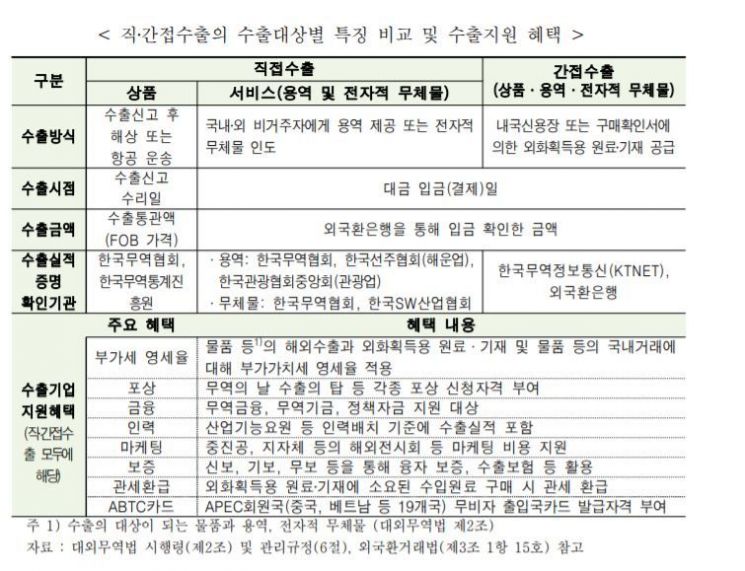
According to the ‘Current Status and Improvement Measures of the Direct and Indirect Export Performance Certification System for the Service Industry’ published on the 28th by the Korea International Trade Association’s International Trade and Commerce Research Institute, among 6,887 companies with service export performance last year, only 952 companies, or 13.8% of the total, received export performance certificates. This is less than half of the 29.6% issuance rate for export performance certificates among goods export companies. Export performance certificates are essential for export companies to receive various support benefits such as VAT zero-rating, customs refunds, trade finance, and manpower support.
In an interview survey conducted by the Trade Association with 10 service export companies, half responded that they ‘do not well understand the concept of direct and indirect exports or whether they are eligible for export support benefits.’ Even among those aware of the benefits, many companies said they ‘lack actual benefits such as loans’ or ‘do not issue export performance certificates because the applicability of benefits is ambiguous.’
The report pointed out, “The reason service companies do not utilize the export performance certification system is that the system is centered on manufacturing,” and added, “Related systems should be reorganized so that service companies can easily access them, and support benefits that can be utilized should also be expanded.”
The report further argued, “The most needed export support for service companies is finance, but loans from commercial banks are mostly based on tangible assets such as real estate and creditworthiness, which is disadvantageous for service companies focused on intangible assets,” and “while strengthening policy financial support for intangible assets, the scope of VAT zero-rating should also be expanded to include indirect exports of services in line with trends such as the popularization of subscription services.”
The report proposed expanding the export performance recognition items so that promising service companies such as Contract Manufacturing Organizations (CMO) for biopharmaceuticals can more easily obtain export performance certificates. It also suggested establishing classification codes for service items that have not been assigned Harmonized System (HS) codes to systematically manage purchase confirmation issuance and service statistics. Additionally, it argued that the application for purchase confirmation, currently allowed only for purchasing companies, should be improved to allow supplying companies as well.
Lee Joon-myung, senior researcher at the Trade Association, said, “Because service export methods are diverse, many companies still do not recognize that they are exporting even though they are,” and added, “As contactless-based service exports are gaining attention due to the COVID-19 pandemic, it is urgent to improve the system so that service export companies can receive various benefits through export performance certification.”
© The Asia Business Daily(www.asiae.co.kr). All rights reserved.

















